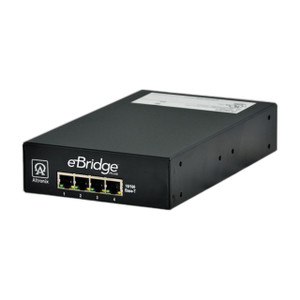
Altronix PACE4PRM 4-Port Long Range Ethernet Receiver
Overview
The Altronix PACE4PRM is a four-port long-range Ethernet receiver designed to extend PoE and PoE+ power and data signals across extended distances in security and surveillance installations. Operating at 100Mbps per port, the PACE4PRM receives extended-range Ethernet signals and delivers both power and data to connected devices without signal degradation. Rated for a maximum range of 150 meters, this receiver eliminates the need for intermediate hubs or repeaters in sprawling campus deployments, industrial facilities, and installations where standard Ethernet cabling distances (100 meters) fall short. The PACE4PRM operates as the receiver half of a paired long-range Ethernet extension system and requires a compatible transceiver at the source end.
Key Features
- Four Independent Ethernet Ports at 100Mbps: Each port delivers 100Mbps throughput independently, allowing simultaneous multi-camera or multi-device deployments across a single extended cable run. This per-port independence means a single receiver can support mixed device types—IP cameras at varying power draw, access points, and sensors—without bandwidth sharing penalties between ports.
- 150-Meter Extended Range: Transmit PoE and data signals up to 150 meters on a single CAT5e run, eliminating the cost and complexity of intermediate infrastructure. For reference, standard Ethernet is limited to 100 meters; the extra 50 meters often avoids a second switch or managed hub at the far end of a facility.
- PoE and PoE+ Pass-Through Power Delivery: Fully compatible with both Power over Ethernet (802.3af PoE, 15.4W) and PoE+ (802.3at, 30W), allowing a single cable run to power and connect IP cameras, wireless access points, edge-compute devices, and sensor nodes without separate power supplies. This significantly reduces installation labor and cable clutter.
- No Configuration Required: Plug-and-play operation—connect the extended Ethernet run from the source transceiver, and powered devices connected to the PACE4PRM ports immediately receive both data and power. No IP address assignment, no software licensing, no firmware updates needed.
- UL Listed for Commercial and Institutional Deployments: Meets UL safety standards, ensuring code compliance and system reliability in commercial facilities, universities, hospitals, and government installations where safety certification is a procurement requirement.
- Transceiver Pairing Requirement: The PACE4PRM is the receiver half of a long-range system. Source-end transceiver selection is critical to performance; verify compatibility with your extended-range Ethernet solution before installation to maintain signal integrity across the full 150-meter distance.
Integration and Compatibility
The PACE4PRM integrates seamlessly into existing PoE infrastructure without modification. Each of the four ports operates independently, so you can mix device types on a single receiver unit—for example, deploy a 5MP camera drawing 15W on port 1, a wireless access point drawing 20W on port 2, and door access sensors drawing under 5W on ports 3 and 4. The 100Mbps per-port throughput supports standard-definition and 1080p video streams, along with real-time access control and sensor data traffic typical in security installations. Backward compatibility with legacy PoE devices is assured; the PACE4PRM delivers power to any device rated for 802.3af or 802.3at.
Deployment Considerations
Position the PACE4PRM near the end of the extended cable run, typically in a weatherproof enclosure or cabinet for outdoor or semi-protected locations. Before deploying cameras or critical devices, test connectivity and power delivery on each port independently to confirm the source-end transceiver is properly paired and signal integrity is maintained. Verify that all connected devices have power requirements within the transceiver's PoE budget—exceeding the transceiver's available watts will cause power negotiation failures on downstream ports. The PACE4PRM itself supports both indoor and protected outdoor mounting; if full environmental exposure is required, mount it within a weather-rated enclosure.
When to Choose a Different Model
If you need Gigabit (1000Mbps) throughput per port rather than 100Mbps, or if you require beyond 150 meters of extension, consult the broader Altronix power infrastructure and cabling product line for alternative long-range solutions. If all devices are within the standard 100-meter Ethernet distance and you do not need long-range extension, a standard managed PoE switch may be more cost-effective and eliminates transceiver pairing complexity.
Frequently Asked Questions
Q: What is the difference between the PACE4PRM receiver and the source-end transceiver?
A: The PACE4PRM is the receiver half. It connects to the far end of the extended cable run and outputs standard Ethernet to your devices. A compatible transceiver at the source (switch/NVR end) encodes the signal for long-distance transmission. Both units are required for a complete system.
Q: Can I use the PACE4PRM with standard CAT5 instead of CAT5e?
A: The PACE4PRM is designed and rated for CAT5e cable. Use of standard CAT5 may result in signal degradation and reduced range. CAT5e should be used for full 150-meter performance.
Q: Will the PACE4PRM work with all IP cameras and access points?
A: Yes, any IP camera or PoE-powered device that conforms to 802.3af (PoE) or 802.3at (PoE+) standards will operate with the PACE4PRM, provided the total power draw across all four ports does not exceed the source transceiver's available watts.
Q: Is the PACE4PRM suitable for outdoor mounting?
A: The PACE4PRM is designed for indoor or protected outdoor mounting (e.g., inside a weatherproof cabinet or enclosure). For full environmental exposure, house it within a rated outdoor enclosure to protect against rain and dust ingress.
Q: How do I know if my source transceiver is compatible with the PACE4PRM?
A: Verify the transceiver is rated for 4-port long-range Ethernet extension and supports the same PoE standards (PoE or PoE+). Consult the transceiver datasheet or contact the manufacturer to confirm pairing compatibility before installation.
Q: What happens if I exceed the transceiver's power budget?
A: If the total wattage of connected devices exceeds the transceiver's available power, the transceiver will not supply power to downstream ports. Some devices may negotiate lower power modes, or ports may fail to initialize. Always verify that the transceiver's wattage budget covers the peak power draw of all connected devices.
Ted PerryPerspective based on aggregated IP Security Depot and affiliated engineering team experience.
I have specified and deployed the Altronix PACE4PRM in several large-footprint surveillance projects where standard Ethernet runs fell short of distance requirements. The 150-meter rated extension on the PACE4PRM eliminates the need for intermediate hubs or repeaters, which simplifies both initial deployment and ongoing maintenance. The four independent 100Mbps ports are particularly valuable in campus environments where multiple devices cluster at the far end of a long cable run—you can mix cameras, wireless access points, and sensors on the same receiver without worrying about port bandwidth contention.
Technical Highlights:
- 150-Meter Range on CAT5e: That 50-meter extension beyond standard Ethernet often eliminates an entire intermediate switch or PoE injector from your bill of materials, reducing both capital cost and ongoing management overhead. The per-port 100Mbps throughput is adequate for 1080p and lower-resolution video deployments.
- Independent PoE Power Delivery per Port: Each of the four ports delivers full PoE or PoE+ power independently, so you can power a 25W camera on one port and a 5W access point on another without cross-port power negotiation failures. Verify the source transceiver's total wattage budget covers your peak device load—that is the limiting factor, not the receiver.
- Plug-and-Play Commissioning: No IP configuration, no firmware flashing, no licensing keys. Connect it, verify connectivity and power on each port with a test device, and move on. This simplicity reduces integration labor, particularly valuable when deploying across distributed remote locations.
Deployment Considerations:
- Transceiver compatibility is non-negotiable. Confirm the source-end transceiver is rated for 4-port long-range Ethernet and supports the PoE standard (802.3af or 802.3at) before you order. Mismatched transceiver/receiver pairs result in signal integrity loss and power delivery failures.
- Watch the source transceiver's power budget carefully. If your four devices draw more combined watts than the transceiver supplies, power negotiation will fail on one or more ports—typically the last port in the sequence. Size your transceiver for 20–30% headroom above peak load.
- Mount the PACE4PRM in a weather-sealed enclosure if it is exposed to rain or dust. The unit itself is not rated for direct environmental exposure, though it tolerates protected outdoor locations (covered eaves, equipment cabinets).
The PACE4PRM is the right choice for warehouse perimeter surveillance, university campus networks, and industrial facilities where camera locations are 120–150 meters from your core switch or NVR. If all your endpoints are within 100 meters and you do not need range extension, a standard managed PoE switch is simpler and often less expensive than a transceiver/receiver pair.