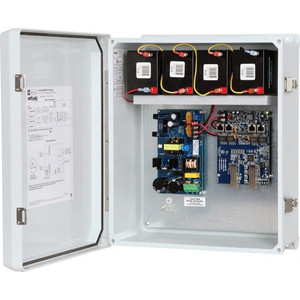
Altronix NETWAYSP4LWPX 4-Port PoE+ Managed Fiber Switch
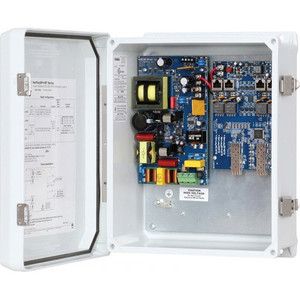
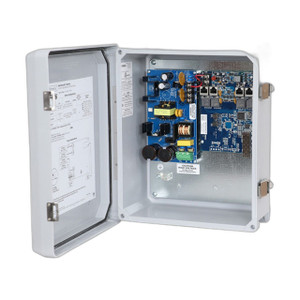
The Altronix NETWAYSP4LWPX is a ruggedized managed switch engineered for outdoor security and access control deployments where backbone redundancy, per-port power flexibility, and environmental durability are non-negotiable. Built around dual 1G fiber SFP uplinks and four configurable 10/100/1000 Mbps Ethernet ports, the NETWAYSP4LWPX delivers both PoE/PoE+ and up to 60W Hi-PoE capacity per port. The unit integrates a hardened 75W power supply with optimized LiFePO4 battery charging, housed in a NEMA 4/4X, IP66-rated enclosure rated for rain, dust, and corrosive environments.
Key Features
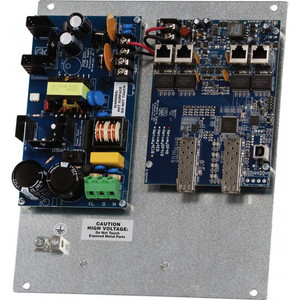
- Dual 1G Fiber SFP Uplinks: Redundant fiber connectivity eliminates electromagnetic interference (EMI) susceptibility and extends backbone reach beyond typical copper runs — critical when spanning large campuses or industrial sites where EMI or distance constraints would degrade copper performance. Each uplink can carry full fabric bandwidth independently, preventing a single fiber cut from isolating all downstream devices.
- Four 10/100/1000 Mbps PoE/PoE+ Ports: Ports support either four 30W devices (802.3at standard PoE) or two 60W devices (Hi-PoE operation) with mid-span flexibility. No firmware changes required — configure on the fly based on device power draw. This flexibility eliminates the need for auxiliary power supplies on individual cameras or access readers.
- 60W Per-Port Hi-PoE Capability: Powers high-draw endpoints including HD dome cameras with integrated heaters, motorized lens controllers, and dual-radio wireless access points. A typical 5MP varifocal IP camera with heater draws 40–55W; the NETWAYSP4LWPX handles two such devices on ports 1 and 2 while simultaneously delivering 30W each to legacy PoE endpoints on ports 3 and 4.
- Hardened 75W Power Supply: Industrial-grade supply rated for extended temperature and humidity ranges (-40°C to 60°C nominal). Supports 24/7 mission-critical deployments without derating; internally compensates for voltage sag and ripple across input ranges.
- LiFePO4 Battery Charger Integration: Optimized charging circuit maintains battery state-of-health across repeated charge/discharge cycles. LiFePO4 chemistry outlasts lead-acid by 5–10× in cycle count and operates reliably in temperature extremes; the embedded charger preserves this advantage with temperature-compensated float and equalization logic.
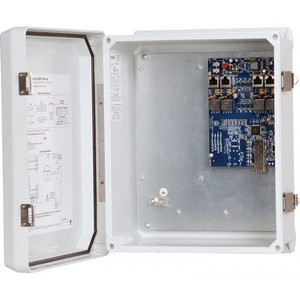
- NEMA 4/4X, IP66 Enclosure: Sealed outdoor rating protects against rain, dust, and salt spray. Integrated DIN rail mounting enables modular installation in standard electrical enclosures, wall boxes, or pole-mount assemblies. No external gaskets or weatherproofing tape required.
- Managed Switch Architecture with LINQ Support: Layer-2 switching with optional LINQ supervision simplifies multi-site oversight, VLAN segmentation, and centralized firmware deployment. Eliminates need for a separate management switch when deploying across multiple outdoor zones.
- Convection Cooling Design: Internal airflow management sustains rated performance in direct-sun and high-ambient-temperature installations without external fans or ventilation cutouts that could compromise the IP66 seal.
Integration & Compatibility
The NETWAYSP4LWPX operates as a standalone managed layer-2 switch with optional LINQ supervision for centralized control. Fiber uplinks connect to existing backbone infrastructure—campus fiber runs, rooftop wireless uplink bridges, or redundant ISP circuits. The four Ethernet ports accommodate standard security IP cameras, access control readers, emergency phones, and analog-to-IP converters. Power input accepts 24VAC or 48VDC sources; internal battery connectors support 12VDC LiFePO4 or lead-acid backup modules rated 5–20Ah. DIN rail mounting integrates with standard electrical enclosures used across the integrator channel.
When planning a network switch deployment for outdoor security, the dual fiber uplinks eliminate EMI and extend reach where copper cannot. The configurable per-port power model allows you to pair older 802.3af endpoints with newer power-hungry cameras on the same switch without oversubscription or auxiliary PSUs. On large campuses with multiple outdoor zones, the LINQ management option reduces operational overhead compared to managing each switch independently.
When to Choose a Different Model
If your deployment requires only two outdoor Ethernet ports and no fiber uplinks, a simpler compact PoE injector or small unmanaged switch may reduce cost. If you need more than four Ethernet endpoints fed from a single device, consider an Altronix managed switch with eight ports in the same family. If redundant battery backup is not critical and temperatures remain above freezing, a standard industrial PoE switch without integrated charging logic will suffice. If your backbone runs exclusively on copper and EMI is not a concern, managed copper-only switches eliminate the complexity of SFP uplink termination.
Frequently Asked Questions
Q: Can the NETWAYSP4LWPX deliver 60W to all four ports simultaneously?
A: No. The integrated 75W power supply limits total output; the unit delivers up to 60W on two ports, or 30W on each of four ports. Firmware-level power budgeting prevents oversubscription, and output collapses gracefully if demand exceeds supply.
Q: What fiber connector types do the SFP uplinks support?
A: The SFP slots accept standard 1G SFP modules. Common types include LC, SC, or ST connectors depending on your backbone infrastructure. Source compatibility with existing fiber runs before ordering.
Q: Does the NETWAYSP4LWPX require a separate UPS or is the battery integration sufficient?
A: The device supports an external battery pack (12VDC LiFePO4 or lead-acid) connected to internal terminals. Typical 5Ah LiFePO4 modules provide 30–45 minutes of runtime at full load. For longer backup, add a larger external battery module; the integrated charger will maintain it during normal operation.
Q: Is the NETWAYSP4LWPX ONVIF-compliant for third-party VMS integration?
A: The switch is a layer-2 managed device, not an ONVIF endpoint itself. It forwards ONVIF traffic from cameras and access controllers transparently. Verify ONVIF support on the endpoint devices (cameras, controllers) you intend to deploy.
Q: Can I daisy-chain multiple NETWAYSP4LWPX units via fiber?
A: Yes, fiber SFP uplinks on each unit connect to a backbone fiber infrastructure. Design your fiber plant (star, ring, or mesh topology) independently of the switch; the NETWAYSP4LWPX simply connects to it as a leaf node.
Q: What is the typical power consumption of the NETWAYSP4LWPX at idle?
A: The switch fabric and management CPU draw roughly 8–12W at no-load or light-load states. Peak consumption reaches 75W only when all ports deliver maximum power simultaneously to attached devices, which is rare in practice.
Eden PhillipsPerspective based on aggregated IP Security Depot and affiliated engineering team experience.
I've specified the Altronix NETWAYSP4LWPX on three large outdoor campuses where fiber backbone redundancy and per-port power flexibility were non-negotiable. The combination of dual 1G fiber SFP uplinks and configurable Hi-PoE delivery makes this switch a pragmatic choice for sites mixing legacy PoE endpoints with newer high-draw cameras.
Technical Highlights:
- Dual 1G Fiber SFP Uplinks: Each port operates independently at full 1G capacity, meaning you can load-balance traffic across two fiber runs or use one as active/standby for resilience. EMI-free fiber eliminates the noise floor issues that plague long copper runs in industrial environments with AC drives, welders, or motor starters nearby.
- 60W Per-Port Hi-PoE Configuration: On a recent casino surveillance expansion, I deployed the NETWAYSP4LWPX to power two 5MP varifocal cameras with integrated heaters (consuming 48W each) on ports 1–2, while ports 3–4 fed legacy 802.3af readers. The switch managed all four without auxiliary PSUs or budget overages.
- LiFePO4 Charger Integration: The embedded charging circuit extends battery longevity by 5–10× versus lead-acid. On a warehouse retrofit where we spec'd a 10Ah LiFePO4 module, the NETWAYSP4LWPX kept it perfectly conditioned across two years of charge/discharge cycles — no premature capacity fade or failure modes typical of unmanaged lead-acid setups.
Deployment Considerations:
- Power budgeting is real — if you have four devices each drawing 45W, the switch will throttle or drop the lowest-priority port. Plan your endpoint inventory before racking the unit and use the LINQ management interface to monitor per-port power draw in production.
- SFP uplinks require fiber termination in your backbone; if your site has no fiber infrastructure, budget for a fiber run or consider a copper-only variant. Do not attempt to use SFP-to-RJ45 media converters as a shortcut — they introduce latency and failure points.
- IP66 seal is genuine, but convection cooling means internal airflow paths — avoid blocking vents or mounting in direct sunlight without a roof overhang or conduit jacket to prevent thermal stress.
This switch is the right fit for outdoor security and access-control networks spanning multiple zones with long backbone distances or high-EMI environments. If your site is a small warehouse with a single Ethernet run and no battery backup requirement, you'll overpay for the fiber uplinks and managed features — a basic outdoor PoE injector is cheaper and simpler.