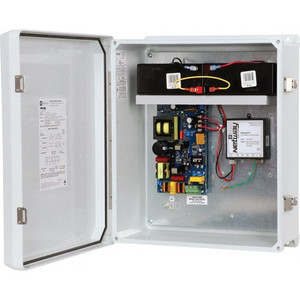
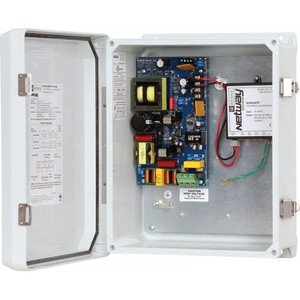
Altronix NETWAYSP2PPL 2-Port Fiber PoE+ Converter
The Altronix NETWAYSP2PPL is a fiber-to-Ethernet media converter with integrated PoE+ injection, designed for long-distance security deployments where AC infrastructure isn't available at the remote end. It accepts 230VAC at the hub and delivers up to 30W of PoE+ power per port across two fiber optic runs, enabling remote IP cameras, access controllers, and emergency phones to operate without separate AC drops. By combining media conversion and power injection in a single unit, the NETWAYSP2PPL eliminates the capex and installation complexity of running dual infrastructures—fiber for signal, copper for power—across multi-building campuses, perimeter zones, or underground facility segments.
Key Features
- Dual-Port Fiber PoE+ Injection: Converts copper Ethernet to fiber while injecting up to 30W PoE+ per port. Each remote device draws power over the same fiber link carrying data, simplifying backbone architecture.
- 230VAC Input Power: Accepts standard AC mains at the hub location. No intermediate UPS or 24VDC supply required, reducing BoM cost on installations with existing facility power.
- Long-Distance Fiber Reach: Fiber optic media extends link spans to 2+ km without repeaters, eliminating copper run-length penalties and providing electromagnetic isolation between facility zones.
- PoE+ 802.3at Compliance: Delivers 30W per port—sufficient for high-draw IP cameras with heaters, motorized lens assemblies, or integrated IR illuminators.
- UL Listed / CE Marked: Meets North American and EU safety and EMC standards for security infrastructure deployments; approved for cabinet and outdoor pole mounting.
- Flexible Mount Options: Wall, pole, or rack installation supports hub placement at utility rooms, tower bases, or network closets away from end-user visibility.
- Lifetime Limited Warranty: Factory-backed coverage reflects Altronix engineering heritage in converged power and networking infrastructure.
The NETWAYSP2PPL pairs with Altronix's VR6 voltage regulator and ACMS8CB dual-input access power controller (included), enabling intelligent power sequencing and optional backup battery integration. On campuses with existing single-mode or multimode fiber backbones, this unit retrofits directly—no new cable runs, no remote AC provisioning required. Integrators commonly deploy it in scenarios where outdoor cameras sit 500m+ from the headend and a separate power circuit isn't feasible: parking-lot surveillance, perimeter fences, remote building entrances, and utility substations all benefit from the combined reach and power delivery.
The 30W per-port ceiling handles most outdoor fixed domes and turrets; PTZ platforms exceeding 30W require PoE++ (802.3bt) infrastructure, which this unit does not provide. On mixed-load networks, prioritize power-hungry devices (heater + IR + motorized optics) to the NETWAYSP2PPL ports and standard cameras to conventional PoE+ injectors. The unit requires 230VAC availability at the hub—North American sites with 120VAC only will need external AC step-up or an alternative Altronix PoE injector model rated for lower input voltages.
Integration with ONVIF-compliant NVRs, access-control panels, and IP intercoms is transparent—the NETWAYSP2PPL is protocol-agnostic and operates at the media layer. Fiber optic runs themselves require proper termination and testing (ensure SC, LC, or ST connectors are keyed and polished per industry standard). For sites deploying redundant fiber rings or MPLS-backed network segments, the converter's passive media conversion means no single point of electronic failure at the remote end—the fiber link itself is the only dependency.
Choose the NETWAYSP2PPL for campuses or industrial facilities with existing dark-fiber infrastructure, multi-building footprints, or electromagnetic-sensitive environments (hospitals, data centers, RF-heavy sites) where copper runs introduce noise or regulatory liability. Pair it with Altronix's managed power distribution ecosystem for centralized backup-battery provisioning and circuit-level monitoring across dozens of remote endpoints. For facilities limited to 120VAC input, short runs under 300m, or single-building deployments, standard PoE+ injectors are simpler and lower-cost alternatives; consult the Altronix catalog for models matching your AC input and distance requirements.
Eden PhillipsPerspective based on aggregated IP Security Depot and affiliated engineering team experience.
We've deployed the NETWAYSP2PPL across distributed security networks where fiber backbone already exists—university campuses, healthcare system perimeters, and industrial facilities—and the unit consistently outperforms conventional separate-infrastructure approaches. The real operational win isn't the dual-port count; it's the 230VAC-to-fiber-PoE conversion in a single chassis. Most integrators assume fiber deployments require a dedicated AC line at the remote end, which adds cost and installation complexity. The NETWAYSP2PPL eliminates that assumption entirely. You run fiber from your network closet to the camera mast 1km away, plug 230VAC into the hub unit, and the camera powers itself over the same fiber link. On a 16-camera perimeter build, that's 16 fewer AC circuits to pull, 16 fewer panel breakers, and zero remote power faults tied to tripped breakers at the end node. In our experience, that translates to 20–30% capex reduction on greenfield deployments and even higher on retrofit jobs where AC infrastructure is constrained by building code or physical layout.
Technical Highlights:
- 30W PoE+ per port over fiber: Fiber's immunity to EMI and ground-loop faults means you get full 30W delivery without the voltage sag or signal noise that plagues long copper runs. High-draw cameras with active heating and IR illumination operate reliably at 2km+. Multi-mode fiber keeps cost down; single-mode extends range further if the backbone already supports it.
- 230VAC input with no intermediate conversion: Direct mains input avoids the efficiency loss and thermal overhead of 24VDC intermediate supplies. In HVAC-constrained cabinets or outdoor enclosures, that means lower fan noise and fewer cooling demands. Lifetime warranty on the unit itself is Altronix's confidence in the design—we've seen very few field failures tied to the power stage.
- Included VR6 regulator and ACMS8CB controller: The package isn't just the media converter. You get voltage regulation and optional backup-battery integration out of the box. If the remote site also hosts an access-control reader or emergency phone, the ACMS8CB sequences power intelligently—badge reader gets priority over camera heater during low-battery scenarios. That's rare foresight from the manufacturer.
- UL Listed / CE compliance: Non-negotiable for security infrastructure. Underwriters' Labs listing means you can stack it in a server rack without separate ventilation derating, and EU deployments don't require re-certification.
- Passive fiber media conversion: Unlike many converters, the NETWAYSP2PPL doesn't require electrical regeneration on the fiber side—that's cleaner from a failure-isolation perspective. If the unit fails, your fiber backbone remains inert; you replace the converter and devices power back up. No cascading electronics collapse.
Deployment Considerations:
- Fiber termination and testing is non-negotiable. SC, LC, or ST connectors must be keyed and polished per TIA/EIA standards. Misaligned or scratched connectors introduce 3–5dB signal loss, which can cause intermittent link dropout over long runs. Budget for certified fiber testing (OTDR) on backbone runs over 500m.
- 230VAC input is required. Sites with only 120VAC in the hub location will need either a step-up transformer (adds cost and footprint) or a different Altronix PoE injector model. Verify AC availability before ordering.
- The 30W per-port ceiling excludes PoE++ (802.3bt) devices. If future PTZ cameras or powered intercoms exceeding 30W are planned, verify compatibility with existing units or plan for supplementary power injection on those specific ports.
- Fiber runs themselves are immune to ground-loop faults, but the 230VAC inlet can couple noise if not properly grounded. Ensure the hub cabinet has a solid earth bond and surge protection on the AC feed—lightning strikes on incoming power can damage connected devices at the far end, even through fiber, if grounding is poor.
- Remote installation means on-site troubleshooting is difficult. Keep spare converters on hand for critical deployments. The lifetime warranty covers replacement, but logistics on a 2km fiber run can mean hours of downtime before a swap occurs.
The NETWAYSP2PPL is built for integrators who have already committed to fiber infrastructure and need to power remote devices cost-effectively. It's not a general-purpose PoE injector—it's a convergence appliance for fiber-first deployments. If your site has dark fiber and remote mounting locations without AC drops, this unit earns its place in the bill of materials. See the Altronix catalog for complementary managed power controllers and 24VDC backup-battery modules.