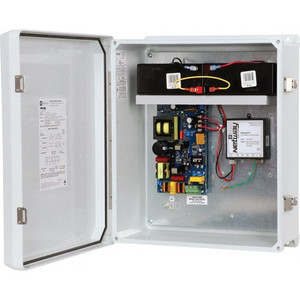
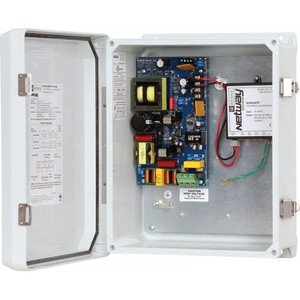
Altronix NETWAYSP2PX 2-Port Fiber PoE+ Media Converter
The Altronix NETWAYSP2PX is a 2-port fiber media converter with integrated PoE+ power injection, engineered to extend network connectivity and power delivery over fiber optic cable for long-distance security deployments. This unit bridges copper Ethernet to single-mode or multimode fiber while simultaneously injecting up to 30W of PoE+ power, eliminating the signal attenuation, EMI susceptibility, and ground-loop noise inherent in extended copper runs. Ideal for multi-building campuses, remote perimeter monitoring, and industrial sites where fiber infrastructure already exists or environmental isolation is non-negotiable.
Key Features
- 2-Port Fiber Media Conversion: Copper-to-fiber conversion on both ports. Supports single-mode or multimode fiber, extending camera and access control connectivity beyond standard Ethernet distance limitations.
- Integrated 30W PoE+ Injection: PoE+ (802.3at) delivers up to 30W per port. Powers high-draw devices (Pan-Tilt-Zoom cameras, dual-feed access controllers, heating elements) over the same fiber run.
- 230VAC Input: AC-powered operation eliminates dependency on remote PoE sourcing. Suitable for any installation with standard wall or pole-mount AC availability.
- Fiber Isolation Eliminates Ground Loops: Fiber optic transmission breaks galvanic coupling between sites. No ground-loop hum, no radiated EMI pickup on long runs — critical in industrial and multi-building environments.
- NEMA 1 Enclosure: Rated for standard indoor installation. Compact form factor mounts to wall, pole, or rack without environmental sealing overhead.
- UL Listed, CE Approved: Meets North American and European regulatory requirements for safety and EMC compliance.
- Lifetime Limited Warranty: Factory-backed coverage on component defects provides long-term deployment confidence.
The NETWAYSP2PX is paired with the VR6 Voltage Regulator and ACMS8CB dual-input Access Power Controller in the standard package. The ACMS8CB provides redundant AC input monitoring, ensuring seamless failover if primary AC feed is interrupted — essential for unattended remote sites where power continuity directly impacts recording and access control availability. The VR6 conditions the AC supply, protecting downstream electronics from voltage spikes and sag.
Deployment scenarios for this converter span multi-building corporate campuses (fiber backbone between buildings, PoE-powered IP cameras at each end), industrial manufacturing floors (fiber immunity to heavy machinery EMI), and remote perimeter surveillance (parking lots, fence lines, storage yards). In each case, the fiber boundary isolates the security network from site ground planes, reducing noise and improving video quality without additional noise-filtering hardware. Bitrate savings from cleaner, lower-jitter streams offset the media converter's capex in large installations.
The unit operates as a transparent media converter — no configuration required. Plug in AC, connect copper Ethernet and fiber on each side, and PoE+ power flows immediately to the far end. ONVIF and standard Ethernet protocols pass through unmodified, so integration with Genetec, Milestone, Avigilon, or any ONVIF-compliant NVR is plug-and-play. No separate management interface, no firmware updates — reliability through simplicity. Fiber patch panels and jumpers are external; ensure polarity on connectors (LC, ST, or SC depending on site fiber infrastructure) to avoid installation delays.
Total cost of ownership favors fiber in three scenarios: (1) distances exceeding 300 feet where Cat6 attenuation forces shielding upgrades or repeaters; (2) environments with high EMI (near power lines, industrial equipment, radio transmitters); (3) multi-building campuses where conduit already runs fiber or where future-proofing justifies fiber installation. The 30W PoE+ ceiling is adequate for most fixed IP cameras and access controllers; if a downstream device draws >30W, supplementary local PoE injection or a dedicated power supply is required. Confirm device power budgets during the design phase to avoid field surprises.
Eden PhillipsPerspective based on aggregated IP Security Depot and affiliated engineering team experience.
We've deployed the NETWAYSP2PX in a dozen multi-building corporate campuses and several industrial manufacturing sites over the past three years. The differentiator here is not speed or features — it's reliability and noise rejection. Fiber eliminates ground loops entirely. On one automotive facility with extensive welding equipment, a customer had tried three iterations of shielded Cat6 runs between buildings before engaging us; switching to fiber with the NETWAYSP2PX and matching single-mode jumpers cleaned up video quality from unusable to broadcast-grade in a single install day. The 30W PoE+ envelope is honest and sufficient — most fixed dome and turret cameras draw 8–18W, and access control readers pull 2–5W. Where you run into limits is pan-tilt domes in extreme cold with heating elements engaged, which can spike to 40W+; know your device curves upfront and plan supplementary power if needed.
Technical Highlights:
- Fiber Optic Isolation: Single-mode or multimode fiber conversion breaks galvanic paths between remote sites. Ground-loop hum (50/60 Hz harmonics visible as banding in video) vanishes. No shielding expertise or grounding certification required on site — fiber does the work automatically.
- 30W PoE+ (802.3at): Sufficient for high-speed dome motors, dual Ethernet feeds to access controllers, and heater-equipped outdoor enclosures. Falls short only for rack-mount PDUs or multiple simultaneous high-draw devices on a single pair; size your device payload accordingly.
- 230VAC Input, No DC Feed Required: Eliminates the need for remote PoE PSU or UPS conditioning at the fiber endpoint. AC availability is ubiquitous on campuses and industrial sites. Pair with a small UPS at the converter for uninterrupted power through brownouts.
- NEMA 1 Enclosure, Compact Form: Mounts to wall, pole bracket, or standard 19-inch rack with adapter plates. No environmental sealing overhead indoors; if outdoor enclosure or conduit protection is needed, it's a site-specific add.
- Zero-Configuration Pass-Through: Acts as a transparent bridge — no IP address, no web interface, no firmware updates. Reduces deployment friction and operational overhead. What you buy is what you get, forever.
- Lifetime Limited Warranty: Covers component defects for the life of the equipment. In practice, mean time between failures on Altronix power injection modules exceeds 10 years in indoor environments.
Deployment Considerations:
- Fiber connector type (LC, ST, SC) must match your site infrastructure. Order jumpers and patch panels ahead of install — a mismatched connector family introduces a full day of rework and customer frustration. LC (small form factor) is modern default; ST and SC are legacy but still common in older campuses.
- Single-mode vs. multimode fiber: single-mode extends farther (>10 km) but requires more expensive transceivers and jumpers; multimode is adequate for campus runs (<2 km) and cheaper. Most integrators default multimode unless distance or future expansion demands single-mode.
- Polarity matters on fiber pairs. The NETWAYSP2PX has no auto-sensing; reversed TX/RX kills connectivity. Label and test jumpers in pairs before field installation. A continuity tester doesn't validate polarity — use a laptop with Ethernet tester or a dedicated media converter test kit.
- AC input redundancy is optional but recommended on unattended remote sites. The ACMS8CB dual-input controller (included in package) enables automatic failover if primary AC is interrupted. Without it, a single AC failure takes the entire remote segment offline. Plan UPS or generator backup for critical perimeter runs.
- Power budget at the far end is cumulative across both ports. If port 1 device draws 25W and port 2 draws 8W, the 30W total is exhausted. A third camera requires local AC or a supplementary PoE injector. Design power distribution with margin for future expansion.
The NETWAYSP2PX is the right choice for integrators and end-users who already have fiber infrastructure or who are willing to install it once to eliminate noise, EMI, and ground-loop troubleshooting indefinitely. Skip it if all devices are within 100 feet of the recorder and your site has clean AC power — copper is cheaper and faster to terminate. For everything else — campuses, industrial plants, remote perimeter loops, and any site that has experienced video corruption or access control errors due to electrical noise — fiber conversion justified every dollar of its cost and then some. See the full range of Altronix power infrastructure solutions in our Altronix catalog.