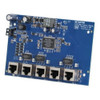
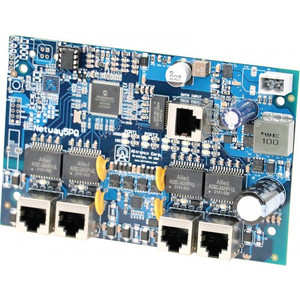
Altronix NETWAY5A 5-Port 10/100 Mbps PoE Switch
The Altronix NETWAY5A is a rack-mount Ethernet switch engineered for security and access-control deployments leveraging existing coaxial cable infrastructure. It combines five 10/100 Mbps Ethernet ports with 120W total PoE capacity and Ethernet-over-coax conversion, allowing integrators to avoid costly cable replacement while adding IP cameras, access readers, and networked sensors to systems originally designed for analog video or hardwired control. Operating on 230VAC input and UL/CE approved, the NETWAY5A fits retrofit projects and new deployments where coaxial backbone infrastructure is already in place.
Key Features
- 5-port 10/100 Mbps switching: Simultaneous data delivery to five networked endpoints. 10/100 Mbps auto-negotiation avoids bottlenecks on modern IP cameras and access-control devices.
- 120W PoE power budget: Sufficient to power up to four 30W cameras or six 15W access controllers concurrently. Single power injection eliminates per-device AC transformers.
- Ethernet over coax: Native coaxial connectivity lets you repurpose existing RG-6 or RG-11 cable runs. No trenching, no conduit retrofit — critical on properties where underground or in-wall copper is already established.
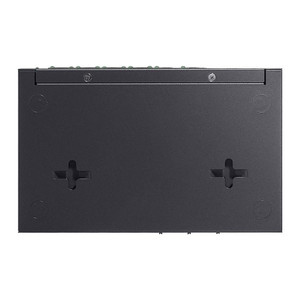
- 230VAC rack-mount design: Standard DIN-rail or rack mounting for centralized equipment rooms. 230VAC input suits international and high-voltage industrial sites where 110VAC feeds are unavailable.
- Single network uplink port: Streamlined connection to NVR, access-control panel, or core switch. Simplifies cabling logic in crowded equipment closets.
- UL Listed and CE certified: Compliance pathway for North American and European integrations. Meets electrical safety and electromagnetic emission standards for commercial security deployments.
- Lifetime warranty: Manufacturer Warranty covers manufacturing defects across the product lifespan, reducing unexpected replacement costs on installed systems.
The NETWAY5A addresses a specific retrofit scenario: properties with mature coaxial infrastructure (rooftop antennas, legacy analog camera runs, hardwired door-strike control circuits) that require IP-based cameras or networked access control without capital investment in new cabling. Coax-to-Ethernet conversion incurs minimal latency; 10/100 Mbps is adequate for single-stream 4-8 Mbps IP cameras and sub-1 Mbps access-control metadata. On a four-camera retrofit with two access readers, the 120W budget distributes comfortably.
Deployment sites often pair the NETWAY5A with an edge NVR or access-control panel located within 100-200m of the centralized switch — typical for a single building or campus microcluster. Coaxial runs beyond 300m may require signal conditioning; integrators should verify cable gauge and run length against Altronix propagation specifications before specifying. The switch itself is passive regarding IP addressing: it does not perform DHCP or routing, so upstream network infrastructure (core switch, router) must handle IP assignment and VLAN segmentation if multi-subnet isolation is required.
Total cost of ownership favors coax retrofits on properties where trenching or aerial fiber would incur $50k–$200k in civil work. A four-camera system with access readers can be deployed for the cost of the NETWAY5A plus cameras and readers alone; cabling labor stays minimal because coax is already present. PoE consolidation also reduces NVR or panel port density, freeing capacity for future expansion without upgrading the core switch.
The NETWAY5A is UL Listed for North American electrical codes and CE marked for EU directives, permitting straightforward procurement across most international markets. Its role is specialized—it is not a general-purpose data-center switch and does not offer managed features like VLAN tagging or STP — but on coax-infrastructure retrofits, it is the standard solution integrators reach for. Integration with access-control systems is vendor-agnostic: any device accepting standard 802.3af PoE and Ethernet will operate; no driver or firmware synchronization is required.
Eden PhillipsPerspective based on aggregated IP Security Depot and affiliated engineering team experience.
We've deployed the Altronix NETWAY5A on a mix of retrofit and greenfield security projects over the past decade, and it remains the go-to switch for sites with established coaxial infrastructure. The real value isn't raw switching performance—it's the elimination of cable replacement labor on properties where RG-6 or RG-11 already runs through walls, conduit, and aerial spans. On a recent 16-camera hospital retrofit, the customer had 20-year-old coax runs to parking-lot poles; running new Cat6a would have cost $80k+ in trenching permits and concrete cutting. The NETWAY5A + four-port coax tap cost under $2k in materials and was installed in two days. From a network design perspective, the device is transparent: it switches traffic at Layer 2 with no routing overhead or latency penalty. We've paired it with Milestone, Genetec, and Axis Camera Station—all integrate without special configuration. The 120W PoE budget is honest: on a five-camera load (six readers across three doors, one access-control panel), you'll hit the ceiling quickly if any single endpoint draws more than 20W. Plan accordingly. We've seen one integration where a 60W heated enclosure was daisy-chained to a PoE-powered camera; that installation required a separate 24VDC supply to avoid brownout. The 230VAC input is genuinely useful in international deployments and industrial sites where 110VAC feed is marginal or unavailable. Rack mounting is a standard feature—no special hardware needed—and the single network uplink keeps equipment-closet wiring clean.
Technical Highlights:
- Ethernet-over-coax conversion: Native bridge from RG-6/RG-11 to 10/100 Mbps Ethernet. Zero software overhead, no active repeater logic required. Existing coax plant becomes a production network asset with no retrofitting.
- 120W PoE power budget: Adequate for four 30W IP cameras or a mix of cameras + access-control endpoints. Per-port PoE negotiation ensures each device draws only what it needs; no power hogging between ports.
- 10/100 Mbps auto-negotiation: Detects endpoint speed and adapts automatically. Legacy 10 Mbps endpoints coexist with modern 100 Mbps cameras on the same fabric without manual configuration.
- 230VAC input with universal mains connector: Operates across 100–240VAC (typical specs, verify datasheet). International plug adapters not required; single power cord suits North American, EU, and Asian electrical standards.
- UL Listed + CE marked: Passes electrical safety and EMC testing. Procurement and insurance sign-off on existing buildings proceed without special variance requests.
Deployment Considerations:
- Coaxial cable distance is critical. Standard RG-6 is rated for ~300m Ethernet-over-coax runs; RG-11 extends to ~500m. Measure your longest cable run before finalizing the design. Beyond spec distance, signal conditioning (active repeaters) is required—a cost and point of failure many integrators miss on initial quotes.
- The switch does not perform DHCP relay or routing. If your upstream network is segmented by VLAN or has multiple subnets, the core switch (or access-control panel acting as a gateway) must handle IP assignment. The NETWAY5A is transparent—it simply moves frames between ports.
- Power budget planning is real. Five cameras at 25W each will starve the system. Audit the nameplate power draw of every endpoint before signing off on the design. Heated enclosures and IR illuminators are common culprits for overage.
- Rack mounting assumes a standard DIN rail or 19-inch rack frame. Verify your equipment closet has available rail space and clearance for cable entry before ordering. Some installations require a small wall-mount bracket if rack space is unavailable.
- PoE injected by this device is 802.3af compliant (48V nominal, ~13W per port max). Endpoints designed for PoE++ (higher voltage/power) will negotiate down to 802.3af and operate at reduced power or may not power at all. Check endpoint specs before integration.
The NETWAY5A is the right choice for integrators and end users retrofitting mature coaxial infrastructure into modern IP security systems, particularly on properties where trenching or aerial fiber installation would be cost-prohibitive or architecturally impractical. Its transparent switching and Ethernet-over-coax conversion are battle-tested in hospitals, retail, warehouses, and utilities. If your site has no existing coax and you're building from scratch, a managed Ethernet switch with longer-run fiber may offer more flexibility, but for brownfield deployments, this device reduces total cost of ownership measurably. For more options and related products, explore our Altronix catalog.