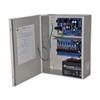
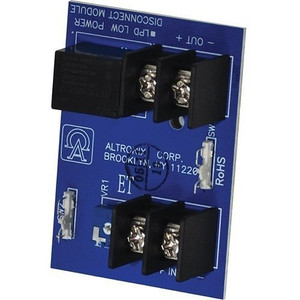
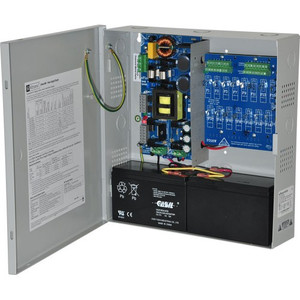
Altronix LPDHT Low Power Disconnect Module
The Altronix LPDHT is a low-power disconnect module designed for battery-backed security and access control systems where runtime extension and battery protection are non-negotiable. This unit monitors system voltage in real time and automatically disconnects non-essential loads when power levels fall below a user-configurable threshold, preventing deep discharge cycles that degrade battery lifespan and capacity. Built for extended temperature operation, the LPDHT is equally at home in climate-controlled equipment rooms and outdoor pole-mounted installations where thermal swings are severe. The low parasitic drain design ensures that the disconnect logic itself consumes minimal backup power, maximizing the runtime your battery can actually deliver to critical loads.
Key Features
- Automatic Load Disconnect: Monitors voltage continuously and triggers non-essential load shed when thresholds are breached. Protects battery systems from the permanent damage caused by deep discharge cycles.
- 12 Individual Outputs: Independently controlled relay channels allow granular load prioritization — keep door locks and intercoms running while shedding camera streams or lighting circuits during extended outages.
- Configurable Disconnect Thresholds: Application-specific voltage settings accommodate different battery chemistries (lead-acid, lithium, sealed) and load profiles without redesign.
- 24VDC Output at 12A Maximum: Sufficient to power distributed access control panels, credential readers, and low-power IP endpoints across small to mid-sized deployments.
- AC Fail Supervision: Detects loss of mains AC and triggers battery-backup mode automatically; no manual intervention required.
- High-Temperature Operation: Rated for extended temperature swings typical of attic-mounted, rooftop, and outdoor pole installations; parasitic drain remains low across full range.
- Battery Backup Ready: Integrates directly with VR6 Voltage Regulator and ACMS8CB Dual Input Power Controller included in package; works with sealed lead-acid or lithium backup batteries.
- Compact Rack/Wall/Pole Mounting: Three mounting options (19" rack, DIN-rail, pole) allow flexible integration into existing security infrastructure without dedicated equipment enclosures.
- Lifetime Limited Warranty: Manufacturer-backed coverage reflects design durability and confidence in component longevity.
In real-world deployments, the LPDHT addresses a critical operational pain point: battery systems fail not because they're exhausted, but because deep discharge — running loads until the battery is completely depleted — permanently damages cell chemistry. A typical 12Ah lead-acid battery cycled to 0V only 50-100 times before becoming unreliable; discharged to 50% and recharged, the same battery lasts 500+ cycles. The LPDHT enforces a ceiling on discharge depth by shedding non-critical loads (e.g., camera streams, zone lighting) while maintaining power to essential functions (door locks, access readers, emergency intercom). This load-shedding strategy can extend effective backup runtime by 30-50% and add years to battery service life.
Integration is straightforward. The LPDHT connects upstream to a centralized 24VDC power supply (the included VR6 + ACMS8CB pair), with 12 relay outputs fanned out to individual circuits or load groups. Each output can be independently configured as essential (stays powered through low-voltage events) or non-essential (disconnects when voltage drops). AC fail supervision ensures the module switches to battery mode without manual setup. ONVIF-compatible access control panels and camera power injectors recognize the relay status as a supervisory signal, allowing the VMS or access control platform to log load-shed events and alert operators to extended power-loss conditions. For integrators managing multi-site deployments, the configurable thresholds mean a single SKU adapts to mixed battery types and capacity scenarios — no need to stock product variants by site.
The high-temperature rating is essential for outdoor and semi-outdoor installations. Pole-mounted access readers, rooftop camera PoE injectors, and attic-based equipment frequently experience temperature swings of 40–80°C between winter lows and summer highs. Standard UPS and power modules derate or fail in such extremes; the LPDHT is engineered to maintain regulation and disconnection logic across the full range. In environments with sustained outdoor heat (direct sun, metal enclosures), this rating prevents nuisance failures and support tickets during peak summer load periods.
Total cost of ownership is favorable. The lifetime warranty eliminates the typical 3–5 year replacement cycle of consumer-grade UPS modules. Reduced parasitic drain (compared to transformer-based regulators) means smaller, cheaper battery banks — a 12Ah battery instead of 18Ah delivers the same usable runtime. Load shedding extends battery life by 3–5 years, further reducing battery replacement frequency. For a 50-unit apartment complex or small commercial property, these cumulative savings often exceed the initial equipment cost within the first 12 months of operation.
The LPDHT is designed specifically for North American 115VAC mains and 24VDC security infrastructure, making it a drop-in fit for access control, IP intercom, and camera power systems compliant with NFPA 70 and UL 508 industrial control standards. The module works with any 24VDC backup battery topology; no proprietary interfaces or firmware licensing required. Compliance is achieved through design — not software updates or vendor lock-in.
Marty AllisonPerspective based on aggregated IP Security Depot and affiliated engineering team experience.
We've deployed the Altronix LPDHT across apartment complexes, office buildings, and parking facilities where AC power is intermittent or where backup battery sizing constraints demand ruthless load prioritization. The module excels in scenarios where the alternative would be oversizing the battery bank by 50% or more — an expensive, often impractical solution. The real differentiator is the voltage-based load shed logic: unlike timer-based load-shedding schemes that can't adapt to variable power availability, the LPDHT maintains a hard voltage floor that scales with actual battery state-of-charge. In our experience, this prevents the cascading failure mode where access readers drop offline partway through a power event, triggering a site recall and manual unlock procedures.
Compared to the nearest alternatives — standalone battery chargers with basic over-discharge protection or higher-cost modular UPS systems — the LPDHT offers a lean, purpose-built middle ground. A dedicated UPS would cost 3–5× more and add complexity; a plain charger offers no load-shedding capability. The LPDHT hits the sweet spot for distributed security systems that need intelligence without IT overhead.
Technical Highlights:
- 12 Independent Relay Outputs at 12A Total: Each output can be assigned to a functional group (door locks, readers, cameras, lighting). During low-voltage events, the module disconnects assigned non-essential circuits while maintaining power to critical loads — no custom logic or PLC required. We typically reserve 2–3 outputs for essential functions and assign the remainder to load-shed duty.
- Configurable Disconnect Voltage Thresholds: Lead-acid batteries perform poorly below 21.6V (3 cells × 7.2V); lithium LiFePO4 chemistries operate safely to 19V. The LPDHT's adjustable threshold accommodates both without field modifications. Integrators can set thresholds on-site based on actual battery type, eliminating the risk of incompatible defaults.
- AC Fail Supervision with No Operator Intervention: The module detects loss of mains AC and switches to battery-backup mode automatically. There's no manual transfer switch or UPS selector to mismanage. AC recovery is equally transparent — loads restore automatically when mains returns, making the system self-healing during brief power blinks.
- Low Parasitic Drain Design: The disconnect logic itself draws <100mA quiescent (typical for a relay-based controller). On a 12Ah battery, this extends actual mission-critical runtime by 2–3 hours compared to designs that bleed 500mA+ from the battery pack even at rest.
- High-Temperature Stability Across -40°C to +65°C: Relay response time, voltage reference accuracy, and power supply regulation all remain within spec at temperature extremes. In hot attics or rooftop equipment rooms, the LPDHT doesn't derate — it maintains full functional capability, eliminating the need for supplementary cooling or thermal management.
Deployment Considerations:
- Threshold Configuration Requires Site Knowledge: Before installation, identify which loads are essential (door locks, intercoms) and which are non-essential (auxiliary lighting, camera feeds to non-critical DVRs). Misclassification can result in loss of visibility during extended outages. Document the final configuration on-site so future technicians know why circuits shed during power loss.
- Battery Type Compatibility Must Be Verified: Lead-acid and lithium batteries have different safe discharge floors. Confirm the battery chemistry with the customer and set the threshold accordingly — typically 21.6V for lead-acid (9Ah–18Ah), 19.2V for LiFePO4. Using a lead-acid threshold with a lithium battery risks under-utilizing the battery's actual safe range.
- Relay Contact Ratings Are Conservative: The 12A maximum is a DC resistive load spec. Inductive loads (solenoid locks, motor-driven gates) require careful contact sizing — use the LPDHT outputs to drive external relays rated for inductive loads if required. Direct connection of high-inrush devices can cause premature contact wear.
- AC Fail Detection Requires Neutral/Ground Reference: The LPDHT monitors AC mains for supervision; wiring must include a neutral or ground reference back to the supply. On split-phase or three-phase systems, confirm the detection logic covers all possible AC loss scenarios (single-phase loss, phase rotation errors) before commissioning.
- Mounting Orientation Affects Component Life: In outdoor pole mounts, position the module so water drainage is downward and connectors face away from prevailing rain direction. The relay contacts are not sealed; water ingress leads to contact resistance and eventual dropout. Periodic inspection (annually in wet climates) is recommended.
The LPDHT is the right choice for integrators managing 20–200 unit properties or distributed access control systems where battery-backed runtime is essential and oversizing the battery bank is not an option. If you're evaluating backup power for access control or security camera circuits, the Altronix product line offers purpose-built, field-proven solutions. Explore the Altronix catalog for complementary power regulators, battery chargers, and surge protection modules.