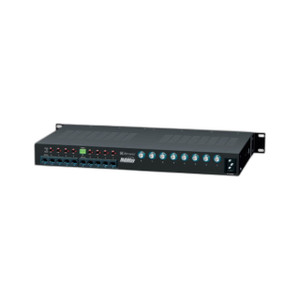
Altronix HUBWAY83DS 8-Channel Passive UTP Transceiver Hub
The Altronix HUBWAY83DS is an 8-channel passive UTP transceiver hub engineered for analog video distribution in surveillance installations where extended cable runs and minimal infrastructure overhead are operational requirements. This hub centralizes video routing across eight channels using standard unshielded twisted-pair (UTP) cabling—the same Category 5/5e/6 wiring already in most commercial buildings—without requiring external power. By eliminating power supply dependencies, the HUBWAY83DS reduces capex on conduit runs, breaker allocation, and UPS battery capacity, making it particularly effective in retrofit deployments or facilities where coaxial runs are impractical.
Key Features
- 8 Passive Channels: Routes eight independent analog video signals simultaneously over a single hub. No active amplification means no power draw and no single-point failure risk from a failed supply.
- Passive UTP Transceiver Design: Extends video transmission distances over standard twisted-pair cabling beyond typical coaxial limitations. Leverages existing network infrastructure, eliminating dedicated cable pulls.
- Zero External Power: Operates passively—no 24VAC, 12VDC, or PoE injection required. Simplifies installation in areas where power is unavailable or restricted.
- Compact Centralized Hub Form Factor: Mounts in standard rack or wall-mount enclosures for organized multi-camera distribution points in retail, office, and campus environments.
- Standard Connectors: BNC video inputs/outputs mate directly with existing surveillance camera connectors and DVR/NVR video input panels; no adapter cost or compatibility risk.
- Lifetime Limited Warranty: Altronix backing ensures long-term reliability and supports integrators through the product lifecycle.
- Hybrid System Integration: Works as a distribution layer between analog cameras and digital NVR systems, simplifying staged migration from legacy SDI/composite to IP-based architectures.
- No Bandwidth Bottleneck: Passive design eliminates processing latency—video signals pass through with zero added delay, critical for real-time monitoring and forensic playback.
The HUBWAY83DS addresses a specific operational gap: buildings with extensive UTP cabling infrastructure (corporate networks, educational campuses, multi-tenant facilities) can now extend analog camera signals to centralized DVR/NVR hubs without running separate coaxial branches. This reduces material cost, installation labor, and ongoing maintenance overhead. Because the hub is passive, there is no firmware to update, no configuration menu, and no diagnostic port to troubleshoot—signal in equals signal out across all eight channels in parallel.
Typical deployment scenarios include retail chains with store-level analog cameras feeding a centralized security operations center via existing structured cabling; university campuses where UTP runs were provisioned during building construction but cameras were added years later; and warehouse facilities where cost-per-camera dictates avoiding dedicated power infrastructure. In these contexts, the HUBWAY83DS acts as a bridging device that defers the transition to full IP-based surveillance by maximizing the utility of analog and existing UTP assets.
Integration with modern NVR platforms (Milestone, Genetec, Avigilon, Hanwha WiseNet) is straightforward: the HUBWAY83DS outputs analog composite video directly into analog input cards on hybrid NVRs or video capture cards on Windows-based DVR systems. There is no ONVIF, no API, and no network configuration—the hub is a pure analog distribution layer, making it immune to network congestion, IP address conflicts, or cybersecurity scanning. For integrators managing mixed-age surveillance ecosystems, this simplicity is often a significant advantage.
Altronix manufactures the HUBWAY83DS in the USA and backs it with a lifetime limited warranty, reflecting confidence in passive component reliability. Because there are no active electronics, failure modes are rare; the primary operational consideration is cable quality and termination integrity—standard BNC and RJ45 best practices apply. Channel isolation is inherent to the passive design, meaning a short or fault on one video line does not cascade to other channels.
Marty AllisonPerspective based on aggregated IP Security Depot and affiliated engineering team experience.
In our experience, the HUBWAY83DS fills a niche that surprises integrators until they encounter it on a real project: the building already has UTP cabling, the budget for new coaxial runs doesn't exist, and a hybrid analog-to-NVR migration is acceptable. We've deployed this hub in office parks where IT infrastructure was extensible but the security department had zero capital allocated for dedicated camera cable. The passive design is the key differentiator. Most video distribution hubs require 24VAC or 12VDC, which means tracking down a spare breaker, running conduit, installing a dedicated supply, and managing periodic UPS battery cycling. The HUBWAY83DS eliminates all of that—you plug BNC and twisted-pair connectors into the back, and it works. No power budget consumed, no thermal load on HVAC, no single point of failure from supply failure. That simplicity translates to lower total cost of ownership and faster payback on retrofit projects where power infrastructure is a bottleneck.
The trade-off is straightforward: UTP transmission distance is longer than coaxial for analog video, but the signal requires clean termination and noise-free routing. On a 500-meter run through building conduit, you'll get reliable video. On an outdoor aerial run with poor shielding and RF interference from cell towers, you may see ghosting or noise. We've seen integrators use the HUBWAY83DS successfully in controlled environments (retail chain stores, office buildings, warehouses) and encounter difficulty in high-RF environments without proper grounding discipline. Know your cabling environment before specifying this hub.
Technical Highlights:
- Passive UTP Transceiver Technology: The hub contains no active amplification, which means signal integrity is entirely dependent on cabling quality and termination. UTP Category 5e or higher is required; older Cat 3 runs will show degradation over long distances. The benefit: no power consumption, no heat generation, and signal latency is measured in nanoseconds rather than milliseconds—critical for synchronous multi-camera recording across all eight channels.
- Eight Simultaneous Channels: Each channel is isolated internally, so a fault or short on camera 1 does not degrade cameras 2–8. This isolation is a passive property—no logic or switching required—making the hub extremely reliable in noisy environments like parking structures or industrial facilities.
- BNC and UTP Termination: Video inputs and outputs are standard BNC connectors (mate directly to cameras and DVR/NVR input panels). Twisted-pair legs are typically terminated via RJ45 connectors or 66-block punch-down, depending on site UTP infrastructure. Verify termination quality before installation—poor punch-down jobs are the leading source of signal degradation.
- Lifetime Limited Warranty: Altronix's US manufacturing and warranty backing reflect component longevity. Passive devices rarely fail; when they do, it's usually due to connector corrosion or physical damage. Keep the hub in a dry, temperature-controlled cabinet and expect 15+ years of service.
- No Configuration Required: Unlike active hubs with DIP switches or web interfaces, the HUBWAY83DS has no setup. Plug it in and video flows. This simplicity reduces commissioning time and training overhead for field technicians.
Deployment Considerations:
- UTP cabling quality is non-negotiable. Ensure all twisted-pair runs are Category 5e minimum (preferably 6 or 6A) and properly terminated. Loose or corroded RJ45 connectors will cause signal loss before the hub itself becomes a suspect. Budget time for tone-testing and continuity verification before installation.
- RF environment assessment is critical in industrial and outdoor proximity scenarios. Cell towers, radio transmitters, and high-power industrial equipment can inject noise into unshielded twisted-pair. If your site is near RF sources, run a short test cable and monitor for ghosting or jitter before committing to a full installation.
- Grounding discipline: Ensure all BNC connectors on both camera and DVR ends are properly grounded through their shield connections. Floating grounds are a leading source of hum and intermittent noise on passive analog video systems. Use quality BNC connectors with strain relief and verify continuity of the shield braid at both ends.
- Integration with analog capture cards or hybrid NVR analog input modules. Verify that your DVR/NVR analog inputs accept standard NTSC or PAL composite video at the expected impedance (75 ohm). Mismatched impedance will cause reflections and signal ghosting; most modern systems accept standard video levels without issue, but document this before installation.
- Passive hub placement should be in a climate-controlled cabinet or enclosure. Although the hub generates no heat, condensation in uncontrolled environments can corrode BNC connectors and degrade signal integrity. A simple wall-mounted rack or industrial DIN-rail enclosure in a secure room is ideal.
The right buyer for the HUBWAY83DS is an integrator supporting legacy analog surveillance estates in buildings where UTP cabling already exists and power distribution is a constraint. This hub is not a replacement for modern IP video infrastructure—it's a tactical bridge that extends the life and utility of analog cameras in retrofit projects. For organizations committed to IP migration, the HUBWAY83DS can serve as a temporary aggregation layer during the transition, allowing analog cameras to coexist with NVR systems until IP cameras can be phased in. Explore the full Altronix catalog for complementary power distribution and video management solutions.