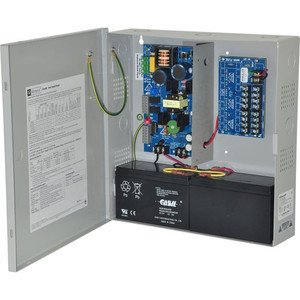
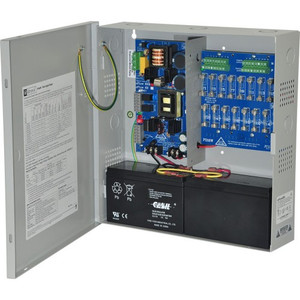
Altronix AL600ULPD8 6A 8-Output Power Supply Charger
The Altronix AL600ULPD8 is a UL-listed AC/DC power supply and battery charger engineered for multi-output security infrastructure deployments. It accepts standard 115VAC mains input and delivers regulated 12/24VDC output across eight independent, fused channels—a critical architecture when powering distributed access control, alarm, and auxiliary security devices from a single chassis without cross-device power-loss risk.
Key Features
- Eight Independent Fused Outputs: Each output is isolated with its own fuse, meaning a fault or short on one device (e.g., a malfunctioning door strike) doesn't kill power to the other seven — essential for maintaining partial system availability during troubleshooting or equipment failure.
- 6A Maximum Current Capacity: Total throughput of 6A means you can distribute roughly 750mA per output on average at 12VDC, or proportionally less at 24VDC. For typical access control panels, door strikes, and auxiliary circuits, this is sufficient, but you must verify individual device draw against available current before final design.
- Switchable 12/24VDC Output: Voltage selection is done once, at unit configuration—a single jumper or switch setting applies to all eight outputs simultaneously. This simplifies mixed-voltage deployments by keeping DC conversion centralized; choose based on your existing infrastructure (many older panels demand 12VDC; modern systems often use 24VDC for lower current draw).
- Battery Backup Charging: The AL600ULPD8 can trickle-charge a backup battery (typically lead-acid or lithium) to bridge mains loss. This is not a UPS in the traditional sense—there is no seamless switchover delay specification published—but it extends operation if mains fails briefly during critical access control or alarm state transitions.
- AC Fail Supervision: Detects when 115VAC input is lost and can signal an alarm panel or monitoring center. Useful for diagnosing power infrastructure issues before they cascade into access denial or security gaps.
- Low Battery & Battery Presence Supervision: Built-in monitoring confirms the backup battery is present and adequately charged. Low Battery alerts you to aging or depleted backup capacity before it becomes a liability during an actual outage—early warning avoids emergency service calls during crisis.
Integration & Compatibility
The AL600ULPD8 is purpose-built for access control panels, alarm system controllers, and auxiliary DC devices that require isolated, supervised power distribution. Its UL listing qualifies it for commercial and industrial installations in North America, and its fused architecture aligns with security industry standards (NFPA 72 / UL 1610 for alarm system powering). When specifying, confirm that your alarm panel or access controller accepts 12VDC or 24VDC input; the choice is made once at installation and affects both the AL600ULPD8 configuration and all downstream devices. Battery charging is passive—no external charge controller is required—but you must pair it with an appropriately sized lead-acid or compatible lithium backup battery.
Power Budget & Wiring Considerations
Total input is 115VAC; maximum output is 6A at the selected voltage (12 or 24VDC). If you are powering eight devices, a load analysis is mandatory: add up the draw of each device, confirm it does not exceed 6A total, and ensure no single output exceeds the fuse rating. Standard installation includes a 115VAC mains connection with circuit breaker protection upstream of the AL600ULPD8; the unit itself provides supervised output protection. Wiring from the power supply to remote devices should use appropriately gauged cable to minimize voltage drop—especially on 12VDC runs of significant distance.
Frequently Asked Questions
Q: Can I operate both 12VDC and 24VDC outputs simultaneously on the AL600ULPD8?
A: No. The voltage is set globally via a jumper or configuration setting. All eight outputs deliver the same voltage (12 or 24VDC). If you need both voltages, you will need a second power supply or a DC-to-DC converter module.
Q: What is the expected runtime if mains fails with a typical backup battery connected?
A: Runtime depends entirely on battery capacity (Ah rating) and the current load. The AL600ULPD8 trickle-charges the battery but does not regulate discharge duration. A 7Ah lead-acid battery with a 1A load would theoretically deliver 7 hours; with a 5A load, roughly 1.5 hours. You must size the battery based on your required hold-up time and typical load.
Q: Are there any restrictions on battery type, or must I use Altronix-branded batteries?
A: The AL600ULPD8 is compatible with standard lead-acid backup batteries and some lithium chemistries, but charging parameters vary by battery type. Consult the product datasheet or contact the manufacturer for approved battery models to avoid overcharging or undercharging.
Q: Does the AL600ULPD8 have a remote monitoring or output for integration into a building management system?
A: The supervision outputs (AC Fail, Low Battery, Battery Presence) are discrete alarm contacts intended for hardwired connection to an alarm panel. There is no Ethernet or serial integration; all monitoring is via relay closure or dry-contact signaling to a local controller.
Q: What is the warranty on the AL600ULPD8?
A: The unit carries a Lifetime Limited Warranty from Altronix, covering defects in materials and workmanship. Review the warranty document for exclusions and claims procedures.
Ted PerryPerspective based on aggregated IP Security Depot and affiliated engineering team experience.
The AL600ULPD8 is a workhorse for distributed security power distribution because it does one job well: isolate and protect eight independent DC circuits without exotic features or unnecessary complexity. The 6A total capacity is the real constraint—not a flaw, but a design boundary you must respect. Most single access control doors draw 0.5–2A depending on the strike type and hold-open duration, so the AL600ULPD8 typically supports four to eight typical door lines before you need a second unit or load balancing.
Technical Highlights:
- Eight Isolated Fused Outputs: A shorted door strike or relay doesn't cascade to adjacent circuits. This isolation is critical in multi-zone deployments where a single fault can't lock down the entire building's egress.
- Switchable 12/24VDC Configuration: Set once per installation. Most modern panels prefer 24VDC (lower current draw, better signal integrity over long runs), but legacy systems may demand 12VDC. Plan your voltage early and confirm all downstream devices match.
- Battery Supervision Trio: AC Fail, Low Battery, and Battery Presence contacts provide hardwired feedback to your alarm panel. These are not optional for compliance-critical installations—they give you visibility into backup readiness before an outage occurs.
Deployment Considerations:
- Current budgeting is non-negotiable. Six amps total across eight outputs means you can't power eight hungry magnetic locks simultaneously. Measure your actual device draw and leave 20–30% headroom.
- Battery sizing is separate from the power supply. The AL600ULPD8 charges passively; you must select and install a backup battery that matches your required hold-up time. Don't assume a 7Ah lead-acid battery is sufficient—test your typical load duration and size accordingly.
- The supervision outputs are 12VDC dry contacts. They require hardwiring to an alarm panel input zone; there is no remote notification or email alert built into this unit. If you need cloud-based monitoring, layer a separate alarm controller or integration module.
The AL600ULPD8 excels in mid-scale access control buildouts (4–8 doors) and hybrid alarm-plus-control sites where isolated output protection prevents cascading outages. If you're designing a single-door emergency egress checkpoint or a small alarm repeater station with battery backup, this is the right choice. For large campuses with 16+ controlled access points, consider multiple units or a modular power distribution frame.