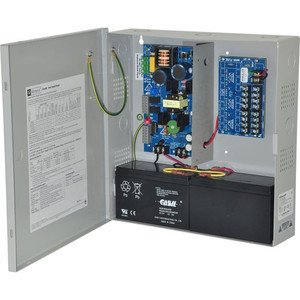
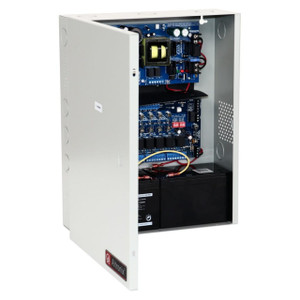
Altronix AL400ULPD8CB 8-Output Power Supply Charger
The Altronix AL400ULPD8CB is a UL-listed, 8-output power supply and charger designed to distribute regulated 12VDC or 24VDC across multiple security and access-control devices in a single installation. This model delivers 4A per output at 12VDC or 3A per output at 24VDC—enough to power field controllers, card readers, sensors, and alarm system components without overloading individual circuits. The built-in battery charger and supervision circuitry eliminate the need for separate monitoring, making it ideal for distributed deployments where redundancy and fault visibility matter.
Key Features
- Eight Independent Outputs: Each channel is individually regulated, so a fault or heavy load on one output won't affect the others—critical when powering mission-critical access points or sensor arrays that must stay online.
- Selectable Voltage (12VDC or 24VDC): Choose voltage based on your device specifications at commissioning, without requiring multiple SKUs for different voltage requirements across your deployment footprint.
- 4A @ 12VDC / 3A @ 24VDC per Channel: Sufficient headroom for high-current readers, strike solenoids, and networked controllers—gives you breathing room if field devices draw slightly more than nameplate under cold-start conditions.
- Integrated Battery Charger: Built-in charging circuitry supports lead-acid or alkaline backup batteries, eliminating the need for a separate charger module and reducing panel real estate and system complexity.
- AC Fail Supervision: Detects mains power loss instantly, triggering alerts before backup power is needed—lets you respond to outages before batteries are depleted.
- Low Battery Supervision: Alerts you when backup capacity falls below usable thresholds, so you can service or replace batteries before an outage strands critical doors or controllers offline.
- Battery Presence Supervision: Confirms the charger and battery are properly connected and functional; catches disconnections or charger faults that would otherwise go unnoticed until a power failure.
- UL Listed: Meets professional security installation codes and insurance requirements—required for commercial and institutional deployments.
Typical Applications
- Multi-zone access-control systems requiring independent power feeds to readers and strike controllers across multiple doors and entry points.
- Distributed camera and sensor networks needing separate circuits to isolation modules or PoE injectors without cross-talk or voltage sag.
- Alarm control panel and emergency lighting circuits where simultaneous mains and battery operation must be supervised.
- Building automation integration in security networks, where HVAC controllers and fire-alarm interfaces run on redundant 24VDC circuits.
- Remote device installations in areas where AC power is unreliable or intermittent, requiring battery redundancy without manual monitoring.
Integration & Compatibility
The AL400ULPD8CB outputs are compatible with any 12VDC or 24VDC security device—card readers, relay modules, door controllers, sensors, and power-over-line modules. Its access control and power supply design fits standard rack or wall-mount installations, and the modular output terminals accept both wire and cable connectors. Battery charging supports standard lead-acid designs rated for 12VDC or 24VDC operation. Consultation with your system integrator on total current draw across all eight outputs and battery sizing ensures proper margin for your specific deployment.
Frequently Asked Questions
Q: What happens if I exceed 4A (at 12VDC) or 3A (at 24VDC) on a single output?
A: Each output includes current limiting and thermal protection to prevent damage. Sustained overload will trigger automatic shutdown of that channel; use the Low Battery or AC Fail supervision to detect and log the event, then review connected devices for excessive draw.
Q: Can I mix 12VDC and 24VDC outputs, or does the whole unit run one voltage?
A: The AL400ULPD8CB is configured for either 12VDC or 24VDC across all eight channels at commissioning—you cannot run mixed voltages simultaneously. Choose voltage based on your largest device population and use isolated modules for minority voltages if needed.
Q: Is the AL400ULPD8CB NDAA-compliant or TAA-compliant?
A: This is a passive power-distribution component with no processing, firmware, or network capability. It does not fall under NDAA Section 889 restrictions. Confirm with your procurement office if Altronix corporate citizenship or country of manufacture affects your policy.
Q: What battery types and capacities does the charger support?
A: The charger supports standard lead-acid batteries rated for 12VDC or 24VDC operation. Refer to the datasheet for recommended battery capacity ranges and charge profiles to ensure proper float voltage and cycle life. Undersized batteries will deplete quickly during extended outages; oversized batteries may extend charge time but provide longer runtime.
Q: How do I monitor the AL400ULPD8CB's supervision signals in my control panel?
A: AC Fail, Low Battery, and Battery Presence supervision outputs are discrete volt-free contacts that wire into your alarm panel's input terminals. Consult your panel manual for supervision input configuration and event logging setup.
Q: Can the AL400ULPD8CB be networked or integrated with a management system?
A: The AL400ULPD8CB is a standalone analog power supply with only supervised relay outputs—it has no IP, Ethernet, or remote management capability. Supervision events are signaled via hardwired contacts to your control panel. For networked power monitoring, integrate the supervision outputs into a building management system or security panel with IP connectivity.
Ted PerryPerspective based on aggregated IP Security Depot and affiliated engineering team experience.
The AL400ULPD8CB solves a real integration headache: powering distributed access-control and sensor networks without daisy-chaining outputs or deploying multiple single-channel supplies. Eight independent 4A (12VDC) or 3A (24VDC) channels mean you can feed card readers, strike controllers, and sensor modules from a single chassis while keeping AC Fail, Low Battery, and Battery Presence supervision wired back to your control panel. That supervision triad is where this model earns its place—it catches power faults before they cascade into undetected reader or door-controller outages.
Technical Highlights:
- 8 Independent Regulated Outputs: 4A @ 12VDC or 3A @ 24VDC per channel eliminates cross-talk and current-sharing complexity. Each channel is isolated, so a short or fault on one reader circuit won't sag voltage to your alarm or strike modules.
- Integrated Battery Charger: Built-in charging eliminates a separate module and keeps the panel compact. Lead-acid batteries receive proper float voltage and charge management without overcharging or cell imbalance.
- Three Supervision Signals (AC Fail, Low Battery, Battery Presence): These hardwired relay outputs feed directly into your alarm panel's input zone. You catch mains power loss, battery depletion, and charger faults in real time, not after an outage reveals a dead battery.
Deployment Considerations:
- This is a single-voltage unit—you must choose 12VDC or 24VDC at commissioning. If your site has both voltage requirements, you'll need either a second AL400ULPD8CB or isolated DC-DC converters for minority-voltage devices. Plan your voltage strategy before installation.
- Battery sizing matters. Undersized batteries deplete in minutes during an outage. Calculate total current draw across all eight outputs under emergency mode (assume readers and one strike per door) and size the battery for the minimum runtime your facility requires. The supervision signals alert you to low battery, but only if the battery and charger are intact.
- Current-limiting on each output is a safety feature, not a power-sharing mechanism. If a connected device draws more than nameplate, that output shuts down. Monitor connected devices during commissioning to confirm they stay within the 4A or 3A envelope.
Best fit: Multi-door access-control systems with distributed readers, strike controllers, and sensor modules where a single, centralized power source with full supervision beats managing eight individual supplies. Avoid if you need IP-based remote power monitoring or mixed-voltage outputs from one chassis.