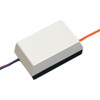
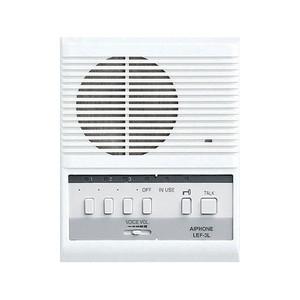
Aiphone RY-ES External Signaling Relay
Overview
The Aiphone RY-ES is an external relay accessory designed to trigger signaling devices—such as sirens, strobes, or warning lights—when a call arrives at a door station. The relay connects to the chime output of an Aiphone master or answering station and draws its operating power from the same master station, eliminating the need for a separate external power supply to the relay itself. This simplifies wiring and reduces installation complexity, particularly in retrofit scenarios where additional circuits are impractical.
The RY-ES delivers only a dry contact closure to activate your external device; it does not source power to that device. This distinction matters: you must supply separate power to any siren, strobe, or actuator you intend to control, but the relay itself operates from the master station's existing power, keeping the design minimal and the wiring straightforward.
Key Features
- Dry Contact Output (125V AC @ 1.0A, 30V DC @ 1.0A): Rated for moderate-load signaling devices. At 125V AC, a 1-amp contact can switch standard alarm sirens or small strobe units; at 30V DC, it suits control relays or low-voltage warning circuits. This dual-voltage design reduces the need for separate relay models across different facility electrical standards.
- Power from Master Station: Red and black power leads connect directly to the master or answering station's power terminals. The relay draws minimal current during idle and only energizes when a chime signal is present, so it won't strain your existing intercom power budget.
- Non-Polar Activation Wires (White/Blue): Wires from the chime output can be connected in either polarity—a small convenience that reduces installation errors and means you don't need to trace polarity on-site during commissioning.
- Compact Wall-Mount Design (4-1/8" H × 2-7/16" W × 1-5/8" D): Fits easily into electrical closets, panel rooms, or next to the master station without requiring additional cabinet space or DIN-rail mounting. The small form factor is particularly useful in retrofit installations where space is limited.
- Replaces IER-2 Legacy Model: If you're upgrading from an older Aiphone installation using the IER-2, the RY-ES is a direct successor with the same mounting and terminal interface, making it a plug-in replacement without rewiring.
- Seamless Integration with Aiphone Series: Compatible with Aiphone intercom systems including JP, JO, JV, KB, AX, NIM, DB, and IE series. This broad compatibility ensures the RY-ES works with a wide range of Aiphone master and answering station models deployed across different facility types.
Integration & Compatibility
The RY-ES pairs with any Aiphone master or answering station that provides chime output. Connection requires three pairs of wires: red and black for power (sourced from the master station) and white and blue for the activation signal (non-polar, so no concern about reversal). Installation is straightforward—no special programming or configuration needed. The relay simply passes a contact closure whenever a door station call is initiated, independent of whether the master station answers or ignores the call.
For integrators deploying multi-station clusters, the RY-ES can be installed once at a central master station to control site-wide alarm signals, or deployed at multiple answer stations if zone-specific notifications are required. The contact rating allows direct switching of small solenoid actuators, door strikers, or siren control circuits; for high-power applications (above 1 amp at line voltage), an external industrial relay should be interposed.
What's in the Box
- RY-ES Relay unit (1)
- Mounting brackets (2)
- Wood screws (2)
- Machine screws (2)
When to Choose a Different Model
If you need a relay capable of switching higher currents (above 1.0A at line voltage) or controlling multiple independent signaling circuits simultaneously, contact an Aiphone applications engineer to explore whether an external industrial relay cabinet or a multi-channel relay module from a third-party control vendor would be a better fit. The RY-ES is single-channel and current-limited by design, so it is not suitable for large building-wide alarm systems requiring dozens of independent outputs.
Frequently Asked Questions
Q: Does the RY-ES supply power to my siren or strobe?
A: No. The RY-ES provides only a dry contact closure to trigger activation. Your siren, strobe, or other device must have its own power supply wired in parallel with the relay contacts. The RY-ES itself draws power from the master station.
Q: Can I wire the white and blue activation leads in reverse?
A: Yes. The activation wires are non-polar, so there is no concern about polarity reversal. Either connection order works.
Q: Is the RY-ES a direct replacement for the IER-2?
A: Yes. The RY-ES replaces the IER-2 legacy model and uses the same mounting interface and terminal layout, making it a plug-in replacement.
Q: What happens if the door station is called but the master station doesn't answer?
A: The relay still energizes and closes the contact, because it responds to the chime signal itself—not to whether an answering party acknowledges the call. If you need the relay to activate only upon answer, a separate logic module or control system would be required.
Q: Can I use the RY-ES to control multiple devices at once?
A: The RY-ES is single-channel. It provides one dry contact closure per call. If you need to control multiple independent circuits, you would need separate relays or a multi-channel relay module.
Ted PerryPerspective based on aggregated IP Security Depot and affiliated engineering team experience.
The Aiphone RY-ES (often searched as RY ES) is a straightforward, low-complexity relay module that solves a specific problem: triggering external alarm signaling when calls arrive at a door station. The 1.0-amp contact rating at 125V AC and 30V DC is the key specification—it's modest by industrial standards, but intentionally so. This relay is built for typical office, school, or small facility deployments where you're controlling a single siren or strobe per location, not orchestrating a large building-wide alarm matrix.
Technical Highlights:
- Dry Contact Rating (125V AC @ 1.0A; 30V DC @ 1.0A): Adequate for standard electromagnetic sirens and small strobe units. At 125V, you can reliably switch a 125-watt siren or equivalent load; at 30V DC, you can control low-voltage relay coils or solenoids in access-control or gate applications. Know your load wattage before installation to avoid nuisance failures or chattering.
- Power Architecture (sourced from master station, no separate supply): This is a deployment win. You're not running separate 120V circuits to the relay enclosure. The RY-ES draws milliamps at rest and powers up only during chime events, so it won't stress a 15-amp or 20-amp master station power circuit. In retrofit work, this eliminates the need for an additional panel breaker.
- Non-Polar Wiring (white/blue activation): Field-friendly. No need to trace or test polarity on-site. Either wire can be 'hot,' reducing installation time and callbacks due to wiring reversals.
Deployment Considerations:
- Device Power Supply is Your Responsibility: The RY-ES does not power your siren or strobe. You must bring separate power to the external device and wire it in parallel with the relay contacts. Common rookie mistake: forgetting to wire the siren supply, then wondering why nothing happens when the relay energizes.
- Single-Channel Limitation: The RY-ES activates one contact per call. If your facility requires zone-specific signaling (e.g., front entrance siren triggers, loading dock siren silent, office siren loud), you'll need either multiple RY-ES units at different master stations or an external relay bank with logic routing. Plan for this early in design.
- No Answer-State Logic: The relay closes on chime signal, regardless of whether anyone picks up. If you need 'audible alert only if call goes unanswered for 30 seconds,' an external timer or PLC must be introduced.
The RY-ES fits neatly into small-to-mid-sized intercom deployments where a single, site-wide alert (main entrance intrusion triggers building-wide chime, for example) is the operational model. It's a workhorse for schools, offices, and small warehouses using Aiphone intercom systems. Don't force it into high-current or multi-zone applications where a proper industrial relay panel or control logic module is genuinely needed.