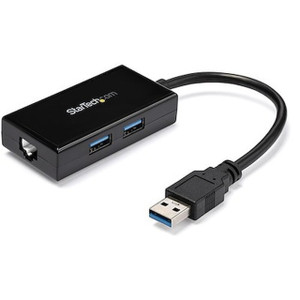
StarTech ST4000SPEXI 4-Port Gigabit PCIe Network Interface Card
Overview
The ST4000SPEXI is a quad-port Gigabit Ethernet network interface card built on the Intel I350-AM4 chipset and fitted to a PCIe x4 slot. If you're building out a surveillance server, NVR host, or workstation that needs to pull separate camera streams across multiple network segments — without adding a managed switch inline — this card gives you four independent 10/100/1000 Mbps ports from a single PCIe slot. At 4.4W idle, it won't push your server's thermal budget, and the standard-profile bracket means it drops directly into 1U and 2U rackmount chassis without a bracket swap.
Where this card earns its place is in deployments where you want physical network separation: isolating camera traffic from corporate LAN, segregating a storage network, or dedicating an interface to a VMS management plane. Four RJ-45 ports, one card, one slot — and no shared-bandwidth bottleneck from a USB or Thunderbolt adapter.
Key Features
- Intel I350-AM4 Chipset: The I350 is one of the most broadly supported server NICs in the industry. Major hypervisors, NVR platforms, and enterprise OS distributions carry native I350 drivers — which means no hunting for third-party drivers on a fresh Windows Server or Linux install. On a surveillance server where driver stability directly affects recording uptime, that matters.
- PCIe x4 Bus Interface: The card occupies a single PCIe x4 slot and delivers up to 2000 Mbps aggregate throughput across all four ports simultaneously. That's enough headroom to sustain four separate 400–500 Mbps camera streams without the bus becoming the bottleneck — useful when you're pulling 4K streams from multiple encoders.
- Four Independent RJ-45 Gigabit Ports: Each port operates at 10/100/1000 Mbps auto-negotiation. In a multi-VLAN surveillance architecture, you can physically assign one port per network segment — camera LAN, storage SAN, management, and WAN uplink — all from a single card.
- 9K Jumbo Frame Support: Jumbo frames (up to 9000 bytes) reduce CPU overhead on the host by allowing larger payloads per packet. On a server ingesting continuous high-bitrate video from a dozen cameras, lower interrupt rates translate directly into headroom for analytics processing or additional stream capacity.
- IEEE 802.3ad Link Aggregation: Supported protocol IEEE 802.3ad means you can bond two or more ports into a single logical channel for increased throughput or failover redundancy — relevant when a single camera subnet needs more than 1 Gbps aggregate, or when link failover for a critical recording channel is required by your SLA.
- IEEE 1588 Precision Time Protocol: PTP synchronization support lets the card participate in a time-disciplined network — a hard requirement for forensic video systems where frame timestamps need to align across multiple recorders and cameras for legally defensible evidence.
- IEEE 802.1Q VLAN Tagging: On-card VLAN tagging offloads that processing from the host CPU. Each port can carry tagged traffic, letting you segment camera, management, and storage traffic across a single physical connection without adding a managed switch at every server.
- Standard Profile Form Factor: At 5.2 in x 4.7 in x 0.7 in and 3.2 oz, this card fits any standard ATX or rackmount chassis with a standard PCIe x4 slot. No low-profile bracket is included — verify your chassis before ordering if you're working with a compact or half-height enclosure.
- 4.4W Power Draw: Low enough that it won't require additional PCIe power connectors or push you over a slot power budget. In a dense rackmount server, that figure adds up across multiple expansion cards.
- Operating Temperature 5°C to 50°C: Covers standard server room and wiring closet environments. Not rated for wide-range industrial environments — if your server sits in an unconditioned space, verify ambient temperatures stay within range.
Integration and Compatibility
The ST4000SPEXI is compatible with any PCIe x4 (or wider) slot — including x8 and x16 slots, which are electrically backward-compatible. The Intel I350-AM4 chipset has broad OS support including Windows Server 2012 R2 through current, Windows 10/11, and major Linux distributions (kernel drivers ship natively). For VMware ESXi deployments, the I350 family is on VMware's Hardware Compatibility List, making it a practical choice for virtualized NVR or VMS server builds where you need to pass through physical NICs to guest VMs.
The card's support for network switches infrastructure standards — 802.3ad, 802.1Q, and 802.3x flow control — means it integrates cleanly into existing managed switch environments without special configuration. Pair it with a PoE-capable managed switch on the camera side and a direct server connection on the storage side to keep traffic paths clean. If you're specifying network video recorders for a large multi-camera deployment, this card is worth evaluating as the host NIC where stream isolation and CPU overhead matter.
For integrators building out IP camera networks and NVR servers, review the network planning guide for guidance on VLAN segmentation and bandwidth budgeting across camera subnets. If you need additional PoE switches to power cameras on those segments, plan the switch uplink capacity to match the NIC's per-port 1 Gbps ceiling.
Frequently Asked Questions
Q: Does the ST4000SPEXI work in a PCIe x8 or x16 slot?
A: Yes. PCIe slots are backward-compatible, so a PCIe x4 card installs and operates normally in x8 or x16 slots. It will not use the additional lanes, but there is no performance or functional penalty for the card itself.
Q: What is the maximum aggregate throughput across all four ports?
A: The ST4000SPEXI supports up to 2000 Mbps (2 Gbps) aggregate across all four ports over the PCIe x4 bus. Each individual port operates at up to 1000 Mbps (1 Gbps).
Q: Does this card support link aggregation (LACP)?
A: Yes. The card supports IEEE 802.3ad, which is the standard for Link Aggregation Control Protocol (LACP). You can bond ports for increased bandwidth or failover redundancy, provided your switch also supports 802.3ad.
Q: Is the ST4000SPEXI compatible with VMware ESXi?
A: The Intel I350-AM4 chipset used in this card has broad VMware ESXi support. Verify your specific ESXi version against VMware's Hardware Compatibility List for the I350 family before deployment in a production virtualized environment.
Q: What is the warranty on the ST4000SPEXI?
A: The ST4000SPEXI carries a 2-year manufacturer warranty.
Q: Does the card support jumbo frames, and what is the maximum frame size?
A: Yes. The ST4000SPEXI supports jumbo frames up to 9K (9000 bytes), which reduces host CPU interrupt overhead on high-throughput workloads like continuous video ingest.
The ST4000SPEXI is one of those components that does exactly what the spec sheet says and causes zero drama at commissioning — which, on a surveillance server build, is exactly the outcome you want. The Intel I350-AM4 chipset is the main reason I keep coming back to this card: native driver support across Windows Server and Linux without any third-party package dependency, and it's on VMware's HCL for ESXi passthrough builds. At 4.4W, it won't strain your server PSU or thermal envelope in a dense 1U chassis.
Technical Highlights:
- 2000 Mbps PCIe x4 aggregate: Enough bus bandwidth to sustain four simultaneous 1 Gbps streams — relevant when you're feeding separate VLANs for cameras, storage, management, and WAN from a single card without the bus becoming a constraint.
- IEEE 1588 PTP support: Time-disciplined NIC operation means frame timestamps stay synchronized across recorders — a requirement on any deployment where footage needs to hold up as forensic evidence in a legal proceeding.
- 9K jumbo frame support: Reduces packet overhead on continuous high-bitrate video ingest. On a 16-camera 4K recording server, the CPU headroom recovered from lower interrupt rates is meaningful for analytics workloads running on the same host.
Deployment Considerations:
- This is a standard-profile card at 5.2 x 4.7 inches — confirm your chassis has full-height PCIe slots before ordering. There is no low-profile bracket option listed in evidence, so half-height or compact builds are not supported.
- Operating temperature ceiling is 50°C. In a wiring closet or IDF without active cooling, measure your ambient before assuming this card is a fit — it's not rated for unconditioned industrial environments.
For a virtualized NVR server running VMware ESXi with multiple isolated camera VLANs, the ST4000SPEXI is a clean, low-overhead solution: four physical ports, broad hypervisor support, and PTP timestamping for evidence-grade deployments — all at a power draw that won't complicate your server's thermal design.