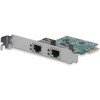
StarTech ST1000SPEXD4 Dual-Port Gigabit PCIe Network Adapter Card
Overview
The StarTech ST1000SPEXD4 is a dual-port Gigabit Ethernet adapter that drops into a PCIe x1 slot to give any desktop, server, or workstation two independent 10/100/1000 Mbps network connections. If you're running a surveillance server that needs to keep camera ingestion traffic isolated from management or storage network traffic — or a workstation that needs a dedicated NIC for VMS software — this card solves the problem without requiring a larger slot or a separate switch. The standard-profile form factor fits standard tower and rack-mount chassis directly out of the box.
For security integrators and IT architects building out network video recorders or dedicated capture workstations, having two physically separate Ethernet ports on a single card means you can segment your network at the NIC level — no VLAN-only dependency, no single point of failure on one port. At a combined maximum throughput of 2000 Mbps across both ports, you won't create a NIC bottleneck even on high-bitrate multi-camera streams.
Key Features
- Dual independent RJ-45 ports at 10/100/1000 Mbps: Two separate Gigabit interfaces mean you can assign one port to your camera VLAN and the other to your management or storage network. Physical separation at the NIC level reduces broadcast domain risk and keeps surveillance traffic off your corporate LAN without relying entirely on switch-side VLAN enforcement.
- PCIe x1 interface (PCIe 2.0 compliant): PCIe x1 is the most widely available expansion slot in modern servers and workstations — you won't be consuming a x4, x8, or x16 slot that's better reserved for GPU or HBA cards. PCIe 2.0 compliance means backward and forward compatibility across most platforms deployed in the last decade.
- Combined 2000 Mbps maximum data transfer rate: With both ports running full-duplex Gigabit simultaneously, you have 2 Gbps of aggregate throughput available. For a surveillance server recording 30+ IP cameras at 4–8 Mbps each, that headroom matters — a single-port card would be a bottleneck before you hit 125 cameras at typical bitrates.
- 9K jumbo frame support: Jumbo frames (up to 9000 bytes MTU) reduce CPU overhead on the host by packaging more data per Ethernet frame. On high-density camera deployments or NAS-connected storage, enabling jumbo frames can meaningfully reduce CPU interrupts per second — relevant on servers handling real-time video analytics alongside recording.
- IEEE 802.1Q VLAN tagging: The card supports hardware-level VLAN tagging, so you can enforce network segmentation at the NIC without depending solely on your managed switch configuration. This is the baseline for any deployment following network segmentation best practices for IP cameras.
- IEEE 802.1P Layer 2 Priority Encoding (QoS): Layer 2 QoS lets you tag video traffic with a higher priority at the frame level. In a mixed-use network where backup jobs or bulk file transfers share bandwidth, QoS tagging ensures camera streams and VMS communication don't get starved during congestion events.
- IEEE 802.3x Full Duplex Flow Control: Full-duplex flow control prevents buffer overflow between the NIC and your switch by signaling PAUSE frames when queues back up. In burst-heavy surveillance environments — think synchronized motion events across multiple cameras — this keeps frames from being silently dropped at the NIC.
- Realtek RTL8111 controller with ASMedia ASM1182e PCIe bridge: The RTL8111 is a well-supported, driver-stable chipset with native drivers in Windows, Linux, and most hypervisor environments. The ASM1182e bridge chip is what enables two independent Gigabit ports over a single PCIe x1 connection — worth knowing for driver troubleshooting and compatibility checks on older or embedded OS builds.
- Standard-profile card at 3.6 x 4.7 in: Fits standard ATX and most rack-mount server chassis without a low-profile bracket swap. At 1.9 oz, it won't stress your PCIe slot retention clips during shipping or vibration in a rack environment.
- Operating temperature 0°C to 70°C: Covers typical server room and wiring closet environments comfortably. Not rated for uncontrolled outdoor enclosures or extreme industrial temperature ranges — plan accordingly if the host machine lives in a non-climate-controlled space.
Integration and Compatibility
The ST1000SPEXD4 installs into any PCIe x1 or larger slot on a motherboard that complies with PCIe Base Specification 2.0. The Realtek RTL8111 chipset has broad native driver support across Windows Server editions, Windows 10/11, and mainstream Linux kernels — reducing the driver management burden on managed workstations and servers. The card supports the full IEEE 802.3 family (802.3, 802.3u, 802.3ab) covering 10BASE-T, 100BASE-TX, and 1000BASE-T operation, so it auto-negotiates correctly with virtually any switch port you connect it to.
For surveillance-specific deployments, this card pairs cleanly with PoE network switches feeding IP cameras — use one port for camera-side ingestion traffic and the second for VMS server communication or iSCSI storage. It also works in virtualized environments where the host NIC needs to present separate interfaces to different VMs, though hypervisor PCIe passthrough configuration should be validated against your specific hypervisor version before deployment. See our NVR selection guide if you're sizing the host platform for a new camera system.
The card is not a managed NIC — there's no out-of-band management interface or IPMI integration. For bare-metal server builds, pair it alongside your existing BMC/IPMI port rather than relying on it for remote management access. Review our IP camera catalog if you're building out the camera layer alongside this NIC upgrade.
Frequently Asked Questions
Q: What PCIe slot does the ST1000SPEXD4 require?
A: The ST1000SPEXD4 uses a PCIe x1 connector and is compliant with PCIe Base Specification 2.0. It will also fit into larger PCIe slots (x4, x8, x16) since PCIe is mechanically backward compatible — the card only uses x1 lane bandwidth regardless of which slot it occupies.
Q: Does the ST1000SPEXD4 work with Linux?
A: The Realtek RTL8111 chipset used in the ST1000SPEXD4 has native driver support in mainstream Linux kernels. Most modern distributions (Ubuntu, CentOS, Debian, RHEL) include the r8169 or r8168 driver out of the box. Verify driver availability for your specific kernel version before deployment in a production environment.
Q: What is the maximum jumbo frame size supported?
A: The ST1000SPEXD4 supports jumbo frames up to 9K (9000 bytes MTU). Both connected switches and the remote endpoint must also be configured for jumbo frames for this to function correctly — enabling it on the NIC alone without matching switch and target configuration will not produce the expected benefit.
Q: What is the warranty on the ST1000SPEXD4?
A: The ST1000SPEXD4 carries a 2-year manufacturer warranty.
Q: Can the ST1000SPEXD4 support VLAN tagging for network segmentation?
A: Yes. The card supports IEEE 802.1Q VLAN tagging and IEEE 802.1P Layer 2 Priority Encoding at the hardware level. This allows you to configure VLAN membership and traffic prioritization directly on the NIC, which is useful for isolating camera traffic from other network segments.
Q: Does the ST1000SPEXD4 fit in a low-profile chassis?
A: The ST1000SPEXD4 ships as a standard-profile card (3.6 x 4.7 in). It is not listed with a low-profile bracket option in the available specifications — verify your chassis clearance before ordering if you're installing in a slim or half-height case.
The spec I keep coming back to on the ST1000SPEXD4 is the 9K jumbo frame support combined with dual independent Gigabit ports over a single PCIe x1 slot. On a surveillance recording server — where you might have 20–40 cameras pushing 4–8 Mbps streams simultaneously while also writing to iSCSI or NAS storage — having two physically discrete NICs on one card lets you architect that traffic separation without consuming two motherboard slots or adding a second card.
Technical Highlights:
- Dual-port 2000 Mbps aggregate: Both ports running full-duplex Gigabit simultaneously gives you 2 Gbps total throughput — enough headroom for high-density camera ingestion on one port and iSCSI or backup traffic on the other without either link becoming the bottleneck.
- 802.1Q VLAN + 802.1P QoS at the NIC: Hardware-level VLAN tagging and Layer 2 priority encoding means you can enforce segmentation and traffic prioritization at the card itself, not just at the switch — useful in environments where the switch config is outside the integrator's control.
- Realtek RTL8111 chipset: One of the most broadly driver-supported Gigabit controllers available. Native kernel support in Linux means no third-party driver management headaches on VMS appliances running Ubuntu or CentOS builds.
Deployment Considerations:
- The ASMedia ASM1182e PCIe bridge chip is what multiplexes two Gigabit ports over a single PCIe x1 lane. In most deployments this is invisible, but if you're troubleshooting driver issues on an older OS or embedded platform, knowing the bridge chip identity helps narrow down compatibility quickly.
- Operating temperature tops out at 70°C — fine for a climate-controlled server room or wiring closet, but not suitable for an unventilated industrial enclosure or outdoor cabinet without active cooling.
This card is a practical fit for a dedicated VMS recording server where the goal is physical network separation between camera ingestion and storage or management traffic — the kind of architecture you'd spec for a 20–50 camera deployment on a single server where network isolation is a documented security requirement.