

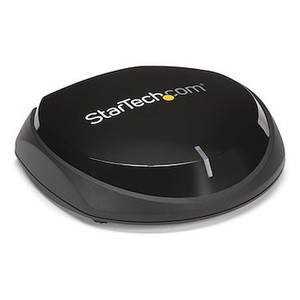
StarTech Bluetooth 5.0 Audio Receiver Adapter TO - BT52A
Usually Ships in 2-3 Weeks
Free shipping over $499
$39.99

Manufacturer-verified compatible cameras, recorders, mounts, accessories, and licenses for this product. Adjust quantities and add the entire bundle to your cart in one click.
Questions about this product? Free pre-sales support from a senior specialist — product questions, compatibility checks, BOM quotes, price confirmation — typically answered within one business day. Need camera placement or system design work? Engineering time is $175 per hour (qty 1 = 1 hour). Hardware buyers get up to one hour ($175) credited back on their order.
The StarTech USBBT2EDR4 is a nano-sized USB Bluetooth adapter that adds Bluetooth 4.0 Low Energy (LE) plus Enhanced Data Rate (EDR) capability to any desktop or laptop with an open USB 2.0 Type-A port. At 0.7 x 0.6 x 0.2 inches and 2.5 grams, it sits flush enough that most users will forget it is there — a practical consideration when deployed across shared workstations, point-of-sale terminals, or field laptops where cable clutter matters. The Broadcom BCM20702 chipset is a well-established Bluetooth controller with broad OS-level driver support, which reduces provisioning friction across Windows environments.
If you need to add wireless peripheral support — keyboards, mice, headsets, barcode scanners, or proximity-triggered workflows — to machines that shipped without Bluetooth hardware, the USBBT2EDR4 is a direct-fit solution. Its Class 2 radio rating and USB bus power draw make it suitable for standard office, light industrial, and retail environments.
The USBBT2EDR4 connects via USB 2.0 Type-A, backward and forward compatible with USB 3.0/3.1/3.2 ports. The Broadcom BCM20702 chipset is supported across Windows operating systems with inbox or downloadable drivers. Bluetooth 4.0 LE support enables pairing with modern BLE peripheral ecosystems including proximity sensors, BLE beacons, wireless HID devices, and audio peripherals. Bluetooth EDR support maintains backward compatibility with Bluetooth 2.0/2.1 devices already in your installed base.
For IT administrators deploying across a network infrastructure with managed endpoints, the BCM20702 chipset is broadly supported in enterprise imaging workflows. If you are sourcing peripheral adapters alongside other USB connectivity accessories, the USBBT2EDR4 can be batch-provisioned without per-unit driver installation on most current Windows builds.
Buyers evaluating wireless connectivity options for barcode scanning terminals or mobile computing peripherals should also review compatible Bluetooth barcode scanners and mobile computers that support BLE or Classic Bluetooth pairing. For guidance on wireless peripheral planning in warehouse or retail environments, the wireless connectivity planning guide covers BLE vs. Classic Bluetooth tradeoff decisions in more detail.
Q: What Bluetooth version does the USBBT2EDR4 support?
A: The USBBT2EDR4 supports Bluetooth 4.0, including both Low Energy (LE) and Enhanced Data Rate (EDR) profiles. This allows it to pair with modern BLE devices such as sensors and asset tags, as well as classic Bluetooth peripherals like keyboards, mice, and headsets.
Q: What is the wireless range of the USBBT2EDR4?
A: The USBBT2EDR4 is a Class 2 Bluetooth device with a maximum operating range of 10 meters (approximately 33 feet). Actual range will vary based on physical obstructions and RF environment.
Q: What chipset does the USBBT2EDR4 use?
A: The USBBT2EDR4 uses the Broadcom BCM20702 chipset, which has broad operating system driver support and is recognized natively on many current Windows platforms without requiring additional software installation.
Q: Does the USBBT2EDR4 require an external power supply?
A: No. The USBBT2EDR4 is fully USB bus-powered through its USB 2.0 Type-A connector. No separate power adapter is needed.
Q: What is the warranty on the USBBT2EDR4?
A: The USBBT2EDR4 carries a 2-year manufacturer warranty.
Q: Will the USBBT2EDR4 block adjacent USB ports?
A: At 0.7 x 0.6 x 0.2 inches, the USBBT2EDR4 has a nano form factor that minimizes port obstruction on most standard USB port spacings. However, exact clearance will depend on the specific chassis port layout of your host device.

The USBBT2EDR4 is one of those adapters that earns its place in a deployment kit precisely because it stays out of the way. At 2.5 grams and 0.7 inches long, it profiles as a nano adapter — and the Broadcom BCM20702 chipset underneath means you are working with a controller that OS vendors have been shipping inbox drivers for across multiple Windows generations. That matters when you are pushing this across fifty managed endpoints and cannot afford to babysit driver installations.
Technical Highlights:
Deployment Considerations:
For IT teams standardizing Bluetooth peripheral access across POS terminals, shared workstations, or barcode-scanner-equipped service desks — where devices ship without native Bluetooth and re-imaging with a new hardware profile is not practical — the USBBT2EDR4 is a reliable, low-friction add-on that does not require per-unit driver work on current Windows builds.

Manufacturer-verified compatible cameras, recorders, mounts, accessories, and licenses for this product. Adjust quantities and add the entire bundle to your cart in one click.

Compact Bluetooth 4.0 adapter that solves a specific integration problem: adding Bluetooth wireless capability to fixed workstations, office


Looking for more StarTech products? Shop the full StarTech catalog →
Support services and planning resources for commercial surveillance, access control, and infrastructure deployments.
Fixed scope • Fixed price