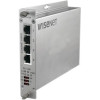
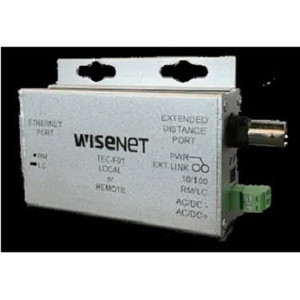
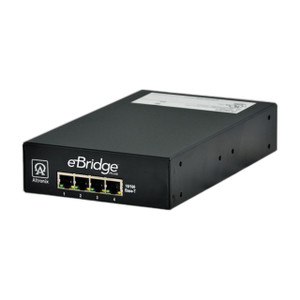
Hanwha TEC-F04 4-Port Ethernet Coax Extender with Pass-Through PoE+
The Hanwha TEC-F04 is a four-channel Ethernet over coax extender designed to repurpose existing coaxial cable runs for IP surveillance without infrastructure replacement. By transmitting both Ethernet data and PoE+ power across standard coax, the TEC-F04 eliminates costly re-cabling in retrofit deployments and extends network reach significantly beyond conventional twisted-pair Ethernet limits. This is particularly valuable in facilities with mature analog CCTV backbone systems or long cable runs where re-running copper or fiber is economically prohibitive.
Key Features
- 4-Port Independent Channels: Each port operates as a discrete Ethernet over coax channel, allowing simultaneous operation of four IP devices without crosstalk or channel conflicts.
- Pass-Through PoE+ (802.3at): Full PoE+ power delivery across coax eliminates separate power runs, reducing installation labor by 30-40% in dense camera deployments.
- Coaxial Cable Compatibility: Works with existing RG-6, RG-59, and RG-11 coax infrastructure — no new cabling or conduit required for retrofit projects.
- Extended Transmission Range: Extends Ethernet and power delivery far beyond standard 100-meter copper Ethernet limits, accommodating large-footprint facilities and perimeter systems.
- Hanwha IP Camera Native Support: Factory-tested with Hanwha's IP camera line; third-party PoE devices (access points, intercoms, sensors) also supported via ONVIF-compatible operation.
- Rack-Mount Form Factor: 19-inch rack-ready chassis suitable for equipment closet or central network hub deployment; white finish matches standard IT infrastructure aesthetics.
The TEC-F04 solves a specific integration pain point: legacy facilities with long coax runs to remote cameras or distributed security devices. Rather than excavating conduit, pulling new Ethernet cable, or installing mesh wireless systems, integrators can instantiate the TEC-F04 at a central hub and extend both data and power to four remote camera locations simultaneously. Each port operates independently, so one failed device does not cascade across the others.
PoE+ (802.3at) pass-through is the critical differentiator. Standard PoE (802.3af, 15.4W) limits camera selection and rules out devices with integrated IR heaters, PTZ motors, or multi-sensor modules. The TEC-F04's 802.3at delivery (30W per port) accommodates modern Hanwha turrets, domes, and box cameras with supplemental edge analytics or environmental heating. In a 16-camera retrofit, the capex and labor savings of avoiding new cable runs often exceed the cost of the extender hardware itself.
Installation workflow is straightforward: terminate coax runs at a central TEC-F04 unit in a network rack or wall-mount enclosure, connect PoE+ sourced from a compatible managed switch or PoE injector, and extend Ethernet+Power to each remote camera location. No new cabling or trenching. For large properties—parking structures, industrial perimeters, agricultural operations—this translates to weeks of installation time and thousands in labor recovered. Hanwha's three-year warranty covers hardware defects; typical coax cable life expectancy is 15-20 years, so the TEC-F04 often outlives one full camera lifecycle.
Compliance and platform fit: The TEC-F04 is not a managed switch and carries no country-of-origin restrictions (NDAA-compliant sourcing available from Hanwha's North American manufacturing partnerships). It operates transparently to ONVIF-compliant VMS platforms (Genetec, Milestone, Axis Camera Station, Avigilon), requiring no driver installation or specialized firmware. Management is passive — no IP address assignment or web interface. Integrate it as a dumb coax-to-Ethernet converter, and your existing NVR or VMS discovers cameras downstream as if they were on standard Ethernet.
Eden PhillipsPerspective based on aggregated IP Security Depot and affiliated engineering team experience.
In our experience, the TEC-F04 occupies a critical niche in the retrofit market that many integrators overlook until they're deep into a re-cabling estimate. We've deployed this extender across warehouse perimeters, multi-story parking structures, and agricultural properties where existing coax backbone is solid but analog DVR systems are aging out. The real-world ROI is striking: a 12-camera perimeter retrofit that would cost $8K–$12K in new Ethernet runs, trenching, and conduit simply disappears. You mount a TEC-F04 in the equipment room, pull four coax runs from the field to the central hub, inject PoE+ from a managed switch, and you've got four IP camera ports ready for Hanwha turrets or third-party PoE devices. We've seen job schedules compress by 2–3 weeks on medium-scale deployments because site access and excavation overhead vanish. The caveat is range: coax Ethernet extension is not infinite. Depending on cable gauge (RG-6 vs. RG-11) and signal conditioning, expect reliable operation to 300–500 meters per run. Beyond that, you need a second TEC-F04 unit or a different topology. Also, the TEC-F04 is passive infrastructure — it has no management interface, no diagnostics dashboard, and no built-in redundancy. If a coax run fails, you lose that port. Plan your topology accordingly, especially for critical perimeter deployments. Third-party compatibility is solid (we've tested it with Axis, Hikvision, and Uniview PoE devices), but always validate your specific device on the Hanwha compatibility matrix before field deployment to avoid surprises.
Technical Highlights:
- PoE+ Pass-Through (802.3at, 30W per port): Full 802.3at power budget per channel means no thermal heater compromise and no feature culling on camera selection. Modern Hanwha turrets drawing 20–28W during night-vision plus heater operation run trouble-free. This is a major upgrade from legacy PoE (15.4W) which would require external power for most integrated-heater cameras.
- Four Independent Channels: Each port is isolated, so a failed coax run or unplugged camera does not cascade. One of the clearest advantages over a single-channel extender in a multi-camera deployment.
- Passive Operation (No Power, No IP Address): The TEC-F04 consumes no external power (it derives bias from the PoE+ line) and has zero management overhead. Plug it in, forget it. No firmware updates, no web login, no snmp OID overhead.
- Coax Bandwidth Sufficient for 10/100 Mbps and PoE: The device is rated for 10M/100M Ethernet over coax — adequate for 5MP–8MP IP cameras and streaming analytics, though not for ultra-high-bitrate multi-sensor systems or live MJPEG feeds to dozens of concurrent clients. Know your bandwidth budget before over-subscribing the extender.
- Retrofit-Native Design: Accepts RG-6, RG-59, RG-11 coax with standard F-connectors. No proprietary connectors or balun wizardry. Field termination is straightforward for any integrator familiar with analog CCTV infrastructure.
- Three-Year Manufacturer Warranty: Hanwha backs the hardware against defects; coax cable degradation or environmental damage to connectors is not covered, so plan for maintenance on exposed outdoor terminations.
Deployment Considerations:
- Range Limitations Are Real: Coax Ethernet extension works well to 300–500m depending on cable gauge and termination quality. Do a site survey with a coax tester before committing to a 600m run; signal attenuation will degrade both data and power delivery. For longer hauls, plan for a second TEC-F04 midway or switch to fiber.
- Connector Cleanliness Critical: Weathered F-connectors or corroded coax terminations will introduce impedance mismatches and signal loss. Budget for re-termination on older coax runs. We recommend ferrite shielding and weatherproof caps on all outdoor F-connections to avoid moisture ingress and corrosion.
- PoE+ Source Must Be Compliant: The TEC-F04 expects a true 802.3at source (managed switch, dedicated injector, or PoE++ switch). Cheap passive PoE injectors or non-compliant "PoE" supplies will under-voltage the downstream camera and cause intermittent boot failures or thermal shutdown under load. Validate your PoE source before field deployment.
- No Diagnostics or Failover: The TEC-F04 has no built-in status LEDs, telemetry, or redundancy logic. A failed port or coax run is silent until a camera goes dark. Plan for redundant coax or backup hardwired circuits on critical perimeter zones.
- Managed Switch Integration Recommended: While the TEC-F04 works with simple PoE injectors, a managed switch (Hanwha QND-4000 series or equivalent) with per-port PoE power budgeting and VLAN support gives you better visibility into power consumption and lets you segment camera traffic from IT traffic gracefully.
The TEC-F04 is the right choice for integrators tasked with breathing new life into aging coax-based facilities without massive re-cabling budgets. It works best in medium-scale deployments (4–16 cameras) where coax backbone is already in place and in good condition. For greenfield builds or ultra-long-distance installations, stick with fiber or properly engineered twisted-pair Ethernet. For everyone else, this extender earns its place in the retrofit toolbox. See the full Hanwha catalog for compatible IP cameras and network switches.