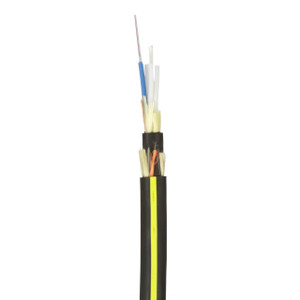
Panduit FSJD912 IndustrialNet™ 12-Fiber OS2 Singlemode DDJ Cable
The Panduit FSJD912 is a dielectric double-jacketed (DDJ) fiber optic cable engineered for permanent backbone installations in commercial security, enterprise networking, and industrial surveillance systems. With 12 strands of OS2 9µm singlemode fiber and dual Kevlar-reinforced jacketing, this cable delivers long-haul transmission capability (up to 40 km) with physical protection comparable to armored cable—without the grounding and lightning-coupling risks of metallic construction. Rated for both Riser (OFNR) and LSZH environments, it supports vertical shaft installations, plenum-adjacent spaces, and outdoor runs where crush resistance and fire-code compliance are non-negotiable. The all-dielectric design eliminates the need for additional conduit or protective pathway in most applications, reducing installed cost and simplifying pathway design in multi-building campuses, datacenter interconnects, and industrial facilities.
Key Features
- OS2 Singlemode: 9µm core diameter, 0.4 dB/km attenuation @ 1310 nm, supports 10G/40G/100G over distances up to 40 km
- 12-Fiber Count: Six duplex pairs for multi-camera trunk lines, redundant uplinks, or future-proofed infrastructure
- All-Dielectric Construction: Zero metallic components—eliminates grounding requirements, lightning coupling, and electrical interference concerns
- Dual Kevlar-Reinforced Jacketing: Inner and outer jackets with aramid yarn reinforcement provide 600 N tensile strength and crush resistance up to 1000 N/10 cm
- Riser & LSZH Rated: OFNR (NEC Article 770) for vertical shafts; Low Smoke Zero Halogen for transit, marine, and European installations
- Indoor/Outdoor Rated: UV-resistant black jacket, -40°C to +70°C operating range, water-blocked for direct burial or aerial runs
- Conduit-Free Installation: Double-jacket construction and crush resistance eliminate conduit requirements in cable trays, J-hooks, and bridle-ring pathways
- IndustrialNet™ Series: Panduit's industrial-grade fiber platform—tested for vibration, impact, and temperature cycling per TIA-568.3-D
The FSJD912's dielectric double-jacket construction solves a recurring problem in campus and industrial installations: how to run fiber between buildings, up vertical shafts, or across rooftops without the cost and labor of conduit or the grounding complexity of armored cable. The inner jacket provides primary protection for the 12 loose-tube buffered fibers, while the outer jacket—reinforced with Kevlar aramid yarn—adds crush resistance and tensile strength. This dual-layer design withstands cable-tray loading (other cables stacked on top), J-hook suspension over long spans, and pulling tension during installation. Unlike armored cable, there's no metallic interlocking sheath to ground or bond, and no risk of lightning-induced current traveling the armor into patch panels or enclosures. For outdoor camera runs in lightning-prone regions (Florida, Gulf Coast, mountain installations), this is the spec that keeps strikes from propagating into head-end equipment.
The OS2 singlemode specification is critical for surveillance and enterprise backbones. At 9µm core diameter and 0.4 dB/km attenuation, OS2 fiber supports 10GBASE-LR (10 km), 40GBASE-LR4 (10 km), and 100GBASE-LR4 (10 km) without amplification—plus legacy 1000BASE-LX runs up to 40 km. For a multi-building campus with cameras distributed across parking structures, perimeter fences, and outbuildings, this cable provides a single-pull trunk from the head-end NVR to remote PoE switches, with enough fiber count (12 strands = six duplex pairs) to support redundant uplinks, future camera expansion, and separate management networks. The Riser rating (OFNR) is the required spec for vertical cable runs in shafts, risers, and floor-to-floor penetrations per NEC Article 770.154(A)—making this the correct choice for mid-rise office buildings, hospitals, and hotels where cameras on upper floors feed back to a ground-floor server room.
LSZH compliance extends the application envelope to transit authorities, marine vessels, and European projects where halogenated materials (PVC, FEP) are prohibited. During combustion, LSZH jackets produce minimal smoke opacity and zero hydrochloric acid—critical in enclosed egress paths (subway tunnels, stairwells, shipboard compartments) where smoke toxicity is the primary life-safety hazard. The water-blocked construction and UV-resistant black jacket support outdoor aerial runs (building-to-building span on messenger wire), direct-burial installations (trenched pathways without conduit), and rooftop/plenum-adjacent runs where temperature cycling and UV exposure degrade standard indoor-rated cable. For datacenter hot-aisle environments or industrial facilities with wide temperature swings, the -40°C to +70°C rating ensures the fiber doesn't crack or lose attenuation performance across seasonal extremes.
The all-dielectric design is the key differentiator for integrators working on campuses with existing grounding problems or lightning-prone geographies. Metallic armored cable must be bonded to facility ground at every termination point and at intermediate pathway transitions—adding labor, material (grounding kits, ground bars), and inspection overhead. If the ground potential differs between buildings (common in multi-building campuses with separate services), ground loops can induce current flow on the armor, creating a shock hazard and EMI source. Dielectric cable eliminates this entire failure mode: there's no conductive path, so no bonding required, no ground-loop risk, and no lightning-induced current. For rooftop camera runs, cell-tower backhaul, or any outdoor installation where the cable is exposed to direct or nearby strikes, this is the only fiber construction that categorically eliminates strike propagation into indoor equipment. The Kevlar reinforcement provides the tensile strength needed for aerial messenger-wire suspension (up to 600 N), pulling through J-hooks or cable tray, and vertical riser installations where the cable weight is self-supported over 30-meter runs—matching the mechanical performance of interlocking-armor cable without the electrical liability.
This cable ships as bulk spool (typically 1000-foot or custom lengths) for field termination with Panduit or third-party connectors (LC, SC, ST). The 12-fiber count is the sweet spot for small-to-mid-size installations: enough strands for six duplex links (primary + redundant uplink to core switch, plus four camera trunk pairs) without the overkill and slack-management burden of 24- or 48-fiber cable. For a 20-camera parking structure with a remote PoE switch, you'd run one FSJD912 pull from the head-end, terminate six fibers (three duplex pairs: two for switch uplink redundancy, one for future), and leave six fibers dark for future expansion or IoT sensor networks. The black jacket is the commercial standard for outdoor and industrial environments—higher UV resistance than gray or yellow, and it disappears visually on rooftops, in cable trays, and against dark pathway backgrounds.
Deployment contexts where the FSJD912 is the correct spec: campus backbone linking building-mounted PTZ cameras back to a central NVR; vertical riser in a 10-story office building feeding floor switches from basement head-end; outdoor aerial run between a parking structure and main facility (suspended on messenger wire); datacenter row-to-row interconnect where conduit isn't available and crush resistance matters (cable trays under raised floor with frequent moves/adds); industrial facility linking cameras in production zones, loading docks, and perimeter fence lines through cable tray exposed to forklift impact and temperature cycling. In every case, the value proposition is the same: singlemode reach, physical protection, and fire-code compliance in a single-pull cable that doesn't require conduit, armor grounding, or separate pathway infrastructure. This is the cable spec for integrators who need armored-cable durability with dielectric-cable simplicity, on projects where the fiber run is permanent infrastructure and the installation has to pass inspection the first time.
The Riser/LSZH dual rating, all-dielectric construction, and Kevlar-reinforced double jacket position the FSJD912 as the standard spec for permanent singlemode infrastructure in commercial security and enterprise IT installations. It meets NEC Article 770 requirements for vertical riser pathways, exceeds LSZH smoke and toxicity limits for transit and marine applications, and eliminates the grounding and lightning-coupling risks inherent in metallic armored cable—delivering the physical protection of armor with the electrical isolation of standard dielectric fiber. For integrators running fiber across rooftops, up shafts, or between buildings on multi-site campuses, this is the one-cable solution that clears fire code, handles the pulling tension and crush loading, and doesn't create a new grounding liability. Backed by Panduit's IndustrialNet™ platform and manufacturer warranty, with field-proven performance in thousands of installations where conduit isn't an option and failure isn't acceptable.