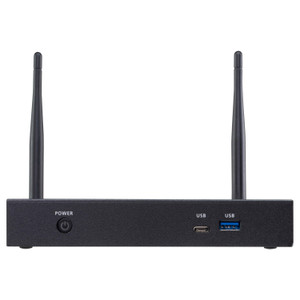
ATEN VP1920 9x2 4K Presentation Matrix Switch
Overview
The ATEN VP1920 is a 9-input, 2-output 4K presentation matrix switch built for boardrooms, lecture halls, and AV integration projects where source diversity is the real challenge. With six HDMI Type A inputs, one DisplayPort input, one VGA (HDB-15) input, one component input, and one composite input, the VP1920 accommodates virtually every signal type you'll encounter — from the latest 4K laptop to the legacy DVD player still running in training rooms. Both outputs carry the full signal simultaneously, making it practical for dual-display setups like a confidence monitor plus a projector screen. This is a rack-mount unit that belongs in a system rack alongside your AV control gear, not tucked behind a display.
The VP1920 supports ATEN's AV switching line, and is a natural fit for environments also deploying presentation switchers and HDMI matrix switches. If you're planning a multi-room AV system, pairing this with a networked AV distribution solution extends reach well beyond the 15m maximum cable distance. For a broader look at source selection and signal routing, the AV switching and distribution guide covers topology decisions worth reviewing before specifying this unit.
Key Features
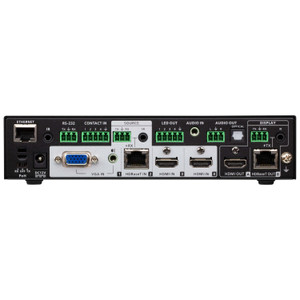
- Nine heterogeneous inputs on a single chassis: Six HDMI, one DisplayPort, one HDB-15 (VGA), one component (3x RCA), and one composite (1x RCA) — this eliminates the adapter dongles and signal converters that plague mixed-source rooms. Every source plugs in directly.
- 4K / Deep Color / 3D compliance: HDMI and DisplayPort inputs handle 4K, 3D, and Deep Color signals natively. For training rooms and board presentations, this means you're not downsampling a presenter's 4K laptop output before it hits the display — what they show on their screen is what the room sees.
- HDCP 1.4 compatibility: Both HDMI and DisplayPort paths are HDCP 1.4 compliant, so DRM-protected content from Blu-ray players, streaming sticks, and corporate media appliances passes through without dropping the signal or triggering handshake errors.
- Consumer Electronics Control (CEC) support: CEC lets connected HDMI displays respond to switching events — powering on automatically when a source becomes active, for example. This reduces button presses for room operators and simplifies AV automation without requiring a full control system.
- Three-format audio output: Optical (Toslink), coaxial (RCA), and stereo analog (2x RCA) outputs are available simultaneously, so you can feed a DSP, a powered speaker, and a recording system from the same unit without an external audio splitter.
- USB keyboard/mouse routing: Two USB keyboard/mouse ports and two USB device ports (all amber, indicating USB 2.0) allow peripheral sharing between connected computers — relevant for dual-PC presentation setups or lecturer stations where two machines share one set of input devices.
- EDID management with three modes: Default, Display A, and Remix EDID modes give integrators control over how connected sources read display capabilities. Remix mode is particularly useful when sources have mismatched native resolutions — it synthesizes a compatible EDID so every source outputs at the resolution your display can handle, not the resolution the source assumes.
- IR control input: A 3.5mm mini stereo jack IR input allows integration with third-party IR control systems. Rooms already running an AMX, Crestron, or similar control system can issue switching commands over IR without modifying existing programming.
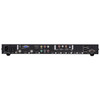
- Front-panel pushbutton control: Eight dedicated pushbuttons (Mode, Menu, Up/Unlock, Esc, Audio, Preview, Down, Enter) provide direct local control without a remote or control system — useful during installation, commissioning, and troubleshooting when the control system isn't yet online.
- Universal AC input: Rated 100–240 VAC at 50–60 Hz, 1.0A — the VP1920 installs in North American, European, and Asian facilities without a step-down transformer or power conditioning concern.
Integration and Compatibility
The VP1920's HDCP 1.4 compliance covers the majority of commercial content protection scenarios, but note that HDCP 2.2 (required for some 4K UHD protected content, including certain streaming platforms and 4K Blu-ray) is not referenced in the evidence. Verify HDCP version requirements against your specific content sources before specifying this unit for entertainment or digital signage contexts where 4K DRM content is the primary use case.
Maximum signal distance is 15m (approximately 49 feet) per the manufacturer specification — standard for passive HDMI at 4K. Runs longer than 15m will require active HDMI extenders or HDBaseT at the output stage; plan rack placement accordingly. The unit supports firmware field updates (current release v1.2.116, dated 2024-12-16), so feature additions and compatibility fixes are deployable post-installation without hardware swap.
Operating humidity range is 0–80% RH, non-condensing — standard for equipment in climate-controlled server rooms and AV racks. The VP1920 is not rated for uncontrolled outdoor or industrial enclosure environments.
Frequently Asked Questions
Q: How many simultaneous outputs does the VP1920 support?
A: The VP1920 supports two simultaneous outputs. Both carry the active source signal at the same time, making it practical for dual-display rooms — for example, a main projection screen plus a presenter confidence monitor.
Q: Does the VP1920 support 4K resolution?
A: Yes. The VP1920 is compliant with HDMI 4K, Deep Color, and 3D standards across its HDMI and DisplayPort inputs. It is HDCP 1.4 compatible on both HDMI and DisplayPort paths.
Q: What audio outputs are available on the VP1920?
A: Three audio output formats are provided simultaneously: one Toslink optical, one coaxial RCA, and two stereo analog RCA outputs (left/right). This allows parallel feeds to a DSP, powered speakers, and a recording device without an external splitter.
Q: Can the VP1920 be controlled by a third-party control system?
A: Yes. The VP1920 includes a 3.5mm mini stereo jack IR input that accepts commands from IR-based control systems. Front-panel pushbuttons also provide direct local control for commissioning and manual operation.
Q: What is the maximum cable distance supported by the VP1920?
A: The manufacturer specifies a maximum signal distance of up to 15m (approximately 49 feet). Longer runs will require active HDMI extenders or an HDBaseT distribution system at the output.
Q: Does the VP1920 support USB peripheral sharing?
A: Yes. The VP1920 includes two USB keyboard/mouse ports and two USB device ports, enabling peripheral sharing between connected computers in dual-source presenter setups.
The VP1920 is the unit I spec when a room's input list reads like a procurement history lesson — legacy composite from a VHS-era document camera, component from a years-old Blu-ray shelf unit, VGA from the one holdout laptop, and a mix of HDMI and DisplayPort from everything purchased in the last five years. Rather than deploying four separate signal converters and a downstream matrix, you wire everything directly into the VP1920 and handle source selection from the front panel or an IR control system. That nine-input, two-output topology in a single rack-mount chassis is the practical value here.
Technical Highlights:
- EDID Remix Mode: In rooms with mixed-resolution sources, Remix mode synthesizes a common EDID so a 1080p laptop and a 4K workstation both output correctly to the same display — eliminates the blank-screen handshake failures that consume install time.
- Three simultaneous audio outputs: Toslink, coaxial RCA, and stereo analog all active at once. In rooms with a DSP processor, a ceiling speaker amp, and a recording interface, you're feeding all three from one box rather than splitting downstream.
- 100–240 VAC universal input at 1.0A max draw: Straightforward rack power planning — under 240W worst-case, compatible with any standard IEC C13/C14 PDU you're already running in the rack.
Deployment Considerations:
- The 15m maximum cable distance is a hard ceiling for passive HDMI at 4K — plan rack placement relative to display locations before the conduit goes in. If displays are further than 15m, budget for active fiber HDMI or HDBaseT extenders at the output stage.
- HDCP compliance is confirmed at version 1.4 only. If your customer's use case includes 4K UHD DRM-protected content (certain 4K streaming sticks, 4K Blu-ray via HDMI 2.0), verify that HDCP 1.4 satisfies the content's protection requirement — it may not in all cases.
The VP1920 is the right call for a university lecture hall or corporate training room with a fixed multi-source AV rack, two display zones, and a mix of legacy and current-generation source equipment — exactly the environment where a single-format matrix would leave you running converters and adapters for the next decade.