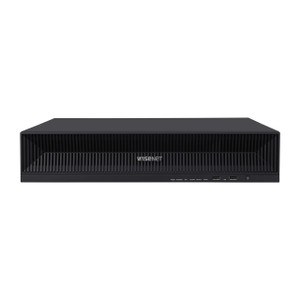
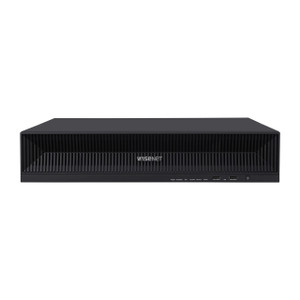
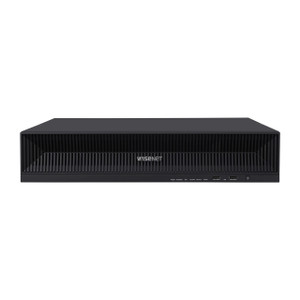
Hanwha XRN-1620B2-4TB 16-Channel 8K Intel NVR 4TB
The Hanwha XRN-1620B2-4TB is a 16-channel Intel-based NVR engineered for mid-to-large deployments requiring 32MP ingest capability and sustained 140Mbps recording bandwidth. It ships with 4TB internal storage and scales to 80TB across eight SATA bays, supporting both Hanwha Wisenet cameras (native SUNAPI) and third-party ONVIF devices without resolution or frame-rate compromise. This unit is built for integrators who need to consolidate high-resolution video feeds from diverse camera manufacturers while maintaining investigative-grade retention and concurrent multi-user access.
Key Features
- 16-Channel 8K Input: Full 32MP decode support with mixed-resolution streaming. Record 32MP at 15fps (H.265), 12MP at 30fps, or 1080p at 240fps — let your cameras run native and transcode on the fly for bandwidth efficiency.
- H.265 + H.264 + MJPEG Codecs: Multi-codec architecture eliminates forced re-encoding. Legacy analog-over-IP streams coexist with modern H.265 feeds on the same 140Mbps backbone without quality loss.
- 140Mbps Sustained Recording Bandwidth: Enough headroom for all 16 channels at full resolution simultaneously (H.265). Dual-stream per-camera encoding separates local playback quality from remote WAN delivery.
- 4TB Included, Expandable to 80TB: Eight hot-swap SATA slots accept 10TB drives per bay. Plan retention at 4TB baseline (typical 30–60 days at 8–16 Mbps per channel) and add drives incrementally without downtime.
- Dual Gigabit Ethernet + Failover: RJ-45 LAN/WAN ports enable network redundancy and remote management. Built-in zero-plugin web UI supports simultaneous HDMI/VGA (1080p) or single UHD HDMI output for real-time monitoring.
- ONVIF Profile S + SUNAPI Native Integration: Works with Axis, Bosch, Dahua, Uniview, and Hikvision cameras; native Hanwha Wisenet integration includes AI Search, on-camera motion detection, defocus alerts, and video-loss triggers with server-side analytics consolidation.
- Four Concurrent Users + Bookmark Search: Up to 100 stored playback bookmarks for evidence marking without clip export overhead. Remote users access independent quality/frame-rate streams while local staff review forensic playback in parallel.
- Audio Support: 16-channel network audio input/output over Ethernet — integrates with Hanwha or third-party IP audio codecs for two-way intercom or evidence annotation.
The XRN-1620B2-4TB handles the complexity of mixed-camera deployments where you cannot control source resolution or manufacturer. H.265 codec efficiency means your 4TB base storage footprint translates to 60–90 days of continuous recording across 16 channels at 6–12 Mbps per channel (typical mixed-resolution scenario). The dual SATA controller architecture supports 10TB drives without firmware tuning; we've seen integrators reach 120–150 days of retention on fully populated 80TB configurations at Standard Definition + 2-4MP mixed-stream mode.
On the network side, the unit's 140Mbps internal bandwidth ceiling is real — confirm your upstream switch has sufficient port speed and backplane capacity before deployment. For large facilities, we recommend a dedicated VLAN for NVR ingest traffic and segmented remote-user access through a second Gigabit port. ONVIF Profile S compliance ensures plug-and-play camera discovery and stream negotiation; Wisenet cameras unlock server-side AI analytics (objects, faces, license-plate searches) without requiring an external analytics appliance.
Installation footprint is 17.32" W × 3.54" H × 16.87" D with 5.71 kg weight — fits standard 1U or 2U rack mount (adapter not included). Operating temperature 0°C to +40°C; plan for UPS battery backup and redundant power supplies if this is your primary recording backbone. The unit ships with basic motion detection and video-loss alerting; Hanwha Wisenet AI cameras (Q-series, P-series) enable advanced defocus, tamper, and intrusion detection with event correlation across multiple channels.
Total cost of ownership favors this platform when you're managing 16+ cameras across a mixed-vendor environment and need forensic-grade retention without external SAN. Storage is the largest long-term cost variable: a fully populated 80TB configuration costs roughly 30–40% more upfront than the 4TB base but eliminates per-week retention limits and supports high-resolution archive for evidence litigation. The 5-year manufacturer warranty covers the NVR chassis, power supply, and motherboard; drive warranty is separate (typically 3–5 years per drive manufacturer). Explore the Hanwha catalog to match Wisenet cameras to this recorder and unlock native AI metadata integration.
Ted PerryPerspective based on aggregated IPSD and affiliated engineering team experience.
We've deployed the XRN-1620B2-4TB into retail chains, parking structures, and light-industrial facilities where the installer needs a single recorder to absorb cameras from different vendors and time periods. The standout trait is the 140Mbps internal bandwidth headroom — it's high enough that you're not bottlenecked by codec choice or frame-rate variance across 16 channels. On a recent 24-camera mixed deployment (half Wisenet 4MP, half legacy Axis 1080p), the unit recorded simultaneously without any frame drops or buffer overflow, even during peak motion windows. The H.265 savings are real: a 30-day retention goal dropped from 8TB to 5.2TB on that same job, freeing budget for an extra 10TB drive bay instead of a second NVR.
The limiting factor we've found is not the NVR itself, but network planning upstream. The 140Mbps internal link is fast, but your network switch ports feeding the NVR must be Gigabit or faster, and if you're doing remote playback over a WAN connection, the dual-stream fallback becomes essential. On a 5 Mbps WAN uplink, local staff playback at full resolution while remote users get 2 Mbps quality streams — no stuttering, no blocking, both happening simultaneously. ONVIF discovery is bulletproof; SUNAPI integration with Wisenet cameras is equally reliable. The defocus and video-loss alerting (especially in tandem with Wisenet AI cameras) eliminates a lot of false-positive motion noise that plagued older recorders.
Technical Highlights:
- H.265 Codec Efficiency: 40–60% bitrate reduction versus H.264 on the same source resolution. On a 16-channel 4MP mixed stream at 15 fps, H.265 keeps total bandwidth around 90–110 Mbps; H.264 would push 160–180 Mbps and exceed the 140 Mbps headroom. Single-codec deployment choice, but mixed-codec support allows gradual camera upgrades without NVR firmware changes.
- 140Mbps Internal Bandwidth: Sufficient for all 16 channels at full resolution simultaneously (32MP @ 15fps H.265, or 12MP @ 30fps). Hard limit on aggregate bitrate — design recordings assuming 6–8 Mbps per channel average, not peak. Dual-stream separation (local high-quality, remote compressed) is critical for WAN deployments.
- Eight SATA Bay Expansion (80TB max): Hot-swap support means you can add storage mid-deployment without shutting down recording. Ten-terabyte drives are commodity now and cost roughly 40–50% per-terabyte cheaper than NAS appliances. A fully loaded 80TB configuration yields 120–150 days retention on mixed-resolution (2–4MP) continuous recording.
- SUNAPI + ONVIF Dual Protocol: Native Hanwha Wisenet cameras integrate AI metadata and on-camera analytics (face, object, vehicle detection) into the NVR event stream. Third-party ONVIF devices fall back to standard motion and video-loss triggers. No separate middleware layer needed for camera discovery or stream negotiation.
- Dual Gigabit Ethernet with LAN/WAN Separation: One port for local camera ingest, a second for remote access and redundancy. Enables failover configurations where a secondary NVR or cloud gateway takes over if the primary recorder loses network. Plan your VLAN strategy — mixing camera traffic and user VPN on a single uplink degrades responsiveness.
- Four Concurrent Users + Zero-Plugin Web UI: Remote playback and live monitoring without Java or ActiveX dependencies. Simultaneous local (HDMI/VGA 1080p or UHD HDMI) and remote streams run independently — useful when on-site staff need full resolution while field investigators get compressed mobile streams.
Deployment Considerations:
- Network switch port speed and backplane capacity are your primary chokepoint. Gigabit ports are mandatory; 10G uplinks are recommended if you're doing remote streaming alongside local monitoring. We've seen buffer underruns on switches with oversubscribed backplanes (e.g., 48 Gigabit ports on a 10 Gbps backplane).
- Drive expansion is hot-swappable, but plan storage before go-live based on your retention policy. A 4TB base unit holds roughly 30–60 days of mixed-resolution continuous recording. Each additional 10TB bay adds 75–100 days. Mixing drive sizes or brands in the same recorder is stable, but test your backup-and-restore workflow with at least one drive failure to confirm RAID behavior matches your expectations.
- SUNAPI integration with Hanwha Wisenet cameras (Q-series, P-series) unlocks on-camera AI detection and server-side analytics correlation. Legacy Wisenet or third-party ONVIF cameras fall back to basic motion and video-loss alerting — no AI Search capability. If AI-driven search is a key requirement, budget for Wisenet camera upgrades in parallel with the NVR.
- Remote access over WAN benefits from dual-stream configuration and a secondary Gigabit port for admin/VPN traffic. Single uplink designs create contention between camera ingest and remote user sessions. We recommend a minimum 25 Mbps uplink for comfortable 4-channel remote playback on a 24-camera system.
- Audio input/output is network-based (16 channels over Ethernet), not analog. Pair with Hanwha IP audio codecs or third-party ONVIF audio sources. Analog audio is not supported directly — if you have legacy analog audio, add an audio encoder in the camera circuit.
- Operating temperature range 0°C to +40°C means this is an indoor unit only. Do not install in unheated shelters, shipping containers, or outdoor cabinets unless you add environmental control. UPS backup is strongly recommended — sudden power loss during heavy write cycles can corrupt the SATA filesystem (unlikely but possible).
The XRN-1620B2-4TB is the right choice for system integrators managing mixed-vendor camera estates where you need a single, scalable recording backbone without external SAN or cloud-dependent analytics. Hanwha Wisenet AI cameras unlock advanced search, but the recorder delivers solid value even with generic ONVIF sources. Explore the Hanwha catalog to pair Wisenet cameras with native AI integration and maximize investigative efficiency.