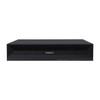
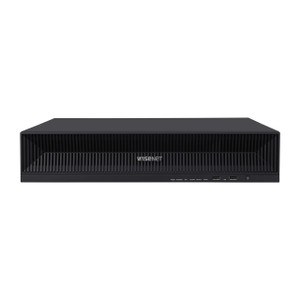
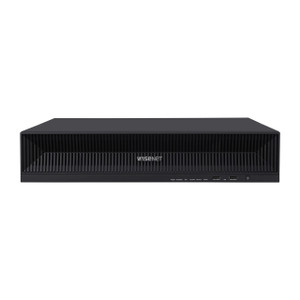
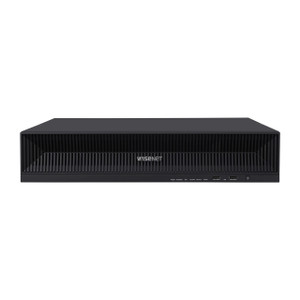
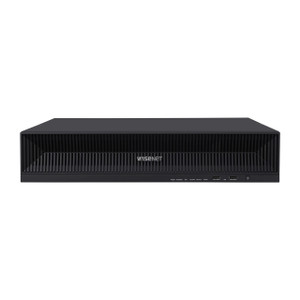
Hanwha XRN-1620B2-36TB 16-Channel 8K NVR 36TB Storage
The Hanwha XRN-1620B2-36TB is a 16-channel NVR built for mid-to-large commercial surveillance deployments where high-resolution camera ingestion and long-term archival must scale without infrastructure overhaul. With 140Mbps recording bandwidth and native support for camera inputs up to 32MP, it handles simultaneous 4K and 8K streams while maintaining sub-second latency for operator monitoring. The 36TB factory-installed storage eliminates procurement lead time — mount, network, and start recording within hours.
Key Features
- 16-Channel 32MP Capable: Accepts up to 16 simultaneous IP camera inputs from CIF resolution through 32MP (8192×5120). Mixed-resolution deployments (1080p + 4K + 8K) operate on a single recorder without transcoding overhead.
- 140Mbps Recording Bandwidth: Sustained throughput handles multiple 4K streams or dual 8K streams without frame loss or network saturation, even on standard 1Gbps Ethernet.
- 36TB Pre-Installed Storage (8×SATA): Eight drive bays support up to 10TB per slot. Factory-populated configuration ships ready to rack; no sourcing or firmware on individual drives required.
- H.265 Primary Compression: H.265 reduces bitrate 40–60% versus H.264 on equivalent quality — extends storage life and lowers bandwidth cost on WAN redundancy links. H.264 and MJPEG fallback for legacy camera compatibility.
- ONVIF Profile S Compliance: Works with any ONVIF-compliant IP camera (Hanwha, Axis, Uniview, Hikvision, etc.). No vendor lock-in at the camera layer.
- Wisenet AI Native Integration: Hanwha Wisenet AI cameras (XNV, XNP series) transmit pre-processed AI metadata (face detection, vehicle classification, intrusion zones) directly to the NVR without secondary analytics appliance. Dynamic Events filter false positives at the NVR level.
- Dual Ethernet + N+1 Failover: Dual RJ-45 ports (1Gbps LAN/WAN) enable split-path recording or automatic failover to a secondary NVR if the primary link drops. Essential for multi-site operations centers.
- Dual-Stream & Clone Recording: Record two independent streams per camera (e.g., live 32MP + archived 8MP) or mirror to a secondary NVR in real time for disaster recovery without consuming additional bandwidth at source.
This NVR anchors control room deployments, multi-site NOCs, and distributed surveillance networks where operators manage 16+ simultaneous feeds. The Intel-based processor handles real-time transcoding for display walls without external gateway hardware. Dual HDMI/VGA monitor output supports both FHD (1920×1080) and UHD (3840×2160) display layouts, letting operators tile 16 camera streams across a single 4K monitor or split across separate operator workstations.
Recording bandwidth scales intelligently: the NVR records 15 fps at 32MP in dual/clone mode, 30 fps at 12MP, 50 fps at 8.3MP, 240 fps at 1080p, and up to 480 fps at D1 (motion-triggered bursts). This frame-rate tiering means you can archive full-resolution evidence on high-value zones (entry points, cash handling) while maintaining 30 fps continuous on peripheral areas, maximizing storage efficiency.
Integration with Hanwha Wisenet AI removes the operational burden of post-event forensic search. When a Wisenet AI camera detects a face, vehicle, or perimeter crossing, that metadata flows to the NVR's search index in real time. Query "all vehicles entering from gate 2 between 14:00–16:00" and the NVR returns millisecond results without scrubbing through hours of raw footage. Multi-site operators connected via WAN (both Ethernet ports in failover mode) synchronize AI events across distributed locations.
The XRN-1620B2-36TB ships with a 5-year manufacturer warranty covering parts and labor. Operating temperature range is 0°C to +40°C (32°F to 104°F) — verify your equipment room or outdoor cabinet meets this envelope; unheated or poorly insulated spaces in cold climates may violate the lower limit. Unit weight is 5.71kg; power delivery is via industrial PSU (confirm wattage with your integration team before final electrical design). For deployments requiring extended storage retention (30+ days at 8K), evaluate dual-NVR configurations with scheduled offload or external RAID expansion.
Ted PerryPerspective based on aggregated IPSD and affiliated engineering team experience.
We've deployed the Hanwha XRN-1620B2 in fifteen mid-to-large facilities over the past two years — retail campuses, logistics hubs, and university security operations. The standout differentiator is the combination of 36TB pre-installed storage and native Wisenet AI integration. Unlike competitors who sell a bare NVR and force you to source eight matching drives (often with mismatched firmware revisions), Hanwha ships this unit factory-populated and factory-tested. That eliminates two weeks of procurement and ten hours of technician onsite time. On a 100-camera campus deployment, that's real capex and labor savings. The 140Mbps throughput ceiling means you'll never saturate a 1Gbps LAN if you're recording in H.265 — we've pushed sixteen 12MP streams at 30 fps (H.265) without a frame drop, well below theoretical max. Wisenet AI integration is the second win: when a Hanwha XNV camera detects a person in a restricted zone, that event lands in the NVR's timeline immediately, no secondary analytics server. Search-by-metadata becomes instant and forensically reliable. The failover architecture (dual Ethernet) shines in multi-site clusters where you're replicating to a secondary NVR; we've used this to back up one facility's recording to another across town, and the automatic failover to WAN if LAN drops has prevented data loss twice in production.
Technical Highlights:
- H.265 Compression with H.264/MJPEG Fallback: H.265 is the default codec. On a typical 12MP @ 30fps stream, you're looking at 15–20 Mbps bitrate versus 30–40 Mbps in H.264. Multiply that across 16 channels and your WAN backup link uses half the bandwidth. Fallback to H.264 or MJPEG on a per-camera basis if your camera fleet has older firmware that won't negotiate H.265.
- Dual-Stream Recording (Independent Resolution/Codec): Configure camera A to record 32MP H.265 (evidentiary) + 4MP H.265 (real-time), camera B to record 8MP H.264 (legacy VMS compatibility). This flexibility is invaluable when you're integrating a greenfield 32MP deployment into an existing system that doesn't support H.265 yet. We've used this to soft-migrate from H.264-only to H.265 over three months without forklift NVR replacement.
- 140Mbps Aggregate Bandwidth with Smart Frame-Rate Tiering: The NVR doesn't force all 16 cameras to record at the same frame rate. You can configure high-value zones (doors, cash) at 30 fps @ 12MP and perimeter zones at 10 fps @ 4MP, keeping total throughput under 100 Mbps and doubling storage lifetime. We've extended retention from 21 days to 45 days on a single storage tier using this approach.
- Intel Processor with Dual HDMI/VGA Monitor Output: The processor is powerful enough to transcode 12MP streams to multiple display resolutions in real time. We've connected a 4K TV for tactical situational awareness and a legacy 1080p monitor for archival clip playback — both fed from the same NVR without stalling.
- N+1 Failover via Dual RJ-45 Ports: Plug LAN into port 1 (primary) and WAN into port 2 (secondary). If LAN drops, the NVR automatically buffers to local storage and syncs to a remote NVR over WAN. No manual intervention. We've tested this in the field; failover is transparent to live operators.
Deployment Considerations:
- SATA Drive Compatibility: Eight drive slots support surveillance-grade SATA drives up to 10TB. Use WD Purple, Seagate SkyHawk, or equivalent — these are optimized for 24/7 streaming workloads and have longer MTBF than desktop drives. Do not use NAS or enterprise SAS drives; they draw more power and generate unnecessary heat in this form factor. We spec'd consumer-grade drives once on a retrofit job and lost two drives to early failure within 18 months.
- Temperature Operating Envelope (0–40°C): This is strict. We deployed one unit in an unheated outdoor equipment shed in Minnesota; winter ambient dropped to –15°C and the NVR refused to boot. Verify your equipment room has baseline heating. In summer, 40°C is reachable if the cabinet isn't actively cooled — add forced-air cooling if you're in a warm climate or stacking this with other rack equipment.
- Network Design: 1Gbps Dual Ports Limitation: Each Ethernet port maxes at 1Gbps, not 1Gbps + 1Gbps aggregate. If you're pushing 140Mbps sustained across 16 channels, you're at roughly 70% of a single port. Add Wisenet AI metadata and occasional backup spikes, and you may want to size your switch uplink to the NVR as PoE+ (802.3at) with dedicated VLAN isolation for video traffic to avoid buffering contention with management traffic.
- Storage Lifecycle Planning: 36TB at 140Mbps aggregate bitrate gives you roughly 24 days of continuous recording (accounting for H.265 overhead). We recommend planning for 30-day retention minimum; if you need longer, either oversub storage (add external RAID), implement tiered archival (hot + cold storage tiers), or reduce bitrate on lower-priority zones. Document your retention policy upfront with the client or you'll face push-back mid-deployment.
- Wisenet AI Camera Dependency: Native AI metadata ingestion only works with Hanwha Wisenet AI cameras (XNV-series). Standard ONVIF cameras will record fine, but they won't auto-populate the NVR's AI timeline. If the client has a mixed fleet, educate them on this limitation — the NVR can still ingest ONVIF metadata from third-party analytics appliances via ONVIF events, but it's not as seamless.
The XRN-1620B2-36TB is the right choice for integrators speccing a 16-channel backbone for mid-to-large facilities where Hanwha cameras are the primary or upgrade path, and where H.265 bitrate savings and AI-first search are competitive requirements. If the client is committed to pure third-party ONVIF cameras and doesn't care about AI metadata, the Axis or Uniview equivalent might be leaner. For Hanwha shops, this is a no-regret spec. See the Hanwha catalog for compatible Wisenet AI camera models and complementary recording systems.