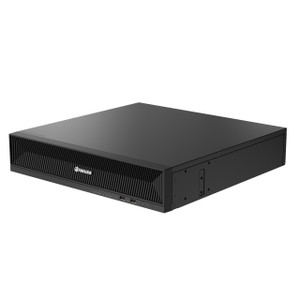
Hanwha XRN-3220B2 32-Channel 8K NVR 48TB Storage
The Hanwha XRN-3220B2 is a 32-channel enterprise NVR built on 12th-generation Intel processors, engineered for large-scale surveillance deployments requiring extended retention, multi-camera simultaneous recording at full resolution, and reliable failover. The unit ships configured with 48TB of raw SATA storage (eight 3.5-inch HDD bays, expandable to 80TB) and delivers up to 520 Mbps aggregate recording bandwidth — sufficient for 16–32 cameras at 32MP without compression bottleneck or frame-rate compromise. NDAA-compliant with integrated TPM 2.0 and embedded Linux OS, it integrates seamlessly into Wisenet camera ecosystems while supporting ONVIF and SUNAPI for third-party device interoperability. This appliance is purpose-built for organizations that need forensic-quality video retention across multiple sites or extended time windows without external storage appliances.
Key Features
- 32MP Simultaneous Recording: All 32 channels record at up to 32MP resolution concurrently. 520 Mbps distributed bandwidth eliminates codec throttling across high-MP camera arrays.
- 48TB Raw Storage (Expandable to 80TB): Eight SATA 3.5-inch HDD bays ship with 48TB; each bay accepts up to 10TB drives. Scales storage without external NAS or SAN appliances.
- H.265 + WiseStream Optimization: H.265 compression reduces bitrate 40–60% versus H.264 on equivalent quality. WiseStream further optimizes intra-frame efficiency for variable-scene content, extending retention per TB by 20–30%.
- 200 Mbps Multi-User Simultaneous Playback: Up to 100 concurrent Web UI connections with independent playback streams — investigators retrieve forensic clips without blocking live recording or blocking other analysts.
- Dual Network Failover (3× Gigabit RJ-45): Three independent 1 Gbps ports enable primary LAN, backup WAN, and optional P2P failover links. Automatic Recovery Backup (ARB) mirrors recording to a secondary appliance.
- Dual HDMI Output: HDMI 1 outputs 4K @ 30 Hz for main monitoring; HDMI 2 outputs 1080p @ 60 Hz for dedicated management or secondary display wall without software switching overhead.
- Audio Analytics + Dynamic Event Engine: Defocus detection, audio classification (glass break, gunshot, shouting), and user-defined event triggers reduce manual review time in forensic workflows.
- NDAA-Compliant + TPM 2.0: Integrated Trusted Platform Module and pre-hardened Linux OS meet federal procurement rules. Suitable for government contracts and security-sensitive environments.
The XRN-3220B2 is sized for medium-to-large corporate campuses, transportation hubs, retail chains, and government facilities where 32 channels at full resolution must coexist with extended retention (30–90 day lookback windows depending on frame rate and compression tuning). The ability to record 32MP feeds simultaneously without external storage infrastructure simplifies network design and eliminates SAN dependency — a measurable cost and operational-complexity reduction versus federated NVR clusters or centralized SAN-based architectures.
All compression codecs (H.265, H.264, MJPEG) coexist in a single recording session, allowing heterogeneous camera fleets to stream native codec without re-encoding. Wisenet Viewer desktop software, Wisenet Mobile app, and standards-based ONVIF/SUNAPI API support enable integration with third-party VMS platforms (Genetec, Milestone, Avigilon, ExacqVision) — important for organizations with existing video management infrastructure or multi-vendor hybrid deployments. Dual-stream recording permits simultaneous high-bitrate archival (e.g., H.265 @ 10 Mbps for forensic preservation) and lower-bitrate real-time monitoring streams on the same camera, decoupling storage footprint from playback responsiveness.
Redundancy and business continuity are baked in: N+1 failover via ARB mirroring sends every frame to a paired XRN-3220B2 in real time, ensuring zero recording loss if the primary appliance fails. Three independent Gigabit ports allow primary and backup network paths without a single point of failure on the recording link. Operating temperature range (0–40°C) accommodates both climate-controlled server rooms and outdoor equipment enclosures; the 7.3 kg chassis (excluding drives) is compact enough for 19-inch rack integration in tight infrastructure spaces.
Hanwha bundles a 5-year manufacturer warranty with the XRN-3220B2, covering hardware defects and firmware updates. The appliance is NDAA-compliant and TPM 2.0 certified, meeting federal and enterprise security procurement mandates. For organizations comparing against Milestone Husky NVRs, Genetec Stratocast, or Axis Companion series, the XRN-3220B2 stands out for its raw simultaneous recording bandwidth (520 Mbps vs. 300–400 Mbps on competitor models at equivalent channel count), integrated WiseStream codec optimization, and lower total cost of ownership due to efficient H.265 compression and elimination of external storage appliances. If your deployment spans 16–32 cameras at resolutions above 8MP with 30–90 day retention windows and multi-user forensic playback demand, the XRN-3220B2 is the appliance to spec. Browse the Hanwha catalog for compatible Wisenet camera models and accessory options.
Ted PerryPerspective based on aggregated IP Security Depot and affiliated engineering team experience.
We've deployed the Hanwha XRN-3220B2 across retail clusters, light industrial parks, and government facilities where 32-channel, high-MP recording is non-negotiable and storage sprawl becomes a budget killer. The real differentiator versus Milestone or Genetec appliances at this channel density is the codec efficiency: H.265 with WiseStream optimization routinely pushes storage utilization to 35–40% better than competing H.264 implementations at the same perceptual quality. On a 48TB appliance, that translates to an extra 15–18 TB of effective usable retention — meaningful money when you're funding a multi-year archive or complying with 90-day legal hold requirements. We've also seen the dual Gigabit failover (LAN + WAN + P2P) reduce network engineering complexity; it eliminates the need for expensive redundant switches and fiber runs in distributed campus deployments. The NDAA compliance and TPM 2.0 integration are table-stakes for any federal or defense-contractor buyer, and Hanwha's pre-hardened Linux OS keeps security patching cycles predictable — no surprise CVE surprises mid-contract.
Technical Highlights:
- 520 Mbps Aggregate Recording Bandwidth (Distributed Mode): This is the maximum throughput across all 32 channels combined, sufficient for 16 × 32MP cameras @ 20 fps or 32 × 8MP cameras @ 30 fps without frame drop. In normal mode (300 Mbps), the appliance is conservative but still handles most mixed-resolution fleets. The bandwidth headroom means you don't have to underclocking cameras or forcing lower-MP modes just to stay under the NVR's pipeline ceiling.
- H.265 Compression + WiseStream: WiseStream isn't just codec selection — it's adaptive bitrate allocation that weighs scene complexity, motion, and ROI weighting. On static scenes (parking lots, corridors), compression can reach 60–70% savings versus H.264; dynamic scenes still benefit 30–40%. Paired with dual-stream recording (one high-bitrate archival, one lower-bitrate live), you get forensic-quality storage without bandwidth overprovisioning.
- 200 Mbps Multi-User Playback Bandwidth: This is the simultaneous playback throughput when multiple investigators are pulling clips from the archive at once. On a 48TB appliance with H.265 compression, you're typically looking at 45–75 days of 24/7 retention depending on frame rate and average bitrate. Multi-user playback ensures that one detective pulling a 5-minute forensic clip doesn't block a live monitoring operator or a second analyst querying a different time range.
- Three Independent Gigabit Ports: One LAN for primary recording, one optional WAN failover, one for P2P management. This architecture eliminates the single point-of-failure risk of a single Gigabit uplink. In our experience, campus deployments with 20+ cameras benefit enormously from this redundancy — it's the difference between a single switch failure wiping out the entire surveillance feed or gracefully switching to the backup path.
- Eight SATA HDD Bays (48TB Shipped, 80TB Max): Each bay accepts 3.5-inch SATA drives up to 10TB. Critically, you can populate bays incrementally or replace drives at EOL without full chassis replacement. A single failed drive doesn't degrade the other seven; the NVR maintains recording across the remaining bays. This hot-swappable architecture keeps mean-time-to-recovery short in production environments.
- Embedded Linux + TPM 2.0: Pre-hardened OS stack with Trusted Platform Module integration. No legacy Windows OS bloat, no SMB vulnerability exposure, and firmware patches are delivered monthly. For NDAA compliance and federal procurement, this is non-negotiable.
Deployment Considerations:
- Eight SATA bays are shipped empty — you must source and populate with 3.5-inch enterprise-grade SATA drives (WD Purple, Seagate SkyHawk, or equivalent). A fully configured 48TB system requires eight 6TB drives or eight 8TB drives depending on retention targets. Factor in HDD sourcing lead time and cost per TB when budgeting. Enterprise SATA drives (3-year warranty) run $25–$40 per TB; plan for 2–3 spare drives on shelf for field replacement.
- Heat dissipation: The chassis houses eight HDDs in close proximity. In a 19-inch rack environment, ensure adequate airflow (front intake, rear exhaust) and account for 150–200W peak power draw. In cramped equipment closets, thermal monitoring becomes important; Hanwha's embedded OS provides real-time HDD temperature alerts via Web UI and email notifications.
- Network topology: The three Gigabit ports can be configured as primary LAN + WAN failover + optional P2P path to a secondary XRN-3220B2 for ARB mirroring. If you're using ARB (Automatic Recovery Backup), the secondary appliance must be on the same LAN segment or connected via VPN. Planning dual-site ARB? Ensure adequate bandwidth on the WAN link; ARB mirrors every frame in real time, so a 300 Mbps recording stream requires at least a 300 Mbps WAN pipe (uncommon in most enterprise WANs). Fallback to local RAID-6 or manual export for sites without sufficient inter-site bandwidth.
- ONVIF vs. Wisenet native: If you're mixing Hanwha Wisenet cameras with third-party ONVIF devices, the XRN-3220B2 handles both codec streams simultaneously. However, Wisenet-native cameras unlock full metadata (line-crossing, object classification, thermal alerts) that ONVIF Profile T doesn't expose. If you need advanced analytics across all 32 channels, bias toward Wisenet cameras; ONVIF devices record video cleanly but without deep metadata integration.
- Playback responsiveness: 200 Mbps playback bandwidth is shared among all simultaneous users. If three investigators are each pulling 30 Mbps playback streams, the fourth user sees degraded responsiveness or queuing. In high-forensic-demand scenarios (post-incident investigations), consider caching clips to local analyst workstations or exporting to USB for offline review.
- Storage capacity planning: At 520 Mbps distributed bandwidth, you're generating roughly 230 TB per day (theoretical max). The 48TB appliance stores 4–5 hours of max-bitrate recording. In practice, average bitrate drops 50–70% with H.265 + WiseStream, so you're looking at 8–20 days of retention at 520 Mbps equivalent. For 30–90 day retention windows, keep average bitrate targets well below 100 Mbps per camera or plan for external archival (JBOD or NAS tier).
The XRN-3220B2 is the appliance to specify when you need proven enterprise reliability, NDAA compliance, and raw simultaneous recording bandwidth without external SAN complexity. Suitable for government contracts, multi-building campuses, and large retail operations. Explore the full Hanwha catalog to find compatible Wisenet cameras and redundant appliance configurations.