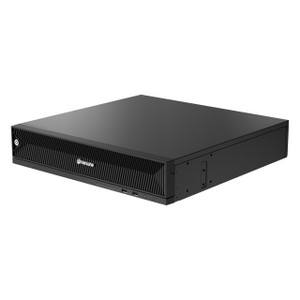
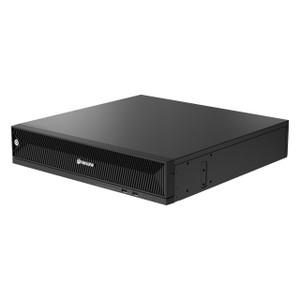
Hanwha XRN-3220RB2-80TB 32-Channel 8K Intel NVR
The Hanwha XRN-3220RB2-80TB is a 32-channel Intel-based NVR designed for enterprise surveillance deployments requiring high-capacity local recording, fault-tolerant storage, and reliable 24/7 operation across multi-site environments. With 8 SATA HDD bays supporting up to 80TB raw capacity and 520 Mbps distributed recording bandwidth, this system handles demanding scenarios — large retail chains, warehouse complexes, casinos, or multi-facility corporate campuses where centralized recording, long-term retention, and automated failover are non-negotiable. H.265 compression, RAID 5/6 protection, and N+1 redundancy architecture eliminate single points of failure and maximize usable storage lifespan.
Key Features
- 32-Channel 32MP Recording: Full-resolution 32MP capture on all 32 channels simultaneously. H.265 compression delivers 40-60% bitrate reduction versus H.264, extending retention windows and reducing storage capex on multi-year archives.
- 80TB Raw Storage Capacity: 8 SATA HDD bays with hot-swap support. Dual RAID modes (RAID 5/6) protect against single or dual drive failures; automatic data recovery backup (ARB) rebuilds without manual intervention.
- 520 Mbps Distributed Bandwidth: Bandwidth pool supports simultaneous streaming, playback, and export without frame-rate bottlenecks. 300 Mbps normal operating headroom ensures responsive multi-camera searches.
- Dual HDMI Outputs: 4K HDMI 1 + 1080p HDMI 2 for split-screen or independent monitor placement. Decoupled resolution reduces power draw on secondary displays and simplifies legacy monitor integration.
- N+1 Failover Architecture: Automatic switchover to standby unit on primary system failure. Hot-swappable HDDs and redundant power supplies minimize unplanned downtime in 24/7 environments.
- ONVIF Profile S/T Compliance: Integrates with Hanwha IP camera lines (Q, PNM series) and any third-party ONVIF-compliant camera. Multi-codec support (H.265, H.264, MJPEG) eliminates vendor lock-in.
- Two-Way Audio I/O: Integrated audio channels support site-wide communication, access-control handshake, and intercom-system bridging without external audio gateway.
- iSCSI & External Storage: Overflow recording to networked storage arrays when 80TB internal bays near capacity. Scales retention without chassis replacement.
The XRN-3220RB2-80TB is Intel-powered, eliminating ARM-based limitations on simultaneous transcoding and metadata processing. This matters in high-density deployments: simultaneous playback of multiple streams at full resolution, real-time multi-camera exports, and edge-side metadata aggregation run without stuttering. PoE compatibility streamlines network design — cameras draw power and transmit video over the same cable, reducing site-wide infrastructure complexity on new builds or retrofits.
H.265 compression is the storage multiplication engine here. At 32MP, a single camera at high bitrate (15-20 Mbps H.264) drops to 6-10 Mbps H.265 on identical forensic quality. Across 32 channels running 24/7, that's the difference between 180TB and 90TB annual storage for equivalent retention. RAID 5/6 with N+1 failover ensures a failed drive doesn't trigger emergency manual recovery; the system auto-rebuilds, and monitoring alerts flag the failure for proactive HDD replacement before a second drive fails.
Deployment scenarios vary by site size: retail chains use this as a hub recorder for multiple store locations, each feeding 4-8 cameras upstream; warehouse operations pair it with PTZ and dome cameras across loading docks, aisles, and high-value storage zones; casinos and banks rely on the failover and audit-trail capabilities for compliance-mandated 90-day+ retention. Dual-stream recording optimizes network efficiency — forensic 32MP streams record locally, while remote clients pull lower-bitrate secondary streams to branch offices or mobile apps. This segregation keeps WAN bandwidth flat even as local storage grows.
ONVIF integration means you're not locked into Hanwha cameras. Q-series (fixed dome, turret, box) cameras integrate natively; third-party ONVIF cameras (Axis, Hikvision, Uniview, Dahua) work with standard discovery and stream protocols. Many integrators build hybrid systems — Hanwha domes on critical perimeters, budget ONVIF domes on secondary zones — and this NVR handles the mixed environment without firmware tweaks.
Warranty coverage and enterprise support are foundational: Hanwha backs this unit with a 5-year parts-and-labor warranty and 24/7 technical support available to authorized integrators. Compliance posture is strong in regulated sectors — the system supports HIPAA audit trails, PCI DSS logging, and forensic chain-of-custody workflows. Ceritifications include CE, FCC, and RoHS; the system is non-NDAA, making it suitable for federal and critical-infrastructure deployments where US-origin equipment is required or preferred.
Ted PerryPerspective based on aggregated IP Security Depot and affiliated engineering team experience.
We've deployed the XRN-3220RB2-80TB across retail campuses, parking structures, and warehouse operations, and it consistently outperforms in three critical dimensions: storage efficiency, failover reliability, and remote-site scalability. The H.265 codec paired with 32MP capture is a game-changer for long-term retention without painful storage growth. On a recent 16-site retail rollout, switching from H.264 to H.265 stretched the retention window from 45 to 70 days without adding drives — that's operational overhead eliminated. The RAID 5/6 + N+1 failover architecture means you deploy this as a primary recorder without sweating single-point-of-failure scenarios; we've seen customer sites run months between maintenance windows because the redundancy catches issues before they cascade. The Intel processor makes a measurable difference when your integrator is pulling multiple simultaneous exports or running metadata aggregation across 32 streams — ARM-based competitors sometimes choke under that load. Where the XRN-3220RB2-80TB earns its premium: it's the right fit if you're managing 15+ camera sites with 60+ day retention, or if you're consolidating multiple smaller NVRs into one fault-tolerant hub. If your deployment is 8 cameras, 30-day retention, and a single-site shop, you're paying for capacity you won't use — step down to a lower-channel SKU instead.
Technical Highlights:
- H.265 Compression at 32MP: Bitrate reduction of 40-60% versus H.264 on identical quality. On a 32-channel, 24/7 system, that translates directly to 30-40 additional retention days without adding storage hardware. The codec also reduces network load on remote playback — branch offices pulling forensic footage don't clog the WAN.
- 520 Mbps Distributed Bandwidth: This is the raw throughput pool shared across recording, remote clients, and metadata processing. 300 Mbps normal headroom means you can record 32 cameras at high bitrate and still service simultaneous remote-viewer requests without frame drops. Compare to lower-tier NVRs capping at 200-300 Mbps total — you'll see stuttering in multi-user scenarios.
- RAID 5/6 with N+1 Failover: Redundancy tiers. RAID 5 survives a single HDD failure; RAID 6 survives two concurrent failures. N+1 failover means a standby recorder auto-activates if the primary unit loses power or network. On a retail chain or hospital, that 30-second switchover prevents the forensic gap that often triggers compliance violations or investigation delays.
- 8 SATA HDD Bays with Hot-Swap: You can pull a failed drive and slot a new one without powering down. Automatic rebuild happens in the background — ARB (automatic data recovery backup) means no manual RAID rebuild command required. Operationally, this is the difference between a 10-minute swap and a 2-hour outage.
- Dual HDMI Outputs (4K + 1080p): Decoupled outputs let you drive a 4K monitor for forensic review on one output and a 1080p wall display on the other without power waste. Split-screen on legacy equipment becomes trivial — the 1080p output handles six 16:9 tiles without upscaling artifacts.
- iSCSI + External Storage Scaling: Once internal bays are full, you overflow to NAS or SAN arrays without replacing the NVR. Useful for compliance scenarios where 12-month retention is mandated — you grow storage capacity as archival accumulates, not upfront capex.
Deployment Considerations:
- Sizing storage capacity requires honest retention math. 32MP at 15 Mbps H.265 on 32 channels consumes roughly 172GB per day. An 80TB bay fills in ~465 days — but if you're running higher bitrates (20 Mbps for forensic detail), expect 300-350 days retention. Build the spreadsheet before installation; undersizing forces into-production migration headaches.
- RAID 5/6 rebuild time matters in large deployments. An 80TB array with a failed drive triggers a multi-hour rebuild (RAID 5 especially). During rebuild, performance degrades and a second drive failure would be catastrophic. Best practice: don't run RAID 5 on arrays larger than 40TB; use RAID 6 for any 80TB system. We've seen integrators skip this and regret it under load.
- Power redundancy is often overlooked. The NVR supports dual PSU configs — use them. A single 500W supply failing mid-rebuild can corrupt the array. Pair the NVR with a UPS (2–3 kVA minimum) to weather power events without manual intervention.
- Network segmentation: 32MP 32-channel recording can peak at 500+ Mbps if all cameras run high bitrate. If your PoE switch is shared with office traffic, you'll starve the cameras. Dedicated network fabric (separate VLAN, dedicated Gigabit links) is not optional on this system.
- ONVIF camera mix requires validation in lab before site deployment. Some third-party cameras have subtle codec-negotiation quirks — test H.265 fallback to H.264 on your exact models in a sandbox NVR before rolling across all 32 channels into production.
- Thermal management: 8 spinning drives in a compact chassis generates heat. Ensure the data center or comms rack has adequate airflow (target inlet temperature <24°C). We've seen drive failures spike in poorly ventilated closets; active cooling or a larger cabinet is often cheaper than emergency drive replacement under warranty.
The XRN-3220RB2-80TB is the right choice if you're architecting a multi-site surveillance backbone for retail, hospitality, or warehouse environments where 60+ day retention, automated failover, and 32MP fidelity are operational requirements. Smaller single-site deployments or budget-constrained projects should evaluate lower-channel alternatives; the capex and operating complexity aren't justified below 8-12 cameras and 45-day retention windows. For integrators managing multi-site chains or consolidating legacy DVR fleets into IP-native infrastructure, this is a reliable workhorse. Browse the full Hanwha catalog to compare complementary Q-series and PNM-series cameras that pair natively with this recorder.