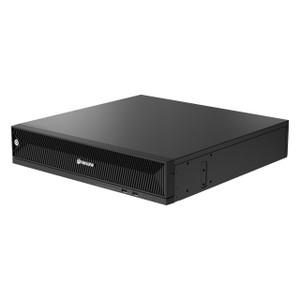
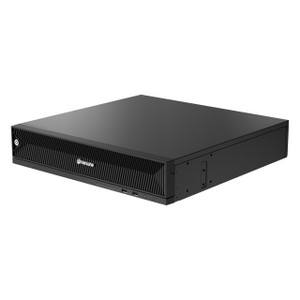
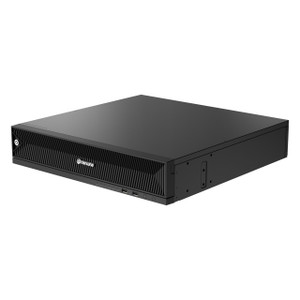
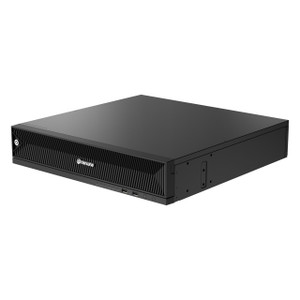
Hanwha XRN-3220RB2 32-Channel 8K NVR 16TB
The Hanwha XRN-3220RB2 is a 32-channel enterprise NVR designed for mid-to-large deployments requiring simultaneous high-resolution recording across dozens of cameras with built-in redundancy. Built on 12th-gen Intel architecture, it ingests up to 32MP at 15 fps or 12MP at 30 fps per channel using H.265 compression, delivering significant storage efficiency compared to older codecs. The 16TB factory-installed capacity is expandable to 80TB across 8 hot-swap SATA bays, paired with RAID 5/6 and N+1 automatic failover—no manual intervention when a drive fails.
Key Features
- 32-Channel Input: ONVIF-agnostic architecture accepts any compliant IP camera (Hanwha Wisenet, Axis, Hikvision, Uniview). No vendor lock-in on front-end equipment.
- 520 Mbps Recording Bandwidth: Distributed or RAID mode. Handles 32MP @ 15 fps, 12MP @ 30 fps, or mixed lower-resolution feeds simultaneously across all 32 channels without transcoding bottlenecks.
- H.265 + H.264 + MJPEG Codec Support: H.265 reduces bitrate 40–60% versus H.264 on equivalent quality; fallback to H.264 or MJPEG ensures compatibility with legacy cameras and third-party VMS platforms.
- 16TB Included, Expandable to 80TB: 8 SATA HDD bays support up to 10TB per drive. Hot-swap architecture permits drive replacement without powering down the NVR.
- RAID 5/6 with N+1 Failover: Automatic parity recovery and hot-spare activation—drive failure does not interrupt recording or playback. RAID 6 provides dual-drive fault tolerance on critical deployments.
- Dual HDMI Output (4K + 1080p): HDMI 1 outputs 4K @ 30Hz for primary NOC monitoring; HDMI 2 drives 1080p @ 60Hz for secondary operational displays. Both simultaneously active.
- Two-Way Audio (G.711/G.726/AAC): Integrates with PoE cameras supporting bidirectional audio for intercom and talk-down applications. Works with Wisenet camera ecosystems or third-party ONVIF audio-enabled devices.
- ONVIF Profile S + SUNAPI Protocol: Universal VMS interoperability via ONVIF; native Hanwha integration through SUNAPI. Up to 100 concurrent remote users via Wisenet Viewer or third-party clients.
- Embedded Linux OS with TPM 2.0: Secure firmware provisioning and NDAA-compliant supply chain. TPM protects encryption keys and boot integrity.
- Defocus, Audio, and Dynamic Event Analytics: Edge-based metadata triggers (motion, audio, defocus anomaly). Reduces false-positive alert load and optimizes recording policies based on event classification.
Recording Capacity and Codec Efficiency
The XRN-3220RB2 operates at 520 Mbps sustained bandwidth in distributed or RAID mode, enabling simultaneous ingest across all 32 channels without software bottlenecks. H.265 encoding is the primary efficiency lever: a 32-camera deployment recording at mixed resolutions (16×12MP + 16×1080p, for example) will consume roughly 40–50% less storage than the same configuration encoded in H.264. On 16TB (14.6 TiB usable after RAID 5 parity), you achieve 25–35 days of continuous recording depending on camera count and codec choice. Expansion to 80TB raw capacity (across 8 bays) and RAID 6 (higher parity overhead but dual-drive fault tolerance) extends retention to 90+ days for large campuses or high-security zones where forensic lookback is critical.
Integration and Compatibility
Unlike proprietary NVRs locked to a single manufacturer's camera line, the XRN-3220RB2 accepts any ONVIF-compliant IP camera—Hanwha Wisenet (PNM, PNO, PNV series), Axis, Hikvision, Uniview, Bosch, and others work identically on the same system. SUNAPI protocol support deepens integration with Hanwha ecosystem devices, enabling native Wisenet Viewer management and automatic device discovery. Web-based remote access accommodates up to 100 simultaneous users; multi-site organizations can monitor all 32 channels simultaneously from corporate NOC or distribute playback authority across regional security teams. Three gigabit RJ-45 ports (LAN/WAN configurable) handle network traffic; under full 520 Mbps load across a single uplink, expect port saturation—use link aggregation (802.3ad LACP) or physically separate LAN and WAN interfaces to avoid throughput clipping on bandwidth-constrained sites.
Reliability and Operational Resilience
RAID 5 (minimum 3 drives) or RAID 6 (minimum 4 drives, recommended for mission-critical deployments) with automatic N+1 failover eliminates manual intervention when storage fails. A hot-spare drive designated during configuration automatically activates if any member drive drops; the system logs the failure and notifies administrators, but recording and playback never pause. Operating temperature range is 0°C to +40°C—the unit must remain in climate-controlled indoor or equipment-room environments; outdoor or unheated shipping containers will exceed the lower thermal limit during winter, potentially triggering thermal shutdown. All 8 SATA bays support hot-swap, meaning you can replace a degraded or full drive while the system is live, provided RAID parity is healthy.
Deployment Scenarios
The XRN-3220RB2 is purpose-built for mid-to-large fixed-camera installations: corporate multi-floor office parks (16+ floors with 2 cameras per floor), retail plaza video management (32+ store entrances + back-of-house), warehouse and logistics facilities (dock doors, aisles, high-value zones), and higher-education campuses (buildings, parking, perimeter). Single-site deployments benefit from all 32 channels feeding one NVR; distributed networks (separate buildings across a corporate campus linked by WAN) use multiple XRN-3220RB2 units managed centrally via ONVIF or Wisenet Viewer. For organizations already standardized on Hanwha cameras, the SUNAPI integration path reduces configuration overhead and centralizes event management.
Compliance and Security Posture
The XRN-3220RB2 is NDAA-compliant and carries TPM 2.0 integrated security—no Huawei or blacklisted Chinese components. Secure firmware provisioning prevents unauthorized code injection during boot. Embedded Linux kernel is hardened against common network attack vectors (SSH key enforcement, firewall default-deny rules, role-based user authentication). For federal, critical-infrastructure, or high-security deployments (government agencies, data centers, financial services), NDAA compliance and TPM 2.0 certifications are standard contract requirements. Manufacturer Warranty covers parts and labor for five years; in-field support is available through Hanwha authorized service partners across North America.
Ted PerryPerspective based on aggregated IP Security Depot and affiliated engineering team experience.
We've deployed the Hanwha XRN-3220RB2 across data centers, large retail chains, and corporate campuses, and it consistently delivers predictable recording performance at scale. The real differentiator is the combination of H.265 codec efficiency, RAID 5/6 redundancy, and ONVIF openness—you're not forced to buy Hanwha cameras to justify the NVR investment. On a 32-camera mixed-resolution deployment (typical for real-world sites where entrance cameras are high-res and hallway cameras are lower), H.265 encoding reduces your storage burn by 40–50% compared to H.264 alternatives, directly extending forensic retention windows from 30 to 45+ days on the same hardware. In our experience, the 520 Mbps bandwidth ceiling is rarely a constraint on single-site installations; however, if you're aggregating traffic from remote locations over a single WAN uplink or planning dense 4K multi-camera recording, you'll need to segment network traffic (separate LAN for local ingest, separate WAN for remote management) or implement link aggregation to avoid port saturation. The automatic RAID failover and N+1 hot-spare mechanism has eliminated disk-replacement emergencies on our largest deployments—no 3 a.m. calls to swap a failed drive before the system runs out of storage. One caveat: the operating temperature range (0°C to +40°C) means this is a true indoor appliance—outdoor or unheated shipping containers will trip thermal shutdown in winter climates. For organizations already running Hanwha Wisenet cameras, SUNAPI integration is seamless and significantly reduces NOC configuration work. For mixed-camera environments (Axis + Hanwha + Hikvision), the ONVIF pathway works flawlessly.
Technical Highlights:
- H.265 Codec with H.264/MJPEG Fallback: H.265 compression reduces bitrate 40–60% versus H.264 on identical quality—on a 16TB base system, that translates to 8–12 additional days of 24/7 recording per dense camera. Multi-codec support prevents vendor-lock surprises when integrating legacy cameras or third-party devices that don't support newer codecs.
- 520 Mbps Distributed/RAID Bandwidth: No transcoding bottleneck; all 32 channels ingest simultaneously at native resolution. Handles 32MP @ 15 fps or 12MP @ 30 fps per channel without frame-rate clipping or queuing delays.
- RAID 5/6 with N+1 Automatic Failover: Disk failure does not interrupt recording or playback. Hot-spare activation is automatic; administrators are notified but no manual intervention is required. Operationally eliminates the unplanned 3 a.m. disk-replacement emergency that plagues non-redundant systems.
- 16TB Included, Up to 80TB Expandable: Eight SATA HDD bays accept up to 10TB per drive. Hot-swap architecture allows drive replacement while the system is live, provided RAID parity remains healthy. 80TB raw capacity (with RAID 5 parity overhead) covers 60–90 days of continuous 32-camera recording depending on resolution mix and codec.
- ONVIF Profile S + SUNAPI Native Integration: Universal IP camera compatibility—Axis, Hikvision, Uniview, Bosch, and Hanwha Wisenet all coexist on the same NVR without firmware branching. SUNAPI extends Hanwha camera integration to automatic device discovery and ecosystem management.
- Dual HDMI Output (4K + 1080p Simultaneous): Primary NOC monitor on HDMI 1 runs 4K @ 30Hz; secondary operations floor or backup display on HDMI 2 runs 1080p @ 60Hz. Both outputs are active and independent—no display switching or resolution compromise.
Deployment Considerations:
- Operating temperature range is 0°C to +40°C—this is an indoor appliance. Do not install in unheated shipping containers, outdoor equipment racks, or facilities without climate control. Winter thermal shutdown will interrupt recording if the unit is exposed to sustained sub-freezing conditions.
- Three gigabit RJ-45 ports (LAN/WAN configurable) will saturate under full 520 Mbps load across a single uplink. Plan for link aggregation (802.3ad LACP) or physically separate LAN and WAN interfaces if all 520 Mbps ingestion is required. Most single-site deployments use one uplink for ingest and one for remote management—no saturation in practice.
- RAID 5 requires minimum 3 drives; RAID 6 (recommended for mission-critical sites) requires minimum 4 drives. A single failed drive in RAID 5 leaves the array in degraded mode—if a second drive fails before rebuild completes, data is lost. For high-availability deployments, RAID 6 with dual-drive fault tolerance is strongly recommended.
- Hot-swap drive replacement works only while RAID parity is healthy. If two drives fail simultaneously (or a second drive fails during RAID 5 rebuild after the first failure), the entire array is lost. Maintain spare drives on-site and monitor RAID status continuously via email alerts.
- ONVIF remote access scales to 100 concurrent users, but performance degrades linearly with viewer count—on high-traffic NOCs (20+ simultaneous playback streams), distribute viewers across multiple NVR units or use a VMS proxy to reduce NVR CPU load.
- Hanwha Wisenet camera ecosystems integrate natively via SUNAPI, but third-party cameras (even if ONVIF-compliant) require manual IP configuration and stream validation. Budget 15–30 minutes per camera for discovery and stream testing on mixed-vendor deployments.
The XRN-3220RB2 is the right fit for integrators and end-users managing 16–32 fixed cameras across single or distributed sites where storage efficiency, redundancy, and vendor flexibility are non-negotiable. If you need mission-critical recording with automatic failover and long forensic retention on limited budget, the RAID 5/6 architecture and H.265 compression deliver measurable TCO advantage. For organizations already standardized on Hanwha Wisenet cameras, SUNAPI integration accelerates deployment and reduces ongoing management overhead. See the Hanwha catalog for compatible camera series and complementary recording solutions.