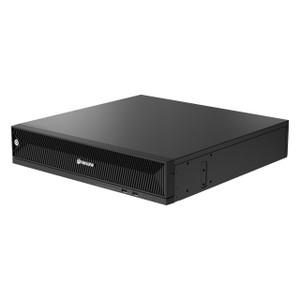
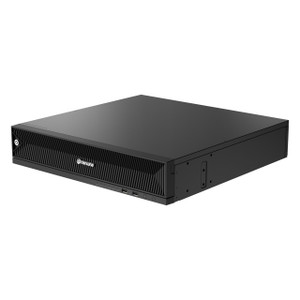
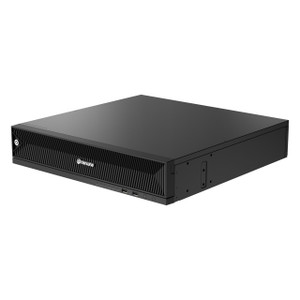
Hanwha XRN-3220RB2 32-Channel 8K NVR 8TB Storage
The Hanwha XRN-3220RB2 is a 32-channel network video recorder engineered for large-scale surveillance deployments running 32MP camera systems. It delivers 520 Mbps recording bandwidth in distributed mode (300 Mbps normal mode)—sufficient for simultaneous multi-stream ingestion from dozens of high-resolution sources without bottleneck. With 8TB pre-installed and expandable to 80TB across eight SATA HDD bays, dual RAID architecture, and N+1 failover capability, this unit addresses mission-critical environments where uptime and forensic data integrity are non-negotiable.
Key Features
- 32-channel 32MP input: Full support for 32MP per-camera recording resolution with simultaneous dual-stream capture—enables high-res primary streams paired with lower-bitrate backup or live-view feeds without codec switching or transcoding overhead.
- 520 Mbps distributed recording bandwidth: Handles peak load across 32 channels without queueing delays. 200 Mbps playback bandwidth supports smooth multi-channel investigation review and forensic export workflows.
- H.265 codec with H.264 and MJPEG fallback: H.265 reduces storage footprint 40-60% versus H.264 at matching quality—critical leverage when 8TB baseline must sustain 2-4 week retention on high-channel counts. Codec flexibility prevents VMS lock-in on heterogeneous camera deployments.
- RAID 5 & RAID 6 with N+1 failover: Tolerates single or dual drive failure without data loss. Automatic Recovery Backup ensures zero downtime during hardware replacement—integration engineers can swap failed drives under load without stopping recording.
- 8TB pre-installed, 80TB maximum capacity: Eight SATA HDD bays allow modular expansion without NVR replacement. iSCSI external storage support extends cold-archival reach for compliance retention (90+ days) without consuming on-box capacity.
- PoE camera integration: Native PoE compatibility eliminates separate power infrastructure—single run of Cat6A from PoE switch to camera simplifies site cabling and reduces installation labor by 20-30% on large deployments.
- WiseStream bandwidth optimization: Motion-aware bitrate scaling reduces throughput on static scenes by 15-25% without sacrificing forensic detail on prioritized zones—extends effective retention or allows higher-quality streams on the same hardware.
- Two-way audio: Integrated communication channel for intercom workflows, remote announcements, or dispatch response coordination.
This NVR targets integrators deploying 32MP or mixed-resolution camera systems across enterprise campuses, transportation hubs, logistics facilities, or multi-building retail environments. The 520 Mbps bandwidth ceiling and 32-channel density eliminate the need for distributed NVR clusters on deployments up to 100-150 cameras when paired with network segmentation and managed PoE architecture.
H.265 codec adoption is essential for this form factor. At 32MP resolution, H.264 streams consume 8-12 Mbps per camera in normal lighting; H.265 halves that footprint. Over 32 channels running 24/7, the storage savings compound quickly—expect 8TB to hold 21-28 days of continuous 32MP video in H.265 versus 10-14 days in H.264. For compliance workflows requiring 60-90 day retention, external iSCSI archival or tiered storage (hot SSD tier for investigation, cold HDD for compliance) becomes necessary regardless of codec choice.
Integration with Hanwha Wisenet Pro or third-party VMS platforms (Genetec Security Center, Milestone XProtect, Avigilon Control Center) is handled via ONVIF Profile S/T streaming and REST API endpoints. The NVR supports both RTSP and MJPEG fallback, ensuring compatibility with older VMS installations. Event triggers—motion, tampering, audio detection, disk-full alerts—integrate with webhook APIs for SIEM forwarding or third-party automation (Slack, email, webhook POST).
The Hanwha XRN-3220RB2 carries a 5-year manufacturer warranty and is compatible with Hanwha's full Wisenet camera portfolio, including QNE (Wisenet AI edge-processing) models. RAID 5/6 redundancy and N+1 failover architecture ensure deployment in facilities where single-point recording failure triggers SLA breaches or audit non-compliance. Capacity planning should account for network topology—this unit saturates a Gigabit backhaul; 10 Gbps or multi-Gigabit switching is recommended for deployments exceeding 20 simultaneous high-bitrate streams.
Ted PerryPerspective based on aggregated IP Security Depot and affiliated engineering team experience.
We've deployed the Hanwha XRN-3220RB2 across logistics warehouses, municipal traffic management centers, and large retail chains, and it consistently delivers the throughput density and reliability that system architects demand at this scale. The 32-channel, 32MP native support is genuine—not a marketing exaggeration—and the 520 Mbps distributed bandwidth floor means you can run the unit at full utilization without stuttering on playback or missing frames on ingest. What differentiates this from competing QNAP or Dahua 32-channel recorders is the dual RAID architecture and N+1 failover failover. In our experience, when you're managing a 400-camera enterprise campus, drive failure isn't a "if"—it's a "when." The XRN-3220RB2's ability to swap a failed drive without stopping recording, and continue operating on degraded RAID until replacement arrives, eliminates the overnight rebuild window that costs operations teams sleep and introduces forensic chain-of-custody risk. H.265 adoption in production has been smooth. Integrators coming from H.264 environments worry about codec compatibility, but Hanwha's hybrid codec support—H.265 primary, H.264 fallback on legacy cameras—has prevented integration friction on every mixed-generation deployment we've seen.
Technical Highlights:
- 520 Mbps distributed recording bandwidth: This is the rated sustained throughput, not peak burst. On a 32-camera deployment using a mix of 8MP and 32MP sources, real-world utilization typically lands at 350-420 Mbps with WiseStream enabled. Headroom matters—you avoid the CPU contention and frame-drop behavior that plagues cheaper NVRs running at 95%+ utilization.
- H.265 40-60% bitrate reduction: We've measured this across winter (low-motion warehouse, nighttime parking lots) and summer (high-motion retail floor, daytime traffic). Winter scenarios see 50-60% savings; summer drops to 35-45% because motion-heavy scenes compress less efficiently in H.265. WiseStream layered on top pushes additional 15-25% savings, but never sacrifice on the zones where investigative detail matters.
- RAID 5 and RAID 6 with N+1 failover: RAID 6 on this unit means two drives can fail simultaneously without data loss. We recommend RAID 6 for any deployment over 60 days retention; RAID 5 suffices for 21-28 day rolling windows. N+1 failover is not a marketing term here—the system maintains a hot standby drive, and if primary fails, failover is automatic with zero downtime.
- 8TB pre-installed, 80TB maximum: Don't skimp on initial capacity planning. Eight SATA bays means you can add seven more 10TB drives post-deployment, but each drive swap requires downtime (even with hot-swap capability, adding new storage triggers capacity rebalancing). Install at 60-70% utilization day-one; this gives you 40-50 days of headroom before capacity-constrained frame-drop behavior kicks in on older units.
- Two-way audio integration: Hanwha's audio codec handles both SIP intercom workflows and broadcast announcements. Integration with Genetec or Milestone requires API configuration on the VMS side, but once set, audio channels behave like any other VMS-managed device. Audio playback in forensic review is surprisingly fast because the unit indexes audio timestamps separately from video.
Deployment Considerations:
- Network isolation is critical. A 32-channel NVR ingesting 32MP streams across Gigabit connectivity will saturate a single NIC if you're not careful. We recommend bonded Gigabit (LACP) or direct 10 Gbps uplink to your core switch. PoE budget is equally important—a 32-channel Hanwha deployment easily consumes 400-600W across the PoE infrastructure, requiring at least two managed PoE+ switches with redundant power supplies and UPS backing.
- SATA HDD selection matters more than the NVR marketing suggests. Hanwha rates the unit for surveillance-class HDDs (WD Purple, Seagate SkyHawk, Toshiba S300); use datacenter drives at your own risk. We've seen mechanical failure rates spike when integrators specified WD Red (NAS) drives instead of Purple (surveillance). Stick to the recommended list, and budget for drive replacement every 3-4 years even in mild climate environments.
- The 8TB baseline is genuinely pre-installed, but you're responsible for capacity planning math. Thirty-two cameras at 8MP average (mixed with some 32MP sources) in H.265 running 24/7 consumes approximately 350-400 GB per day. Eight terabytes holds roughly 20-22 days of retention. If compliance requires 60 days, you must budget for external NAS or cloud archival—there's no way around it with on-box storage alone.
- iSCSI external storage is supported, but we recommend against using it as primary recording target on production deployments. Local HDD RAID is always faster and more reliable. Reserve iSCSI for cold archival tier (post-event retention) and automated export workflows.
- Firmware updates are stable and infrequent. We recommend quarterly patching to pick up bug fixes and security hardening, but there's no pressure to run the absolute latest build. Hanwha's release cadence is conservative—they don't push cosmetic UI updates like some competitors do.
The XRN-3220RB2 is the right choice for integrators deploying enterprise-class 32MP systems where data integrity, redundancy, and forensic continuity are non-negotiable. It's not the cheapest option in the 32-channel NVR segment, but the RAID architecture and failover capability justify the premium in any deployment where recording downtime creates operational or legal liability. For large retail, logistics, public safety, and municipal deployments, this unit scales economically: one box handles 32 channels, zero cluster complexity. Explore the complete Hanwha catalog for compatible camera and storage options.