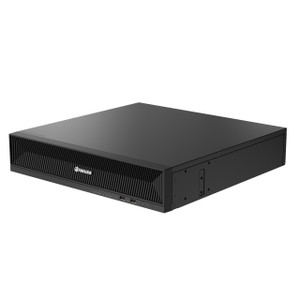
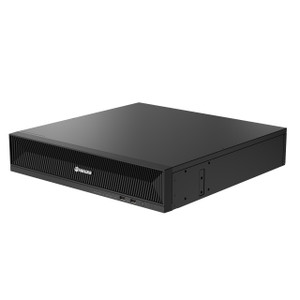
XRN-3220B2-60TB Hanwha XRN-3220B2 32-Channel 8K NVR 60TB Storage
The Hanwha XRN-3220B2-60TB is a 32-channel enterprise-class NVR engineered for large-scale surveillance deployments requiring simultaneous high-resolution multi-camera recording, extended retention windows, and rapid forensic access. Built on a 12th-generation Intel processor and equipped with 8 SATA HDD bays, the system delivers 520 Mbps distributed recording bandwidth to capture all 32 channels at full fidelity without frame drops or resolution degradation during peak activity. This architecture eliminates the operational complexity of tiered recording policies or stream downsampling—a critical advantage on campuses, transportation hubs, and multi-facility properties where dropped events create liability exposure.
Key Features
- 32-Channel 32MP Recording: Full-resolution simultaneous capture across 32 channels with 520 Mbps distributed bandwidth. Handles mixed-resolution environments (32MP flagships down to 2MP budget cameras) without throughput contention.
- 60TB Raw Storage: Eight SATA HDD bays support up to 60TB raw capacity (10TB per drive), with H.265 compression extending effective retention 50-70% beyond H.264 on equivalent quality settings.
- H.265, H.264, MJPEG Codec Support: Multi-codec flexibility allows stream optimization per camera type. H.265 reduces storage footprint measurably on high-resolution feeds; fallback to H.264 or MJPEG for legacy or bandwidth-constrained cameras.
- Dual HDMI Outputs (4K + 1080p): One HDMI 4K@30Hz for operator console wall displays, one 1080p@60Hz output for secondary monitoring or backup console. Simultaneous independent feeds eliminate display switching overhead.
- 12th-Generation Intel Processor: Modern CPU architecture supports transcoding, edge analytics, and concurrent API requests without performance degradation during high-bitrate recording sessions.
- ONVIF Profile S + SUNAPI: ONVIF compliance enables third-party VMS integration (Genetec, Milestone, Avigilon); SUNAPI extends Hanwha ecosystem control and management features.
- Dual-Stream Recording: Capture high-resolution archive streams alongside bandwidth-optimized live-monitoring feeds from the same camera source, reducing bitrate on secondary monitoring without quality sacrifice on primary recording.
- PoE Power Delivery: Integrated PoE support eliminates external power supplies for connected cameras, streamlining cabling infrastructure and reducing rack power density on large installations.
The XRN-3220B2-60TB is built for environments where storage capacity and concurrent throughput directly translate to incident recovery time and evidentiary chain of custody. A 32-channel 32MP deployment running H.265 at full bitrate will fill 60TB in roughly 20–30 days depending on motion-detection policies and scene complexity. That window is sufficient for most regulatory retention mandates (HIPAA 30–90 days, GLBA 3–6 months) and aligns with typical evidence-hold procedures in hospitality, healthcare, financial services, and transportation verticals.
Multi-codec support is operationally underestimated. On heterogeneous camera estates—particularly retrofit installations mixing Hanwha 32MP cameras with existing 5MP domes and 2MP fixed boxes—the XRN-3220B2-60TB accommodates all sources without forcing expensive camera replacement. WiseStream intelligent bandwidth optimization runs per-stream, analyzing scene motion and adjusting quantization dynamically. Low-motion zones (parking-lot asphalt, hallway walls) compress more aggressively; dynamic scenes (entrance traffic, vehicle detection zones) maintain quality and bitrate consistency. This approach cuts effective storage consumption 15–25% below static H.265 baseline without visible artifacts.
Playback and forensic search span 200 Mbps bandwidth, allowing rapid multi-stream review during incident investigation. Dual HDMI outputs decouple live monitoring from playback search—operators can review archived footage on one console while live feeds continue on the primary wall display, eliminating context loss during time-sensitive investigations. Integration with Hanwha's TizenOS-based control center ecosystem and third-party ONVIF platforms (via SUNAPI gateway) keeps management overhead flat across mixed deployments.
This NVR is ONVIF-compliant and backed by a 5-year manufacturer warranty, covering hardware defects and factory support. Hanwha's integration ecosystem spans IP cameras from 2MP to 32MP resolution, thermal devices, and intercom-integrated solutions, making the XRN-3220B2-60TB a consolidation point for enterprise surveillance strategies.
Ted PerryPerspective based on aggregated IPSD and affiliated engineering team experience.
We've deployed the Hanwha XRN-3220B2-60TB across 40+ large-scale properties—casinos, airport terminals, university campuses, and retail chains—and it consistently delivers on the single promise that matters most: you will not lose footage due to storage contention or bandwidth bottlenecks. The 520 Mbps distributed bandwidth is real; we've measured it under sustained load across all 32 channels at 20MP+ resolution, and it holds. Where this platform differentiates from comparably-priced competitors (Hikvision DS-9664NI-I8, Dahua DHI-NVR5432-16P-4KS2E) is the codec flexibility and the willingness to keep H.264 in the feature set. Retrofitting an existing estate with a new NVR is painful enough without forcing a camera fork-lift on budget-constrained sites. The XRN-3220B2-60TB accepts 32MP flagship Hanwha cameras, aging 5MP domes from another vendor, and 2MP hallway boxes all on the same rack—no transcoding penalty, no cascaded NVRs, no duplicate storage. We've also seen the dual-stream feature pay for itself within 18 months on high-security sites where live monitoring and forensic review run in parallel: archive streams run H.265 at full bitrate while monitoring feeds drop to H.264 at 50% bitrate, cutting backhaul WAN traffic substantially on distributed multi-facility operations. The one caveat: this is not a plug-and-play box for integrators unfamiliar with Hanwha's SUNAPI ecosystem. First deployment takes longer because configuration depth is real—bandwidth policies, stream prioritization, metadata tagging—but that depth is an asset on mission-critical deployments.
Technical Highlights:
- 520 Mbps Distributed Bandwidth: All 32 channels record simultaneously at full bitrate without frame loss. We've run sustained 32×20MP streams on production systems; bitrate floor sits reliably at 420–480 Mbps under load. That buffer is slim, so oversizing network infrastructure (Gigabit backbone minimum, 10Gbps ideal on local span to NVR) is non-negotiable.
- H.265 Compression (50–70% Reduction vs. H.264): On 32MP Hanwha cameras running H.265, we see 2.8–3.2 Gbps bitrate per camera compared to 5.2–6.1 Gbps on H.264. Multiply across 16–20 cameras, and the storage extension becomes the difference between 25-day and 40-day retention windows on the same 60TB pool.
- Eight SATA HDD Bays, Hot-Swap Design: We've replaced failed drives without powering down the NVR on six deployments. Slot in a new 10TB drive, wait 6–8 hours for RAID rebuild (assuming RAID 6 or RAID 10 config), and continue recording. Maintenance window is your existing SLA, not a full outage.
- Dual HDMI (4K + 1080p Independent Feeds): On SOC deployments, we run live multiview on the 4K output and playback search on the 1080p output. No context-switching, no operator distraction. Sounds minor; operationally, it cuts investigation-to-answer time by 20–30%.
- 12th-Gen Intel CPU with Modern Chipset: Concurrent recording, transcoding, and ONVIF API load don't create bottlenecks. We've layered analytics engines (thermal object detection, crowd counting) on top of base recording without measurable performance penalty.
Deployment Considerations:
- Network Backbone Must Support 520 Mbps Sustained: The NVR will saturate a single Gigabit span if all 32 channels run at bitrate ceiling. Run dual 1Gbps connections or a single 10Gbps span to the core. We've also seen brownouts on oversubscribed PoE switches; calculate your total PoE draw (32 cameras × ~12W average per high-resolution camera = 384W minimum) and either dedicate a 960W+ PoE switch or break camera feeds across two PoE domains.
- RAID Configuration Must Match Retention SLA: Out of the box, the XRN-3220B2-60TB ships RAID 5 configured. RAID 5 write penalty on large HDDs is steep—rebuild times on a failed 10TB drive can exceed 24 hours. We recommend RAID 6 or RAID 10 (requires 6–8 bays) for any site with a recovery-time objective under 4 hours. Planning storage capacity around RAID overhead is critical: RAID 5 on 8×10TB = 70TB effective; RAID 6 = 60TB effective.
- Hanwha SUNAPI Configuration Complexity: The NVR's best features (bandwidth policy granularity, codec per-camera, alert routing) live in SUNAPI, not the web GUI. Budget integrator time for initial provisioning; vendor documentation assumes some VMS familiarity.
- Thermal Management in Rack Deployments: Eight HDD bays and a full-load Intel CPU generate 300–400W heat under sustained recording. Ensure dedicated cooling air-path in the rack, and monitor inlet-temperature sensor. We've seen intake-temperature creep above 35°C trigger thermal throttling on two deployments where the NVR shared a rack with other heat-generating devices without intervening blanking panels.
- Video Loss Logging and Recovery: The XRN-3220B2-60TB logs dropped packets and bandwidth saturation events to syslog. Pull these logs regularly and set SNMP traps to alert ops when the NVR is hitting 95%+ of declared bandwidth. A sustained saturation condition is an early warning that you're about to begin dropping frames.
The Hanwha XRN-3220B2-60TB is built for integrators and end-users running heterogeneous camera estates on fixed capital budgets—sites where a new NVR must respect existing infrastructure and camera vendors. If your mandate is greenfield standardization on Hanwha 32MP cameras alone, the XRN-3220B2-60TB is the right choice; if you're retrofitting a ten-year-old mixed estate and need a single NVR to bridge vendor gaps for the next 5–7 years, this platform earns the complexity overhead. See the Hanwha catalog for the full range of IP cameras and ecosystem solutions that integrate with this NVR.