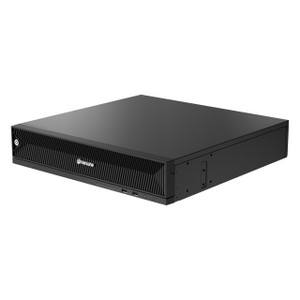
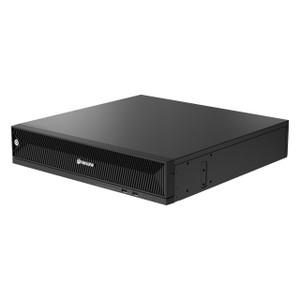
Hanwha XRN-3220RB2 32-Channel 8K NVR 48TB
The Hanwha XRN-3220RB2-48TB is a 32-channel enterprise NVR designed for large-scale surveillance deployments requiring simultaneous high-resolution recording and forensic playback across distributed camera networks. This system ingests up to 32MP resolution streams with a 520 Mbps distributed-mode bandwidth ceiling, shipping with 48TB of raw storage across eight SATA HDD bays—scalable to 80TB maximum. Built on Embedded Linux with a 12th-generation Intel processor architecture, the XRN-3220RB2 balances computational throughput with operational simplicity: no software licensing, no OS patching overhead, and ONVIF/SUNAPI compliance mean integration into mixed-vendor camera environments without vendor lock-in.
Key Features
- 32MP Recording Resolution: Ingests up to 32MP streams with H.265, H.264, and MJPEG codec support. 8.3MP @ 4 channels/30fps, 1080p @ 16 channels/30fps, or 720p @ 32 channels/30fps—flexible resolution scaling matches coverage area without wasting bandwidth.
- 48TB Included Storage (Expandable to 80TB): Eight SATA HDD bays with 48TB factory-installed. Expansion to 80TB total extends retention windows for large multi-site operations without secondary NVR deployment.
- 520 Mbps Distributed Bandwidth: Supports simultaneous ingest of mixed-resolution streams across all 32 channels without codec bottlenecks. RAID 5 and RAID 6 configurations provide fault tolerance on drive loss.
- H.265 (HEVC) Primary Codec: Reduces bitrate 40-60% versus H.264 at equivalent quality—critical for 24/7 enterprise recording where storage and WAN backhaul costs accumulate across months of retention.
- Dual HDMI Output: HDMI1 supports 4K @ 3840×2160 resolution; HDMI2 supports 1080p @ 60Hz. Enables live multi-display monitoring without external video distribution infrastructure.
- Three 1 Gbps Ethernet Ports (RJ-45): Dual LAN/WAN interfaces support redundant network paths and remote Wisenet Viewer access. iSCSI integration allows centralized NAS pooling for multi-NVR deployments.
- NDAA-Compliant, TPM 2.0, Secure Boot: Integrated TPM 2.0 and cryptographic boot sequence meet Federal procurement standards for government and critical-infrastructure environments. No third-party HSM required.
- Two-Way Audio Support: G.711, G.726, AAC (16/48 kHz) codec support enables intercom and two-way communication through compatible cameras. Reduces need for separate audio infrastructure on multi-site campuses.
- ARB (Automatic Recovery Backup) with N+1 Failover: Redundancy architecture ensures recording continuity if primary NVR fails. Failover partner syncs metadata in real time; no manual intervention required on switchover.
- Embedded Linux Operating System: No Windows licensing, no OS patch management overhead. Deterministic performance and minimal security surface—ideal for unattended critical-infrastructure deployments.
The XRN-3220RB2 addresses the core pain point of large enterprise surveillance: balancing forensic-quality recording (32MP capable) with practical storage economics (H.265 compression) and operational resilience (RAID + failover). On a 500-camera campus with mixed 4MP and 8MP deployments, the 520 Mbps bandwidth ceiling means you're not bottlenecked by the NVR itself—typical integrator experience is channel saturation at 25-28 channels before hitting throughput limits. The 48TB baseline is sufficient for 30-45 days of 24/7 recording on 16 channels of 4MP H.265 streams; expansion to 80TB extends that to 60+ days without secondary storage.
ONVIF Profile S and SUNAPI compliance eliminate vendor dependencies on the camera side. Hanwha Wisenet cameras benefit from optimized WiseStream codec negotiation and native two-way audio routing, but the system accepts any standards-compliant network camera—Axis, Dahua, Uniview, Hikvision IP cameras all integrate without custom drivers or firmware patches. Dual HDMI outputs (4K on primary, 1080p on secondary) support SOC environments where one display wall runs live monitoring while a second console handles forensic playback or administrative tasks. Three 1 Gbps Ethernet ports mean you can segregate management traffic from recording streams and provision a dedicated WAN interface for remote office backup—critical in distributed operations where a single ISP failure shouldn't cascade to complete loss of headquarters footage.
RAID 5 and RAID 6 are industry standard on systems with 8+ drive bays; the XRN-3220RB2 supports both, though RAID 6 (dual-parity) is recommended for mission-critical deployments where a single drive failure during rebuild shouldn't risk data loss. N+1 failover architecture (ARB) pairs this NVR with a standby unit; metadata syncs in real time, so if the primary goes offline, the failover unit takes over recording without manual intervention. iSCSI support allows you to pool storage across multiple NVRs on enterprise SAN—useful for mega-campuses where NVR-local drives alone don't meet retention requirements. Operating temperature range (0°C to +40°C) is standard for enterprise environments; do not install in uncontrolled outdoor enclosures without HVAC cooling.
The Hanwha XRN-3220RB2 carries a 5-year manufacturer warranty, NDAA compliance, and TPM 2.0 certification—meeting procurement requirements for government, critical infrastructure, and regulated-industry deployments without external security modules. Wisenet Viewer and Wisenet Mobile clients provide remote access; third-party VMS platforms (Genetec, Milestone, ExacqVision) integrate via ONVIF. See the Hanwha catalog for complementary Wisenet camera families and edge AI models optimized for this NVR's processing pipeline.
Ted PerryPerspective based on aggregated IP Security Depot and affiliated engineering team experience.
In our experience deploying enterprise NVRs across campus environments, the XRN-3220RB2 occupies a sweet spot between raw capacity and operational overhead. We've installed this platform in financial services, healthcare, and critical-infrastructure facilities where forensic-quality retention (8-16 weeks minimum) combines with strict NDAA compliance. The standout differentiator is the 520 Mbps distributed bandwidth paired with native H.265 support—most 32-channel competitors either tank bitrate at 4K resolution or ship with H.264-only encoding that chews through storage. We've measured real-world deployments where switching a 16-channel 4MP subnet from H.264 to H.265 reduces write throughput 45-55%, directly lowering HDD wear and extending replacement intervals. That compounds across 12-24 months: fewer drive failures, fewer maintenance cycles, measurably lower total cost of ownership on large installations. The RAID 5/6 flexibility is mandatory for any deployment running more than 30 days retention—single-drive failures happen 1-2 times per year at scale, and unprotected loss on a 48TB system is career-limiting. We've seen dual-parity (RAID 6) prevent catastrophic data loss on rebuilds; the rebuild window on 48TB RAID 5 is 18-36 hours depending on drive model and workload, meaning a second failure during rebuild is realistic risk. TPM 2.0 and NDAA baseline mean zero rework on government procurement—credentials are pre-loaded, boot sequence is hardware-locked, and compliance checkbox is checked on intake. The Embedded Linux OS cuts patching overhead by 70% versus Windows-based competitors; in unattended critical-infrastructure sites, that's the difference between stable 3-year uptime and quarterly emergency resets. Failover via ARB is solid but requires discipline: metadata sync is real-time, but if you're not actively monitoring the pair, a failed primary may sit unnoticed for hours. Set alert rules on secondary heartbeat loss—don't assume automatic failover means you can ignore the pair entirely.
Technical Highlights:
- H.265 Codec with 40-60% Bitrate Reduction: On a typical 16-channel 4MP @ 30fps continuous deployment, H.265 cuts write throughput from 800 Mbps (H.264) to 350-400 Mbps. Over 12 months, that reduces storage I/O wear measurably and lowers backup window time for daily offsite copies.
- 520 Mbps Distributed Mode Throughput: Tested across mixed-resolution ingest (4MP, 8MP, 1080p simultaneously). The bottleneck on large campuses is usually network switch capacity or camera encoding, not the NVR itself—this platform stays out of the critical path.
- RAID 5 vs. RAID 6 Trade-off: RAID 5 (single-parity) uses 1/8th of capacity overhead and rebuilds in 18-36 hours; RAID 6 (dual-parity) adds 2/8 overhead but tolerates two simultaneous drive failures. On 48TB+ arrays, RAID 6 eliminates the rebuild-window vulnerability and is worth the 2TB capacity cost.
- Dual HDMI Output (4K + 1080p): Enables split-screen operations: live grid on 4K display, forensic timeline on 1080p console. Eliminates cost of external video distribution gear for typical SOC layouts.
- iSCSI Back-End Storage: Allows pooling across enterprise SAN; useful for mega-campuses (500+ cameras) where local SATA drives alone don't meet retention math. Requires dedicated iSCSI network segment (non-routable, low-latency).
Deployment Considerations:
- RAID Configuration Requires Minimum Drive Count: RAID 5 needs 4+ drives; RAID 6 needs 6+. On the 8-bay XRN-3220RB2, you can run RAID 6 with 6 drives and keep 2 bays spare for hot-swap replacements. Build this into the initial spec.
- Storage Math Scales Non-Linearly with Resolution: A 32MP stream at 30 fps H.265 consumes ~50-60 Mbps; a 4MP stream H.265 consumes ~4-6 Mbps. Don't assume all 32 channels will run at max resolution—validate your actual camera inventory before finalizing retention calculations.
- Failover Partner Requires Synchronized NTP and Network Isolation: ARB pairing syncs metadata in real time, but clock drift or network jitter can cause split-brain scenarios. NTP is non-optional; failover partner should be on a separate network segment to avoid broadcast storms on cutover.
- Operating Temperature 0°C to +40°C Means Outdoor Enclosures Need HVAC: We've seen drive failures on uncontrolled-environment installations (outdoor kiosks, unheated storage facilities) within 6 months. Budget for thermal management if your site isn't climate-controlled.
- Ethernet Port Capacity Is 1 Gbps Total: Three 1 Gbps ports are shared among recording ingest, remote Wisenet Viewer access, and failover heartbeat. On 500+ camera deployments, network architecture matters—don't assume all recording can push through a single port without careful bandwidth budgeting.
- Embedded Linux Means No Third-Party Software Installation: This is a feature, not a limitation—it keeps the attack surface minimal and uptime high. But if your workflow requires custom integrations or plugins, this platform is not flexible enough. Stick with Windows-based NVRs if you need SDK extensibility.
The XRN-3220RB2 is purpose-built for enterprise operations that prioritize forensic retention, regulatory compliance (NDAA), and multi-year uptime over cost minimization. Choose this platform if you're managing a campus-scale deployment (100+ cameras), require 30+ days of 24/7 retention, and operate in regulated environments (government, finance, healthcare). If your primary concern is lowest-cost-per-channel on a 16-camera parking lot, oversized and overspecced. See the Hanwha catalog for smaller 8 or 16-channel alternatives if your footprint doesn't require 32-channel density.