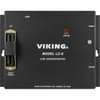
Viking Electronics LC-8 8-Line Emergency Phone Concentrator
The Viking Electronics LC-8 is an 8-port line concentrator that lets up to eight emergency phones — elevator cabs, fire floor stations, ADA phones, or credit card readers — share a single PSTN telephone line. If you're wiring a mid-rise or high-rise building where running eight separate phone lines to every elevator and stairwell emergency phone isn't practical or cost-effective, the LC-8 (often searched as LC 8) is the hardware that makes single-line multi-phone installations viable without sacrificing call access or reliability.
Overview
Line concentrators solve a straightforward but critical infrastructure problem: code-required emergency phones must be reachable and functional, but provisioning a dedicated POTS or VoIP line per phone quickly becomes expensive. The LC-8 arbitrates access across all eight ports, granting the line to whichever phone initiates a call first. Inbound calls are answered automatically and routed via touch-tone transfer — which means the monitoring center or building operator can reach any of the eight connected stations from a single line appearance. Built-in talk battery means the unit powers the connected phones directly, eliminating the need for external phone power at each station.
The LC-8 connects to the building's phone infrastructure via an RJ21 multi-pair connector — the standard 50-pin Amphenol jack used in commercial telephony wiring closets — which simplifies tie-in to existing punch-down blocks and distribution frames in elevator machine rooms or IDF closets.
Key Features
- 8-Port Emergency Phone Sharing: Connects up to eight emergency phones on a single telephone line. In a 10-story building with two elevator cabs, fire floor phones, and lobby ADA stations, this eliminates seven additional monthly line charges while keeping every phone independently accessible.
- Automatic Inbound Call Answering: The unit answers inbound calls without manual intervention and supports touch-tone transfer to any connected station — so a 24/7 monitoring center can check in on any phone port from the central line without a technician on site.
- Built-In Talk Battery: Powers connected phones directly from the LC-8, removing the requirement to provision local power at each emergency phone cabinet. One power connection at the concentrator feeds the entire chain.
- Fire Floor Phone Connection: Explicitly supports fire floor phone integration — a code-driven requirement in most jurisdictions for high-rise buildings. This is not a generic feature; it means the LC-8's call arbitration logic is designed to handle the signaling conventions used by dedicated fire floor stations.
- 4-Hour Battery Backup: The unit maintains full operation for four hours on battery during a mains outage. For elevator emergency phones — where code requires the phone to function during a power failure — this is the spec that determines whether you pass inspection, not a convenience feature.
- 120V AC Power Input, 13.8V DC Operation: Runs on standard North American 120V AC mains and steps down to 13.8V DC internally. No special electrical service required; a standard outlet in the machine room or electrical closet is sufficient.
- RJ21 Connectivity: Uses a 50-pin RJ21 (Amphenol) connector for all phone port wiring, compatible with standard 25-pair cabling infrastructure. If your building already has 25-pair runs to the IDF, you can home-run all eight emergency phone pairs back to the LC-8 without new cabling infrastructure.
- Broad Device Compatibility: Works with Viking emergency elevator phones, standard POTS handsets, modems, and credit card readers. This matters in parking garages and mixed-use facilities where the same line might need to serve both an emergency phone and a payment terminal.
- Compact Form Factor: At 210mm × 159mm × 44mm (approximately 8.3" × 6.3" × 1.7"), the LC-8 fits in a standard elevator machine room panel or on a DIN-rail shelf without requiring a dedicated enclosure. At 1.8 kg (approximately 4 lbs) shipping weight, it wall-mounts easily.
- Operating Range 0°C to 32°C (32°F to 90°F): Rated for the temperature range typical of conditioned machine rooms and electrical closets. Not rated for unheated utility spaces or outdoor enclosures — if your machine room routinely drops below freezing, plan for enclosure heating.
Integration & Compatibility
The LC-8 is compatible with the full range of Viking Electronics emergency communication products, including elevator emergency phones designed for ADA compliance and multi-tenant monitoring. It integrates into standard emergency phone systems where a single POTS or analog line from a DMARC or telephone board feeds multiple required stations across a building.
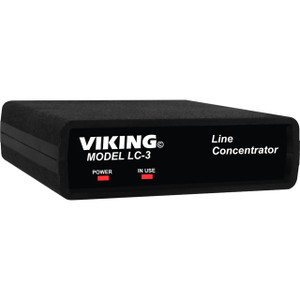
For larger installations requiring more than eight stations on a single line, or for buildings where additional concentrators will be daisy-chained, consult the LC-3 (3-port variant) for smaller zones or lower-density floors. The LC-8's RJ21 interface integrates cleanly with 66-block and 110-block structured cabling terminations common in commercial building IDF closets, avoiding punch-down adapters in most cases.
Modems and credit card readers are explicitly supported, making the LC-8 suitable for parking garage applications where elevator emergency phones and payment kiosks share a single analog line run. If your facility uses a PoE-based VoIP infrastructure at the main distribution frame, note that the LC-8 requires an analog POTS line — confirm your telephone service or ATA configuration before specifying.
Frequently Asked Questions
Q: How many emergency phones can the LC-8 support?
A: The LC-8 supports up to eight emergency phones, modems, or credit card readers on a single telephone line.
Q: Does the LC-8 have battery backup for power outages?
A: Yes. The LC-8 includes a 4-hour battery backup, keeping all connected emergency phones operational during a mains power failure — a requirement in most elevator emergency phone codes.
Q: What type of connector does the LC-8 use for phone wiring?
A: The LC-8 uses an RJ21 (50-pin Amphenol) connector, compatible with standard 25-pair commercial telephone cabling and 66/110-block terminations.
Q: Is the LC-8 compatible with fire floor emergency phones?
A: Yes. The LC-8 explicitly supports fire floor phone connections alongside standard elevator emergency phones, modems, and credit card readers.
Q: What power does the LC-8 require?
A: The LC-8 runs on 120V AC / 13.8V AC at 1.25A — standard North American outlet power. No special electrical service is needed.
Q: What are the operating temperature limits for the LC-8?
A: The LC-8 is rated for 0°C to 32°C (32°F to 90°F) operating temperature and 5% to 95% non-condensing humidity. It is intended for conditioned machine rooms and electrical closets, not unheated or outdoor locations.
The LC-8 is the unit I reach for when a building owner wants to meet elevator emergency phone code requirements without paying for eight separate analog lines. With a 4-hour battery backup spec and built-in talk battery, the LC-8 handles both the power-failure scenario that most AHJs will ask about and the station-powering requirement that would otherwise mean a power supply at every cab — those two specs together are what close the inspection checklist on most mid-rise projects.
Technical Highlights:
- 8-Port Capacity on Single Line: Eight emergency phone stations share one POTS or analog line. On a 12-story building with two cabs, fire floor phones, and lobby ADA stations, that's potentially seven line charges eliminated monthly — real budget impact over the life of the installation.
- 4-Hour Battery Backup: Maintains full operation through a four-hour outage. Elevator emergency phones under ASME A17.1 and IBC requirements must work during power failures — this spec is the compliance anchor, not a nice-to-have.
- RJ21 Interface: The 50-pin Amphenol connector integrates directly with 25-pair building cabling. In practice, if the building already has 25-pair runs to the machine room from the MDF, home-running all eight emergency phone pairs to the LC-8 is a clean, adapter-free termination.
Deployment Considerations:
- The RJ21 connector requires a 25-pair Amphenol cable or a breakout harness to individual RJ11/RJ12 station drops — budget for that breakout assembly if your elevator contractor is expecting individual RJ11 tails at the concentrator.
- The 0°C to 32°C operating temperature range is a real constraint: unheated machine rooms in cold climates will need supplemental enclosure heating or a different installation location. Don't assume a standard machine room in a northern climate stays above freezing in January.
The LC-8 fits cleanest on mid-rise commercial projects — office towers, hotels, and apartment buildings in the 6-to-20-story range — where the combination of multiple elevator cabs, required fire floor stations, and a single incoming analog line from the building's telephone service makes a line concentrator the right architectural call over provisioning individual lines per station.