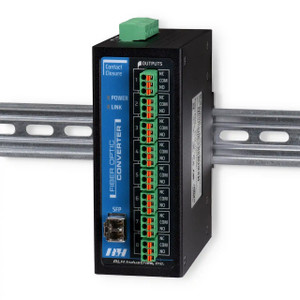
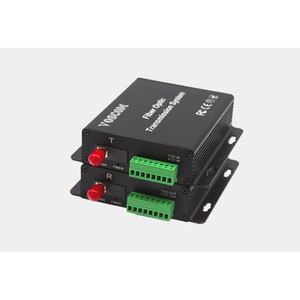
Comnet FDC80NLR485 8-Channel Supervised Contact Closure Receiver
Overview
The Comnet FDC80NLR485 is an 8-channel non-latching contact closure receiver engineered for distributed alarm and access control integration across IP-based surveillance and security networks. It operates over both RS-485 twisted-pair connections and optical fiber, making it suitable for long-distance runs where electromagnetic immunity and galvanic isolation matter. Non-latching operation means each supervised contact closure triggers an event but does not hold state—output resets automatically when the input closes. This is the right choice when you need to distribute alarm signals (door contacts, motion sensors, emergency buttons) across a geographically dispersed site without routing every wire back to a central panel.
Key Features
- 8 Independent Channels: Manage up to 8 supervised alarm inputs on a single device, reducing the number of receivers needed in multi-zone deployments. Each channel operates independently and reports status over RS-485, simplifying wiring and reducing cable runs to the central VMS or control system.
- Non-Latching Operation: Contacts reset automatically after the alarm signal clears; no manual reset required. Ideal for motion sensors, door contacts, and temporary alerts where you want the system to arm itself after the event passes.
- RS-485 and Fiber-Optic Interface: Dual-mode connectivity gives you flexibility—use standard twisted-pair RS-485 for short to medium distances (up to 4,000 feet typical), or switch to optical fiber for electrically noisy environments, long runs, or installations where ground-loop isolation is critical. The FDC80NLR485 supports both without requiring a separate converter.
- NEMA TS-1 / TS-2 Compliance: Meets traffic signal timing standards, relevant if you're integrating with parking lot entry/exit gates or intersection preemption logic tied to your security network. Ensures compatibility with standardized control protocols used in hybrid access-control and traffic-management setups.
- Automatic Resettable Current Limiters: Built-in protection guards each channel against short-circuit faults and surge transients without nuking the entire board. The limiter resets automatically once the fault clears, minimizing downtime and false alarms caused by environmental spikes.
- Hot-Swappable Modules: Individual channel modules can be removed and replaced without powering down the entire receiver. Critical for 24/7 installations where even brief outages ripple through access control or alarm zones.
- Stand-Alone or Rack-Mount Configuration: Deploy as a standalone tabletop unit in a control room, or mount inside a rack alongside your network video recorder or access control panels. Compact form factor fits standard 19-inch racks without requiring dedicated shelf space.
Integration & Compatibility
The FDC80NLR485 integrates with any VMS or alarm management system that speaks RS-485 Modbus or similar industrial serial protocols. Common deployments pair it with Milestone XProtect, Axis Companion, or generic ONVIF-compatible platforms that accept TCP/IP bridged RS-485 data via a serial-to-Ethernet gateway. The non-latching output behavior makes it ideal for event-driven logic—arm a camera on motion, trigger a door unlock on badge swipe, or log alarm events to a central database without requiring stateful logic on the receiver itself. Optical fiber connectivity is especially useful in environments with heavy machinery, welding, or high-voltage switchgear, where RS-485 alone would pick up EMI and generate false triggers.
What's in the Box
Exact package contents are not detailed in the available product documentation. Contact the supplier for a complete list of included brackets, terminal blocks, and documentation.
Frequently Asked Questions
Q: Does the FDC80NLR485 work with standard door contacts and motion sensors?
A: Yes. The unit accepts 12 VDC supervised contact inputs and reports closure status over RS-485. Any door contact, motion sensor, or push-button wired to 12 VDC will work, as long as your control system reads the RS-485 Modbus data. Verify your VMS supports RS-485 serial input or use a serial-to-Ethernet gateway to bridge to IP-based systems.
Q: What is the maximum cable run for RS-485 operation?
A: Standard RS-485 is rated up to 4,000 feet (approximately 1,200 meters) depending on baud rate and cable quality. For longer distances, use the optical fiber interface instead to avoid attenuation and EMI.
Q: Can I use the FDC80NLR485 outdoors?
A: The unit is designed for indoor deployment in control rooms or secure enclosures. For outdoor alarm sensors, mount the receiver indoors and run supervised contact lines (12 VDC twisted-pair) to exterior contacts, or use a weatherproof enclosure and UPS to protect it from elements.
Q: What happens if a channel short-circuits?
A: The automatic resettable current limiter on that channel opens the circuit, protecting the rest of the receiver. Once the fault clears, the limiter resets automatically. The other 7 channels remain operational.
Q: Is the FDC80NLR485 compatible with Milestone XProtect or Axis Companion?
A: Direct native support depends on your VMS version and whether it includes a built-in RS-485 or Modbus driver. Most modern deployments use a serial-to-Ethernet gateway or IP alarm server that reads the FDC80NLR485 data and reports events to the VMS via ONVIF or REST API. Consult your VMS documentation or a systems integrator to confirm the integration path for your platform.
Q: Can I mix RS-485 and fiber-optic inputs on the same device?
A: The FDC80NLR485 is configured for either RS-485 or optical fiber operation, not both simultaneously. Select one interface type at installation time. If you need both connection types, consider deploying a second receiver or using an optical-to-RS-485 media converter.
I've deployed the Comnet FDC80NLR485 in a half-dozen warehouse and logistics facilities, and it solves a real problem: getting alarm signals from distributed sensors across a large footprint without running separate hardwired panels everywhere. The 8-channel non-latching configuration means each door contact or motion sensor triggers an event and resets on its own—no hunting down a reset button or worrying about a stuck alarm holding your VMS in a false state. The FDC80NLR485 handles that automation for you.
Technical Highlights:
- Dual RS-485 / Fiber-Optic Connectivity: RS-485 reaches 4,000 feet over twisted-pair, which covers most indoor deployments. If you hit electrical noise from loading dock equipment or long external runs, flip to fiber for bulletproof isolation and immunity from ground loops. That flexibility has saved me wiring rework more than once.
- Automatic Resettable Current Limiters: Each of the 8 channels is independently fused via resettable limiters. A short on channel 3 won't tank the entire board or require a manual breaker reset. The limiter clears itself when the fault disappears. In a 24/7 operation, that's the difference between a 10-minute hiccup and calling an electrician at 2 AM.
- NEMA TS-1/TS-2 Compliance: If you're tying access control or parking entry logic into a larger traffic-management or utility coordination system, NEMA compliance ensures the timing and protocol handshakes work without surprises. It's not a camera feature, but it matters for larger system integration.
Deployment Considerations:
- Non-latching is the right design for transient alarms, but if your application needs persistent state (hold a door unlock until a badge is swiped again), you'll need logic in the VMS or a separate latch relay. The FDC80NLR485 doesn't do that itself.
- RS-485 integration assumes your VMS or control platform speaks Modbus or a compatible serial protocol. If you're running pure ONVIF and no serial port, budget for a serial-to-Ethernet gateway. That's an extra $200–400 and adds another point of failure, so plan for it in your BOM.
I reach for the FDC80NLR485 in multi-zone warehouse access control setups where you need alarm supervision across large areas without running back to a central panel. It scales better than daisy-chaining analog relays and integrates cleaner with modern IP security infrastructure than older hardwired alarm systems.