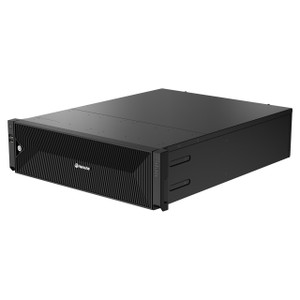
Hanwha XRN-6420DB4-1 60TB 64-Channel Network Video Recorder
When you're deploying a multi-building campus, high-density retail environment, or distributed enterprise site requiring centralized recording, channel count and storage capacity determine whether you're managing one recorder or three. The Hanwha XRN-6420DB4-1 delivers 64 IP camera channels with 60TB of pre-installed storage in a single 4U chassis, eliminating the complexity and cost of splitting recording duties across multiple platforms while providing room for expansion as surveillance requirements grow.
Key Features
- 64 IP camera channels support simultaneous recording from high-megapixel cameras across distributed locations
- 60TB pre-installed storage provides weeks to months of retention depending on camera resolution, bitrate, and motion activity
- 4U rackmount form factor integrates into existing server room and IT infrastructure with standard mounting hardware
- H.265/H.264 codec support reduces bandwidth consumption and storage requirements without sacrificing image quality
- RAID configuration options protect against drive failure and minimize downtime in mission-critical deployments
- Multiple display outputs enable simultaneous live view on operator workstations and NOC video walls
- Dual Gigabit Ethernet ports support network redundancy or separate management/recording network topology
- Hot-swappable drive bays allow maintenance and capacity expansion without taking the system offline
- Integration with Hanwha Wisenet WAVE VMS and third-party platforms via ONVIF provides flexible management options
The XRN-6420DB4-1 addresses the integration challenges that emerge when camera counts exceed 32-48 channels. Rather than deploying multiple smaller recorders—each requiring separate licensing, configuration, and management—this platform consolidates recording, storage, and playback functions into a single system. The 60TB capacity isn't just about raw retention; it's about avoiding the support calls that come when a 16-camera site suddenly needs to archive 90 days instead of 30, or when you add perimeter cameras that record continuously instead of on motion.
For integrators managing enterprise-scale deployments, the difference between a 32-channel and 64-channel recorder isn't just doubled capacity—it's reduced truck rolls, simplified firmware management, and the ability to standardize on a single platform across multiple sites. The combination of channel density and pre-configured storage makes this unit suitable for hospitals, universities, logistics facilities, and multi-tenant commercial properties where surveillance requirements evolve but infrastructure refresh cycles don't.