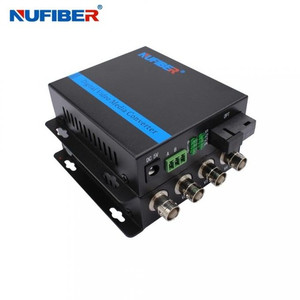
Comnet FVR412S1 4-Channel Digitally Encoded Video Receiver
Overview
The Comnet FVR412S1 is a 4-channel digitally encoded video receiver designed to recover video and bidirectional data signals transmitted over single-mode fiber infrastructure. This unit addresses long-distance surveillance deployments where traditional coaxial or twisted-pair cabling introduces signal loss or EMI — fiber optics eliminate both by operating over distances that would require repeaters or signal conditioning on copper. The FVR412S1 accepts encoded video from a corresponding transmitter and restores four independent video channels plus two bi-directional data paths for control signals, pan-tilt-zoom commands, or alarm data.
Key Features
- 4 Independent Video Channels: Recover four separate video streams from a single fiber pair. Meaningful when you're already running fiber infrastructure — you consolidate four camera feeds into one strand instead of four separate cables, reducing conduit congestion and simplifying long-distance backbone runs.
- 2 Bi-directional Data Channels: Transmit control signals back to the camera site — PTZ commands, IR control, alarm relay triggers, or serial data. Two independent paths mean you can dedicate one to PTZ and one to alarm, or load-balance asynchronous serial traffic without cross-talk.
- Single-Mode Fiber Input: Single-mode fiber carries data over much longer distances than multimode (10+ km typical vs. 300–500 m for multimode). Pick this receiver when the camera or transmitter site is kilometers away or when fiber is already in the ground.
- Digitally Encoded Video Recovery: Encoded transmission means the FVR412S1 does not amplify analog noise. It locks onto the digital bitstream and regenerates a clean video output — no signal degradation even after tens of kilometers of fiber.
- Compact 2-Pound Chassis: At 2.0 lbs and roughly 6.7 × 3.2 inches footprint, mounts on a DIN rail or shelf in a telecom cabinet without consuming significant rack space. Designed for field deployment alongside fiber termination panels and patch equipment.
- Made in the USA: Manufactured and sourced domestically, with direct channel sourcing ensuring genuine parts and support continuity for long-term remote deployments.
Integration and Deployment Context
The FVR412S1 is one half of a point-to-point fiber video link. It pairs with a Comnet FVT transmitter (or compatible encoder) on the camera end. You install the FVR412S1 at the central monitoring location — typically in a control room, NOC, or head-end facility — and connect it to a video recorder (DVR/NVR) via composite or digital video output, depending on the firmware revision. The two bi-directional data channels support RS-485 or relay contact closure, enabling you to send PTZ or iris commands back to the camera over the same fiber without a separate control cable.
Fiber-based links are standard in utility substations, large campuses, perimeter fences, and highway corridors where trenching copper is impractical or where electrical noise from power transmission demands isolation. The FVR412S1 fits into these architectures as the end point where the fiber backbone terminates and video re-enters the analog/digital domain.
Physical and Environmental Specifications
The unit measures 14 × 6.7 × 3.2 inches and weighs 2 pounds, typical for a compact receiver chassis. It is rated for operation in telecom enclosures and climate-controlled facilities. Consult the manufacturer datasheet for specific operating temperature range and power input requirements, as the evidence does not include detailed environmental or power specs. The housing is metal, suitable for standard DIN rail or mounting bracket installation.
What's in the Box
Package contents are not specified in the available documentation. Contact the manufacturer or supplier for a complete list of included cables, mounting brackets, and documentation.
Frequently Asked Questions
Q: Does the FVR412S1 require a matching transmitter?
A: Yes. The FVR412S1 is a receiver and must be paired with a compatible Comnet fiber video transmitter (such as an FVT series unit) installed at the camera or video source location. The transmitter encodes the video and data channels and sends them over single-mode fiber to this receiver.
Q: What is the maximum fiber distance supported by the FVR412S1?
A: Single-mode fiber typically supports distances of 10+ kilometers, far exceeding multimode capability. Exact maximum distance depends on the specific transmitter model and any optical signal degradation over the fiber route. Consult the paired transmitter datasheet for confirmed specifications.
Q: Can I use multimode fiber with the FVR412S1?
A: The FVR412S1 is designed for single-mode fiber input. Using multimode fiber would require a different receiver model or optical adapter. Confirm compatibility with the manufacturer before substituting fiber types.
Q: What type of video output does the FVR412S1 provide?
A: Video output format (composite, SDI, or other) is not specified in the available documentation. Contact the manufacturer or consult the product datasheet for exact output specifications and compatibility with your recorder or display system.
Q: Are the bi-directional data channels separately switchable?
A: The FVR412S1 includes two independent bi-directional data channels. They operate in parallel and can carry different types of control data (PTZ, alarms, serial) simultaneously. Configuration details are in the product manual.
Q: What is the country of origin for the FVR412S1?
A: The unit is manufactured in the United States, supporting domestic sourcing requirements for government or critical infrastructure deployments.
I've deployed Comnet fiber receivers like the FVR412S1 on several large campus and utility projects where the distance between camera sites and the NOC stretched beyond what twisted-pair or coax could reliably handle. The four independent video channels over a single fiber pair eliminate the cable-counting headache — instead of running four separate fiber strands or four coax cables, you get all four camera feeds plus bidirectional control in one infrastructure package.
Technical Highlights:
- 4 Digitally Encoded Video Channels: Each channel is independently recovered and regenerated, so signal quality does not degrade with distance. On a 15 km fiber run, you get the same picture as 15 meters — no amplifier noise, no attenuation artifacts.
- 2 Bi-directional Data Channels: Separate control paths mean PTZ and alarm relay don't compete for bandwidth. I typically dedicate one to RS-485 PTZ and one to contact closure alarms, eliminating the need for a separate control cable run.
- Single-Mode Fiber Architecture: Single-mode fiber is the standard for anything beyond 500 meters. Multimode would limit you to a few hundred meters; single-mode gives you 10+ km with regenerative repeaters available for longer runs.
Deployment Considerations:
- The FVR412S1 is a receive-only device — you must pair it with a matching FVT transmitter at the camera end. Plan the transmitter installation before committing to the receiver; incompatible models waste money and delay commissioning.
- Fiber termination and polarity matter. Single-mode fiber couplers are directional (TX and RX fibers must be correct). Mislabeled or swapped fiber pairs are a common field gotcha that looks like the receiver is broken when it is just inverted.
The FVR412S1 is built for perimeter and campus surveillance where fiber backbone is already deployed or where electrical isolation from power transmission lines is a hard requirement. If your distance is under 300 meters and budget is tight, twisted-pair extenders are cheaper; if you are already pulling fiber, this receiver pays for itself in cabling and maintenance.