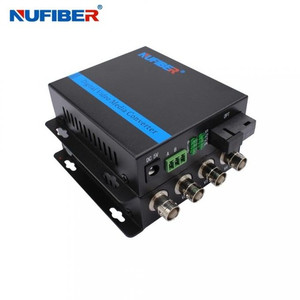
Comnet FVR4012S1 4-Channel Video + Data Fiber Receiver
Overview
The Comnet FVR4012S1 is a 4-channel digitally encoded video receiver paired with 2 bi-directional data channels and 1 contact closure channel, all multiplexed over a single strand of single-mode optical fiber. This is the receive end of a fiber-optic transmission system designed for long-distance CCTV deployments where electrical isolation, immunity to ground loops, and distance are non-negotiable. Typical applications include freeway or arterial surveillance, remote industrial facilities, airport perimeter systems, and traffic signal integration where camera sites are 10–69 kilometers distant and conventional coaxial cable becomes impractical.
Key Features
- 4-Channel 10-Bit Digital Video: Each video channel accepts standard 1V pk-pk composite (NTSC, PAL, or SECAM) at 75Ω and encodes it into 10-bit digital format for transmission. This encoding preserves fine luminance gradation over long fiber runs—critical when you need readable license plates or facial detail after 50+ kilometers of optical transport. Maximum bandwidth per channel is 6.5 MHz, supporting full color CCTV to 6 MHz without roll-off.
- 67 dB Signal-to-Noise Ratio: The SNR of 67 dB typical means minimal visible noise floor in the recovered video, even at maximum optical loss (23 dB power budget). Compared to older analog fiber systems, this translates to forensic-grade footage quality suitable for evidence capture and facial recognition preprocessing.
- Single-Mode Fiber to 69 km: The FVR4012S1 operates at 1310/1550 nm wavelengths with a 23 dB optical power budget, extending reliable transmission to 69 kilometers (43 miles) on single-mode fiber. This eliminates the distance ceiling of multimode or analog fiber—deploy cameras at truly remote locations without intermediate repeaters.
- Dual-Channel RS232/422/485 Data Interface: Two independent data channels support RS232, RS422, or RS485 (2-wire or 4-wire) protocols at data rates from DC to 250 kbps. Bit error rate is less than 1 in 109 at maximum optical loss, meaning your PTZ commands, telemetry, and control signals arrive intact and synchronized with video. No jitter, no data corruption over distance.
- One Bi-Directional Contact Closure Channel: SPST relay output rated 0.5 A with 0.5 msec response time for alarm integration, gate control, or siren triggering. The contact closure travels the same fiber as video and data—one cable pulls duty for everything.
- -40°C to +75°C Operating Range & NEMA TS-1/TS-2 Compliance: Independent laboratory testing confirms full compliance with NEMA TS-1/TS-2 and Caltrans specifications for ambient extremes, mechanical shock, vibration, humidity with condensation, high/low line voltage, and transient surge protection on all power and signal lines. This is purpose-built for unconditioned roadside or out-of-plant installations where equipment lives outdoors year-round.
- 4W Power Budget from 8–15 VDC: Low power draw (4W) and wide voltage tolerance mean the FVR4012S1 runs on a single small power supply or shared 12VDC rail without straining the supply. Automatic resettable solid-state overcurrent protection safeguards against wiring faults.
- Bi-Color LED Status Indicators: Red/green LEDs signal video sync presence and system status at a glance. Useful for field troubleshooting before you pull diagnostic equipment to a remote site.
- Lifetime Manufacturer Warranty: Comnet backs the FVR4012S1 with a lifetime warranty, reflecting confidence in MTBF >100,000 hours in rugged field conditions.
Integration & Compatibility
The FVR4012S1 is the receive module; pair it with a Comnet FVT4012S1 transmitter at the camera end. The system accepts standard composite video from any NTSC, PAL, or SECAM camera—no proprietary image sensor required. Video input overload tolerance exceeds 1.5V pk-pk, accommodating driver output variations without clipping. The 10-bit encoding is transparent to the receiving VMS; the recovered analog video output (BNC connectors, gold-plated center pins) plugs directly into any DVR or frame grabber that accepts composite video. Data channels integrate with serial-based PTZ controllers, SCADA gateways, or toll/traffic management systems via terminal block connections.
Maximum coaxial distance from the FVR4012S1 output to your DVR is 100 meters (300 feet) while maintaining 6 MHz bandwidth. For longer runs to a central facility, cascade the recovered video into a fiber transmission stage or use short runs and re-drive with a distribution amplifier.
What's in the Box
Evidence does not provide a detailed package contents list for the FVR4012S1. Contact the manufacturer directly or consult the product documentation for specific included accessories and mounting adapters.
Frequently Asked Questions
Q: What is the difference between the FVR4012S1 and the FVR4012M1?
A: The FVR4012S1 is configured for single-mode fiber; the FVR4012M1 variant is multimode. Single-mode extends range to 69 km; multimode is suitable for shorter runs (typically under 5 km) where cost of the transmitter is the driver. Choose single-mode if your camera site is more than 5 km away or if you need maximum isolation and future-proofing.
Q: Can I use the FVR4012S1 with analog security cameras?
A: Yes. The FVR4012S1 accepts standard composite video (NTSC, PAL, or SECAM) from any analog camera and recovers that same analog video at the receiver output. It does not require IP cameras or complex encoding schemes.
Q: What is the power budget and maximum optical distance?
A: The optical power budget is 23 dB at 1310/1550 nm wavelengths, supporting distances up to 69 kilometers (43 miles) on single-mode fiber. Actual distance depends on fiber condition and splicing losses.
Q: Does the FVR4012S1 require any optical or electrical adjustments during installation?
A: No. The FVR4012S1 is plug-and-play. Simply connect the ST optical connector, BNC video outputs, and terminal block power and data connections. No field adjustments are required.
Q: What environmental certifications does the FVR4012S1 hold?
A: The unit is tested and certified by an independent laboratory for NEMA TS-1/TS-2 and Caltrans specifications, covering ambient temperature extremes, mechanical shock, vibration, humidity with condensation, high/low line voltage, and transient surge protection.
Q: What is the warranty on the FVR4012S1?
A: Comnet provides a lifetime manufacturer warranty on the FVR4012S1, backed by MTBF >100,000 hours in field conditions.
The FVR4012S1 solves a real problem: how do you pull forensic-quality video 40+ kilometers without breaking the installation budget or introducing ground-loop hum. I've seen integrators fight with analog fiber extenders that chew up bandwidth and introduce sync issues. The FVR4012S1 takes the opposite approach—10-bit digital encoding locks in the video quality at the transmitter, and the 23 dB optical power budget buys you 69 kilometers of reach on single-mode fiber. Pair it with an FVT4012S1 at the camera, and you have a system that hands off clean analog composite video at the receive end, ready for any legacy DVR or modern frame grabber.
Technical Highlights:
- 10-Bit Digital Encoding + 67 dB SNR: Translates to readable facial detail and legible text in low-light scenes after 50+ km of fiber travel. Older analog fiber systems degrade noticeably; this one doesn't. The 67 dB noise floor is forensic-grade, suitable for evidence admissibility work.
- 23 dB Optical Power Budget at 1310/1550 nm: Unlocks 69 km range on single-mode fiber without intermediate repeaters or signal regeneration. Real-world: a freeway or arterial project where the central station is 50 km from the remote camera site. One fiber, one shot.
- RS232/422/485 Data to 250 kbps, <1 in 109 BER: PTZ commands, gate signals, and toll collection data arrive synchronized with video, with vanishingly low error rates. No re-transmissions, no jitter. The 0.5 msec contact closure response means gate triggers feel instantaneous to the operator.
- -40°C to +75°C, NEMA TS-1/TS-2 Certified: Tested for ambient extremes, mechanical shock, vibration, humidity with condensation, and transient surge protection. This isn't a lab bench unit; it's rated for unconditioned roadside cabinets and pole-mounted enclosures.
Deployment Considerations:
- You need a matching FVT4012S1 transmitter at the camera end. The FVR4012S1 is receive-only. If you're retrofitting, confirm the transmitter is single-mode compatible.
- The recovered video is analog composite, not IP. If your central facility is IP-only, you'll need a separate composite-to-IP gateway or hybrid DVR with analog inputs. Plan this before ordering fiber runs.
- Maximum coaxial distance from the FVR4012S1 output to your DVR is 100 m at 6 MHz bandwidth. If your facility is farther, re-drive with a distribution amp or push the fiber run all the way to the DVR.
Use the FVR4012S1 for remote traffic camera networks, airport perimeter surveillance, or industrial facility monitoring where distance and electrical isolation are drivers and legacy composite cameras are already deployed. If you're building a new greenfield system, IP over fiber is often simpler. If you're extending an analog CCTV system across town or across a region, this module earns its place.