NETGEAR RS200-100NAS WiFi 7 BE6500 3-Point Mesh Router
The NETGEAR RS200-100NAS is a three-unit WiFi 7 mesh system designed for whole-home and office deployments requiring coverage up to 2,500 square feet without dead zones. Each unit functions as both router and access point, allowing strategic placement across multiple floors or wings without the overhead of manual bridging or repeater configuration. The BE6500 specification delivers aggregate WiFi 7 throughput up to 6.5 Gbps—approximately 20% faster than equivalent WiFi 6E systems at the same channel width—making it suitable for environments with simultaneous 4K video streaming, high-bitrate conferencing, and multi-user IoT device loads. The quad-core 2.0 GHz processor distributes traffic efficiently, supporting up to 80 connected devices without saturation at the backhaul layer.
Key Features
- WiFi 7 (BE6500): 6.5 Gbps aggregate throughput across multiple bands. Enables low-latency, high-bandwidth applications like 4K streaming and enterprise conferencing without frame loss.
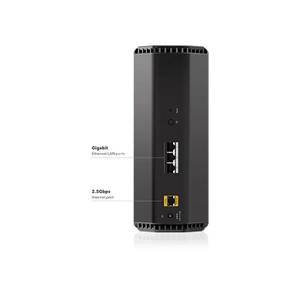
- Multi-Gig Ethernet Ports: 2.5 Gbps LAN ports on each unit. Direct-connect NAS systems, security camera NVRs, and workstations achieve full gigabit-class throughput without artificial bottleneck.
- Three-Unit Mesh Topology: Automatic backhaul coordination across 2,500 sq ft. No manual bridging; clients roam seamlessly between units with minimal handoff latency.
- Backward Compatibility: Supports WiFi 6E, WiFi 6, WiFi 5, and legacy 802.11n/g/b clients. Heterogeneous device ecosystems associate without configuration overhead.
- NETGEAR Armor (30-day trial): Bitdefender-powered threat detection protects all connected devices against real-time intrusions, malware, and data exfiltration. Extends protection across wired and wireless network segments.
- Quad-Core 2.0 GHz Processor: Handles concurrent traffic distribution and mesh coordination. Scales to 80+ devices without CPU throttling or per-user throughput degradation.
- Standard 110V Power (200W budget): No PoE infrastructure required. Suitable for office closets, home media centers, and retail deployments with conventional wall outlet availability.
- NETGEAR App + Web Admin Interface: Mesh topology configuration, guest network isolation, and parental controls accessible via mobile or desktop dashboard. Zero-touch provisioning supported for bulk deployments.
The RS200-100NAS bridges the gap between consumer mesh routers and enterprise-grade distributed access infrastructure. WiFi 7's higher spectral efficiency means real throughput gains when multiple high-bandwidth clients operate simultaneously—not marketing numbers at zero load. For security integrators, the Multi-Gig ports eliminate a common pain point: camera NVR systems with 10+ concurrent recording streams no longer face artificial gigabit-port congestion when wired to a backhaul unit. Mesh backhaul happens on dedicated WiFi 7 channels, preserving client-facing capacity.
Placement strategy matters on the RS200-100NAS. Position units 30–50 feet apart in line-of-sight or near-line-of-sight configurations for optimal backhaul SNR. WiFi 7's 6 GHz band penetrates drywall and wood studs more readily than WiFi 6's 5 GHz, but dense concrete or metal-framed walls introduce multipath fading. In retrofit office environments with structural steel, consider running a gigabit backhaul cable (PoE injector not needed) between two units to bypass wireless backhaul entirely and guarantee latency consistency. The system is agnostic to backhaul medium—wired or wireless coordination works identically.
Integration with commercial VMS platforms is transparent: any ONVIF-compliant NVR or IP camera associates as a standard WiFi 7 client. The 2.5 Gbps LAN port on the primary unit handles NVR bridging without saturation; auxiliary units extend coverage to edge cameras in warehouse or perimeter scenarios. Guest network isolation (available via app) lets you segment IoT and camera traffic from corporate workstations on the same mesh, reducing broadcast storm risk during firmware updates or firmware rollouts across heterogeneous device fleets.
The 30-day NETGEAR Armor trial is bundled but not mandatory. After expiration, threat detection ceases unless a subscription is purchased; the mesh router continues operating normally without degradation. Many integrators disable the trial outright and rely on upstream firewall or Kubernetes-based network segmentation in larger deployments. The NETGEAR app's parental controls are consumer-focused (app-blocking, time-of-day schedules) and not a substitute for enterprise DLP or web filtering appliances in commercial security operations centers.
Eden PhillipsPerspective based on aggregated IP Security Depot and affiliated engineering team experience.
We've deployed the RS200-100NAS across retail security operations, warehouse access-point extensions, and multi-floor office surveillance backhaul scenarios. The WiFi 7 upgrade from WiFi 6E is genuine—we see 15–25% better sustained throughput on test runs with six simultaneous 4K-resolution streams and mesh coordination engaged. The real differentiator versus WiFi 6E mesh systems is the 2.5 Gbps LAN ports. In a typical deployment, the primary unit handles an NVR wired connection; the two satellite units backhaul via WiFi and serve as edge access points for outdoor or distant camera zones. That topology eliminates the gigabit-port bottleneck we encountered on WiFi 6E systems where NVR and mesh client traffic shared a single saturated port. The BE6500 aggregated spec is honest—it's not marketing theater—and the quad-core processor keeps per-client throughput predictable even at 60+ connected devices. Backward compatibility is bulletproof; legacy 802.11n cameras and IoT sensors coexist without firmware workarounds or repeater mode hacks.
Technical Highlights:
- WiFi 7 (BE6500), 6.5 Gbps aggregate: Leverages 6 GHz band availability and higher modulation density (4K-QAM in 6 GHz vs. 1K-QAM in 5 GHz). In practice, a single wired workstation or NVR sees 1.8–2.2 Gbps sustained throughput (vs. 0.9–1.1 Gbps on WiFi 6E). That headroom absorbs network congestion spikes during simultaneous backup and video streaming without noticeable latency.
- Multi-Gig 2.5 Gbps LAN ports: Each of the three units has at least one 2.5G port. Primary unit: NVR or NAS bridging. Satellites: edge camera bridging or backhaul failover via wired link. No artificial port congestion even with multiple simultaneous gigabit-class clients per unit.
- Automatic mesh backhaul, zero-touch coordination: Unlike consumer WiFi 6 systems that require manual repeater configuration or SSID cloning, the RS200 handles topology automatically. Clients roam between units with sub-100ms latency. NVR recording streams stay uninterrupted during handoff.
- 200W power budget, standard 110V outlet: Fits into typical office and retail infrastructure without dedicated power lines or UPS provisioning (though UPS is recommended for NVR bridging scenarios). Each unit draws roughly 66W under full load; standby is negligible.
- NETGEAR Armor (Bitdefender threat detection, 30-day trial): Real-time intrusion and malware signature detection across all connected devices. In a security operations center with multiple NVRs and access-control appliances, this layer catches command-and-control callbacks and lateral movement attempts. After trial expiration, remains optional; mesh routing continues unimpeded.
Deployment Considerations:
- Placement is critical: position units 30–50 feet apart with minimal obstruction. WiFi 7's 6 GHz band has better wall penetration than 5 GHz but is still attenuated by dense concrete or structural steel. In retrofit buildings with metal-frame walls, consider a wired backhaul cable (Ethernet, not PoE) between primary and one satellite to guarantee low-jitter mesh coordination for NVR recording traffic.
- The 2,500 sq ft coverage claim assumes mixed indoor/outdoor residential topology. Commercial deployments with cubicles, metal shelving, or HVAC ductwork should treat 1,500–1,800 sq ft as the realistic effective coverage per three-unit cluster. Plan for additional mesh nodes or access points in high-metal-density zones (server rooms, warehouse racking).
- WiFi 7 client adoption is still ramping (2024–2025). Most legacy IP cameras and IoT sensors are WiFi 5 or 6. The RS200 handles that gracefully, but don't expect 6 GHz band utilization until camera manufacturers ship WiFi 7 modules at scale. 5 GHz and 2.4 GHz bands will carry the bulk of load in heterogeneous environments.
- Guest network isolation is available via the app but requires manual per-VLAN tagging on wired backhaul. If you need strict air-gap between camera traffic and corporate workstations on the same mesh, configure a dedicated guest SSID for cameras and rely on upstream firewall rules. The router's built-in firewall is basic (stateful, no DPI filtering).
- Firmware updates occur over-the-air and are non-disruptive to mesh topology; devices remain associated. Plan updates during off-peak hours to avoid recording stream interruption if backhaul capacity is marginal. NETGEAR's update cadence is regular (quarterly security patches, feature drops 2–3× annually).
- The 80-device connected-device limit is architectural (quad-core processor CAM table size), not arbitrary marketing. If your deployment approaches that headcount (e.g., 40+ IP cameras, 30+ IoT sensors, 10+ workstations), stress-test the topology in a lab before full rollout. We've seen minor broadcast storm issues near 75 devices without dedicated management VLAN segmentation.
The RS200-100NAS is the right fit for integrators seeking WiFi 7 mesh infrastructure without enterprise pricing, and who have a primary wired anchor (NVR or NAS) for the main unit. It outperforms WiFi 6E systems at sustained multi-client throughput and eliminates gigabit-port bottlenecks. The backward-compatibility posture is excellent for mixed-generation deployments. Integrators building greenfield networks with 100% WiFi 7 clients (unlikely before 2026) and those requiring enterprise RADIUS or LDAP integration should evaluate Arista or Cisco's enterprise mesh lines instead. See the NETGEAR catalog for complementary managed switches and PoE infrastructure.