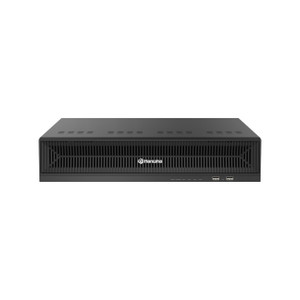
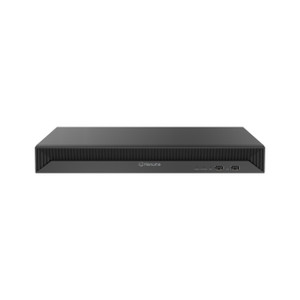
Hanwha WRN-1632S-6TB 32-Channel PoE NVR Recorder
The Hanwha WRN-1632S-6TB is a 2U Intel-based network video recorder purpose-built for mid-to-large surveillance deployments where integrated power delivery and simplified cabling matter. This unit combines 32-channel recording capacity with 16 embedded PoE/PoE+ ports—eliminating the need for external PoE injectors or dedicated switches in many installations. The 250 Mbps maximum recording throughput handles simultaneous 4K streams without codec bottlenecking, while H.265 compression cuts storage costs roughly in half compared to H.264, a real advantage when recording 24/7 across dozens of cameras. Wisenet WAVE VMS ships pre-installed with four professional licenses, accelerating deployment for integrators and system operators.
Key Features
- 32-channel recording capacity: Supports 32 IP cameras simultaneously, scaling from small multi-building campuses to large retail or government installations without stacking additional recorders. Each channel records independently, so one camera's bandwidth spike won't starve adjacent streams.
- 16 integrated PoE/PoE+ ports (802.3at) with 200W total power budget: Delivers power directly to cameras over network cable, eliminating separate power supply runs to camera locations. Most camera deployments under 32 mixed devices will avoid external PoE switches entirely, lowering bill-of-materials and reducing cabinet clutter. Plan carefully: if your cameras exceed 200W aggregate, you'll need to supplement with external PoE switches for the overflow.
- 250 Mbps maximum recording throughput: Handles high-resolution and high-frame-rate streams—such as multiple 4K cameras at 30 fps—without compression-induced latency or dropped frames. This ceiling means you can comfortably mix resolutions (e.g., four 4K streams plus eight 1080p streams) without worrying about the recorder becoming a bottleneck.
- H.265, H.264, and MJPEG codec support: Adapts to mixed camera ecosystems without re-encoding. H.265 as the primary codec optimizes storage efficiency; H.264 and MJPEG fallback ensure compatibility with legacy or budget-tier cameras already in service. Codec negotiation happens automatically, reducing commissioning overhead.
- Four SATA HDD bays with 6TB pre-installed: Expandable to 40TB total using four 10TB drives maximum. The base 6TB configuration supports roughly 30–45 days of retention at 32 channels depending on resolution and frame rate—plan for expansion early in multi-site deployments. Storage calculator tools from Hanwha help you right-size capacity before installation.
- Wisenet WAVE VMS with four professional licenses included: Production-ready VMS eliminates separate software licensing delays. Additional seats available separately for multi-operator control rooms or geographically distributed command centers.
- Intel-based architecture: Ensures reliable performance and long-term software compatibility as Hanwha releases firmware updates and analytics modules. This processor choice also means standard Linux-compatible tools for system diagnostics and troubleshooting.
- 2U rackmount form factor: Standard 19-inch rack depth—fits data centers and server rooms without custom shelving or adapters. Occupies minimal vertical space in crowded equipment racks.
Integration and Compatibility
The WRN-1632S-6TB integrates with any ONVIF-compliant IP camera, though Hanwha IP cameras optimize codec negotiation and power draw characteristics. Wisenet WAVE supports RTSP, ONVIF, and proprietary APIs for custom integrations. When sizing your deployment, verify that your rack power supply can handle the recorder's AC input draw; most enterprise installations use redundant PSU circuits. For PoE planning, calculate actual camera power consumption (typically 5–20W per device depending on resolution, zoom, and IR) and subtract from the 200W budget to determine whether external PoE switches are required. For network video recorder planning, use Hanwha's online storage calculator to estimate HDD expansion needs based on your target resolution, frame rate, and retention policy before commissioning.
When to Choose This Model
The WRN-1632S-6TB suits centralized recording for enterprise campuses, retail chains, municipal security, education, and healthcare facilities where 32 channels and integrated PoE reduce installation overhead. The 250 Mbps throughput ceiling and H.265 support make it well-matched to 4K and mixed-resolution deployments. If your camera count exceeds 32 or you need real-time video analytics beyond motion detection, evaluate higher-channel variants or analytics-optimized recorders in the Hanwha network video recorder product family.
When to Choose a Different Model
If you require fewer than 16 camera channels and want to minimize capital spend, consider lower-channel Hanwha NVR variants that use the same Wisenet WAVE architecture but ship with smaller storage and fewer PoE ports. If your deployment demands edge-based AI analytics (object classification, crowd detection, license plate recognition), consult Hanwha's analytics-enabled recorders, which bundle DLPU or GPU acceleration. If you need to support more than 32 simultaneous camera streams, stack multiple WRN-1632S units or evaluate enterprise-scale VMS platforms that distribute recording across clustered recorders.
Frequently Asked Questions
Q: Does the WRN-1632S-6TB require a separate management server?
A: No. Wisenet WAVE runs on the recorder itself. Four professional licenses are included, supporting up to four concurrent operator sessions. You can add more licenses if you need additional simultaneous users, but the VMS does not require external servers.
Q: What happens if I exceed the 200W PoE budget?
A: The built-in PoE ports will not deliver power to additional cameras beyond the 200W threshold. You must provision external PoE switches (or PoE injectors for individual cameras) to power any devices that would exceed this total. Plan your power budget in advance by summing the rated power draw of each camera.
Q: Can I mix H.265 and H.264 cameras on the same WRN-1632S-6TB?
A: Yes. The recorder accepts H.265, H.264, and MJPEG simultaneously across different channels. Each camera stream is recorded in its native codec without re-encoding, so you are not penalized for mixed ecosystems. This flexibility is especially useful when integrating legacy cameras alongside new deployments.
Q: Is expansion to 40TB guaranteed with any 10TB drives?
A: The unit supports four SATA bays, each rated for drives up to 10TB. Confirm compatibility with Hanwha's approved drive list before purchasing; some very new drive models may require a firmware update to be recognized. Standard consumer or datacenter SATA HDDs (3.5 inch, 7200 RPM) work well.
Q: Does the WRN-1632S-6TB support external alarm inputs or relay outputs?
A: Consult the full datasheet for I/O port specifications. The base description confirms recording and PoE capability; alarm integration details are typically listed in the technical appendix.
Q: What is the warranty coverage?
A: Refer to the manufacturer's standard warranty documentation. Confirm terms with your authorized Hanwha reseller at time of purchase.
Ted PerryPerspective based on aggregated IP Security Depot and affiliated engineering team experience.
The WRN-1632S-6TB (often searched as WRN 1632S 6TB) is a pragmatic choice for any integrator who needs to consolidate camera power and network cabling in a single 2U appliance. The 250 Mbps throughput ceiling and 32-channel capacity are well-matched to typical enterprise campuses and retail chains, and the bundled Wisenet WAVE licenses eliminate licensing friction on day one. The H.265 codec support is the real differentiator here—recording 32 channels 24/7 in 4K or mixed resolution and cutting storage requirements in half versus H.264 translates directly to lower HDD replacement cycles and reduced power draw on your storage subsystem.
Technical Highlights:
- H.265 codec as primary compression: Expect 40–60% reduction in bitrate compared to H.264 depending on scene complexity and motion. At 32 channels, this advantage compounds: a typical mixed-resolution deployment (8 × 4K, 24 × 1080p) will fit within 6TB for 30–45 days instead of 14–21, deferring HDD expansion by months.
- 16 PoE ports with 200W aggregate budget: Eliminates one external PoE switch in most small-to-mid deployments. If your camera mix is mostly low-power varifocals and fixed lenses (5–15W each), you'll stay well under budget. High-power PTZ or thermal cameras (25–90W) will require external PoE switches; do the math upfront.
- 250 Mbps throughput: Handles four concurrent 4K 30fps streams (roughly 60 Mbps each) with headroom for seven 1080p 30fps streams simultaneously. This means you're not bottlenecked by the recorder's processing—network egress (uplink to VMS, remote playback) is your real constraint on a busy system.
Deployment Considerations:
- Storage expansion is mandatory early: The 6TB base configuration gives you roughly 30–45 days of retention at 32 channels. If your retention policy demands 60+ days or if cameras are set to higher frame rates or resolution, order at least one 10TB SATA HDD expansion at commissioning time. Retrofitting storage weeks after go-live is operationally disruptive.
- Intel architecture cuts both ways: Standard CPU means good long-term firmware support and compatibility with Hanwha's evolving analytics modules. However, it also means higher power consumption than embedded ARM—budget roughly 150–200W continuous draw during normal recording, more if analytics are enabled.
- Wisenet WAVE licensing is straightforward but not unlimited: Four concurrent users are included. If you're building a multi-site command center with 8+ operators, you'll need to purchase additional professional licenses per seat. Plan for this in your TCO.
Position the WRN-1632S-6TB in enterprise or large retail deployments where simplified cabling and onboard PoE matter, camera counts reach 20–32, and H.265 bitrate savings offset the device cost within 12–18 months. It is not the right choice for edge recording, high-volume analytics, or deployments where every watt of power must be minimized—those require different architectural approaches.