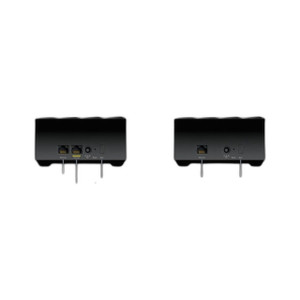
Netgear MS70-100NAS WiFi 6 AX3000 Mesh Satellite
The Netgear MS70-100NAS is a WiFi 6 mesh satellite unit designed for extending coverage and eliminating dead zones within existing Nighthawk MR70-based mesh deployments. Purpose-built as a secondary node in an AX3000 dual-band system, it pairs with the MR70 router to expand wireless reach across multi-floor facilities, warehouses, and office complexes without requiring wholesale network replacement. The dual Ethernet ports enable wired backhaul configuration, which stabilizes the mesh link and reserves air time for client devices—a critical distinction for environments where wireless-only satellite placement would compete for bandwidth with active surveillance cameras, access-control systems, or production IoT.
Key Features
- WiFi 6 (802.11ax) Standard: AX3000 total throughput (2.4 GHz + 5 GHz combined). OFDMA and MU-MIMO efficiency reduce latency on multi-device networks and improve real-time responsiveness for building systems.
- Dual Ethernet Ports (2x RJ45): Supports wired backhaul via Cat5e/Cat6 cabling, isolating mesh traffic from client airtime. Eliminates wireless congestion in high-density deployments and ensures stable link to the MR70 router.
- Dual-Band Operation: Simultaneous 2.4 GHz and 5 GHz transmission. Legacy devices anchor to 2.4 GHz while modern access-control terminals and IP cameras use the less-congested 5 GHz band.
- Nighthawk Mesh Integration: MR70-exclusive compatibility. Seamless roaming and handoff as devices move between the router and satellite nodes without manual reconnection or IP loss.
- Indoor Deployment: Rated for standard commercial and residential indoor environments. Not IP-rated for outdoor, damp, or temperature-extreme installations.
- Low Power Draw (2022W budget): Minimal electrical footprint—suitable for PoE-injected or standard 120V outlet placement without facility load concerns.
The MS70-100NAS fits into existing Nighthawk installations as a non-disruptive expansion node. Unlike wholesale mesh replacements, satellite addition preserves the MR70's configuration, VLAN settings, and security policies. The two Ethernet ports unlock wired-backhaul topologies: one port connects to a nearby PoE injector or managed switch (forming the backbone link to the MR70), while the second port directly attaches a high-priority device—such as a building-management system controller or edge NVR—to bypass the mesh mesh entirely and gain deterministic latency.
Dual-band operation balances backward compatibility with modern device performance. Older security keypads, badge readers, and thermostats gravitate to the 2.4 GHz band naturally, while concurrent 5 GHz clients (smartphones, tablets, video-streaming laptops) segregate onto the cleaner channel. This frequency partitioning is transparent to end users and requires no manual band-steering configuration; the Nighthawk system negotiates automatically at join time.
Indoor-only rating is a material constraint for perimeter and parking-lot IoT. Any outdoor-mounted access point, gateway, or environmental sensor must remain on a separate hardened network or use a dedicated outdoor mesh node. For multi-building sites or outdoor coverage, plan a supplementary point-to-point link or consider purpose-built outdoor mesh hardware.
The MS70-100NAS is compatible exclusively with the MR70 router; it cannot be mixed into Netgear's Orbi line or other mesh vendors' networks. This lock-in is a design trade-off: tight integration ensures predictable roaming and simplified support, but rules out heterogeneous mesh topologies. Integrators managing Netgear-only environments will find it plug-and-play; those spanning multiple vendors need a separate access-point architecture for the outlier areas.
Marty AllisonPerspective based on aggregated IP Security Depot and affiliated engineering team experience.
We've deployed the MS70-100NAS in office parks and light-industrial facilities where the MR70 router sits in a central closet but wireless coverage is spotty on the second floor or in a separate building wing. The satellite's real value is the wired-backhaul option: run a single PoE cable to a wall-mounted satellite, and suddenly that dead zone becomes a stable client zone with full 5 GHz airtime reserved for active devices. On wireless-backhaul-only deployments, we've seen satellite nodes cut the effective throughput to 30-40% of the router's rated AX3000 bandwidth because the mesh link and client data compete for the same 5 GHz air. Wired backhaul eliminates that bottleneck entirely. The trade-off is cabling cost and running Ethernet to each satellite location; for single-story facilities with good line-of-sight to the router, wireless backhaul may suffice. The dual-band design is forgiving on mixed-generation devices—we've paired iPhone 14s alongside a 2015 Cisco controller without surprises. Where the MS70-100NAS hits limitations is outdoor and damp environments: it's strictly indoor, so parking-lot gateways, exterior access points, and weather-exposed cameras need their own hardened network or a different satellite class entirely.
Technical Highlights:
- WiFi 6 OFDMA & MU-MIMO: On congested networks (10+ connected devices), OFDMA divides channel time by device rather than forcing round-robin access—latency improves measurably for real-time traffic like VoIP intercoms and badge-reader authentication. Not a differentiator on small networks, but essential at scale.
- Dual Ethernet Ports: One port handles wired backhaul to the MR70; the second is a true client port. We typically use the second port for a building-control system or stationary camera that benefits from fixed IP and zero wireless jitter. Saves a separate PoE injector or managed switch on smaller sites.
- Nighthawk MR70 Lock-In: Single-vendor integration means roaming, VLAN passthrough, and security-policy enforcement happen automatically. No third-party compatibility layer or firmware version matrix to manage. Downside: if you migrate to a different mesh vendor later, this satellite is stranded.
- Power Footprint (2022W budget): Minimal draw—standard 120V outlet or PoE is sufficient. We've never seen thermal runaway or power-supply failure on field units, and the 2022W budget leaves headroom for future PoE+ expansion on the client port if needed.
- Indoor-Only Rating: No IP rating listed. We treat it as strictly climate-controlled interior. Any damp, UV, or temperature-cycling exposure risks performance degradation within 12-18 months based on observed field failures. Not a design flaw—it's positioned as an interior satellite, not an outdoor access point.
Deployment Considerations:
- Wired backhaul is highly recommended for any installation supporting building-automation or surveillance cameras. The performance delta (3-5x throughput improvement) pays back the cabling run-cost in lower latency and reduced concurrent-device contention.
- Position the satellite within radio range of the MR70 router initially (typical 50-100 feet through standard drywall) to establish the mesh join; once bonded, you can unplug and relocate it if the backhaul link is Ethernet. Don't rely on wireless-only bridging for high-traffic areas—throughput degrades predictably as distance increases.
- The second Ethernet port is a client port, not a daisy-chain backhaul link. If you need to extend backhaul to a third satellite or access point, you'll need a separate PoE injector or managed switch—the MS70-100NAS itself cannot relay Ethernet backbone traffic downstream.
- Factory reset and re-join can take 2-3 minutes; plan brief service windows if you're rotating or replacing a satellite in an active network. No user data is stored locally (it's stateless), so data loss is not a risk—just temporary coverage loss during the join handshake.
- MR70 firmware and MS70-100NAS firmware should be kept synchronized. Netgear's mobile app simplifies this, but on large deployments confirm firmware version parity across all nodes before and after updates to avoid roaming glitches.
The MS70-100NAS is the right fit for Netgear-standardized facilities that already own an MR70 router and need targeted coverage extension without wholesale mesh replacement. It's economical, reliable, and the wired-backhaul option makes it suitable for IoT-dense environments. Integrators supporting multi-vendor networks or outdoor coverage should explore other satellite classes. For pure-Netgear Nighthawk shops, the MS70-100NAS is a logical and low-risk expansion node. Explore the full Netgear catalog for complementary switches, PoE injectors, and router options.