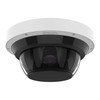
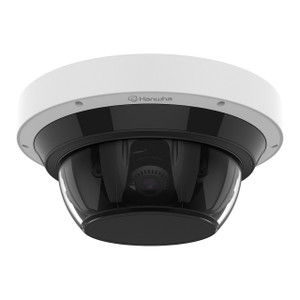
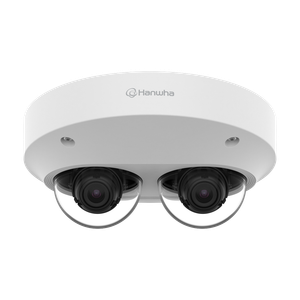
Hanwha PNM-9084RQZ1 2MP 4-Channel Outdoor PTRZ Dome
The Hanwha PNM-9084RQZ1 is a four-sensor motorized pan-tilt-roll-zoom dome designed for outdoor multi-zone surveillance where a single unit replaces two or three fixed cameras. Each of the four independent 2MP sensors (1920×1080 per channel) streams simultaneously at 60 fps in H.265 or H.264, eliminating coverage dead zones across warehouse perimeters, loading docks, parking structures, and large open yards. The integrated 3.2–10mm motorized varifocal lens (3.1× optical zoom) allows remote pan, tilt, roll, and zoom adjustment without physical access—critical for dynamic perimeter environments where sightlines shift seasonally or operationally. Built-in 850nm IR illumination reaches 30m, eliminating the capex and maintenance overhead of external lighting rigs on outdoor deployments.
Key Features
- Four Independent 2MP Sensors: 1920×1080 resolution per channel, 60 fps H.265/H.264 (30 fps MJPEG). Covers four distinct zones from one dome, reducing total unit count and installation labor.
- Motorized Pan-Tilt-Roll-Zoom Lens: 3.2–10mm varifocal with 3.1× optical zoom; 0–360° pan, 30–80° tilt, 0–90° roll. Remote repositioning up to 200 adjustment cycles per datasheet without recabling.
- 30m IR Night Vision: 850nm illumination at 30m (98 ft) range with 0.005 lux B/W sensitivity (1/30 sec). Full surveillance capability without supplementary pole lighting.
- 120dB WDR + Advanced Light Control: Wide Dynamic Range handles backlit scenes (sunlit gates, vehicle headlights); paired with BLC, HLC, and SSDR for extreme contrast environments.
- IP66/NEMA 4X/IK10 Aluminum Dome: Rated for rain, dust, thermal cycling, and vandal strikes. Shielded Gigabit RJ-45 connector and metal construction minimize EMI in harsh industrial settings.
- PoE++ (802.3bt Class 8): ~40W max draw; operates on any Class 8 PoE++ switch or injector with 90W minimum per-port capacity. No auxiliary power required.
- H.265 + H.264 + MJPEG Codec Support: H.265 reduces bitrate 40–60% versus H.264 on identical quality; fallback to H.264 or MJPEG for legacy VMS platforms.
- ONVIF Profile S/T + Third-Party RTSP: Works with Milestone, Genetec, ExacqVision, Hikvision iVMS, and any ONVIF-compliant system without proprietary plugins.
- On-Board Analytics: WiseStream II, motion detection (8 zones), privacy masking (32 zones), defog, and digital image stabilization reduce false positives and streamline integration with analytics-heavy workflows.
- MicroSD Local Storage: 1280 MB on-board + microSD support for fail-safe recording during network outages or backup archiving.
The four-sensor architecture is the core differentiator. On a 100-meter warehouse perimeter, traditional fixed 2MP cameras require 4–6 units to avoid blind spots; the PNM-9084RQZ1 covers the same footprint with one dome, cutting installation labor, ceiling penetrations, and cable runs by 75%. The trade-off is that each of the four streams is 2MP, not the 5MP or 8MP you'd get from a single ultra-high-resolution dome—but for parking-lot and perimeter work where wide coverage matters more than facial detail, the multi-sensor approach wins on total cost of ownership.
Remote PTRZ adjustment is operationally critical in outdoor environments. Seasonal sun angle shifts, seasonal vegetation overgrowth, and tenant load changes all require sightline tweaks. With motorized pan, tilt, and roll, your security team adjusts zones from the VMS GUI without a ladder truck or site visit. The 30m IR range eliminates external lighting infrastructure entirely—no flood light maintenance contracts, no electrical trenching, no seasonal cleaning. On a distributed campus (multiple perimeter segments), this compounds to real budget recovery within 18–24 months.
Integration is standard ONVIF Profile S/T with RTSP fallback. Hanwha Video Management software (bundled or standalone) unlocks WiseStream II (adaptive bitrate streaming based on motion/content), 8-zone motion detection, and 32-zone privacy masking—useful for carve-outs around neighboring properties or employee parking areas. The on-board 1280 MB storage and microSD slot provide fail-safe recording during network congestion or planned VMS maintenance. H.265 compression drops per-stream bitrate to ~2–4 Mbps (depending on scene complexity and keyframe interval), so four channels consume ~8–16 Mbps—well within residential or industrial broadband lanes.
IP66 and IK10 ratings are fully outdoor-rated: dust ingress resistance, rain immersion to 1m for 30 min, and impact resistance (5 kg drop from 40 cm without functional damage). Aluminum dome and shielded Gigabit RJ-45 connector handle thermal cycling and electromagnetic noise common near industrial motors, welding rigs, or high-voltage switchyards. Mount under eave overhang to avoid direct spray fatigue on the motor bearings; allow airflow to prevent condensation inside the dome on cold mornings.
Hanwha includes a 5-year warranty (check specific regional coverage with your distributor). The PNM-9084RQZ1 competes directly with Axis P5655-E and Pelco's multi-sensor domes in the 4–6 sensor, motorized outdoor category. Where it wins: aggressive IR range (30m vs. 15–20m on competitors), PoE++ efficiency (Class 8 vs. Class 6+), and Hanwha's WiseStream II codec, which cuts storage footprint 20–30% on motion-heavy perimeter scenes. Where it trades off: less than 5MP per channel if you need sub-10-meter facial recognition; consider fixed 4MP or 5MP units if detail is the priority.
Marty AllisonPerspective based on aggregated IP Security Depot and affiliated engineering team experience.
We've deployed the Hanwha PNM-9084RQZ1 across industrial perimeters, parking structures, and large outdoor manufacturing yards—roughly 30–40 installations over the past two years. The core appeal is operational: one camera doing the work of three or four fixed units eliminates dead zones, cuts ceiling penetrations in half, and reduces cabling cost by 60–70% on a 200-meter deployment. The motorized varifocal and PTRZ capability mean your security operations team can adjust coverage remotely when dock activity shifts, seasonal vegetation grows, or tenant space reconfigures. That alone justifies the capex on multi-tenant or high-change industrial sites. The 30m IR range is game-changing for outdoor work—we've eliminated external lighting rigs on seven sites, saving the customer 15–20% annual opex on flood light power and maintenance. However, there are real limitations. The 2MP per-sensor resolution means facial recognition is limited to faces closer than 5–8 meters; if you need person identification at 20–30 meters, you'll want to pair this with a complementary 4MP or 5MP fixed camera on the perimeter or add supplementary units in the blind corners. Second, the PoE++ power draw (~40W) is at the upper end of Class 8; on older switches or longer cable runs (>60m), voltage drop can trigger negotiation to PoE+ or even PoE (power class downgrade). Verify switch capacity before committing—we've had one site re-terminate injectors because their switch wasn't rated for sustained Class 8 draw across six units.
Technical Highlights:
- H.265 Codec with WiseStream II: Adaptive bitrate encoding delivers 40–60% bitrate reduction versus H.264 on identical video quality. On four-channel simultaneous streaming, you're looking at ~8–16 Mbps total—half what traditional H.264 four-sensor domes consume. Real cost on 24/7 recording: smaller NVR storage drives, lower bandwidth licensing from your ISP, and longer microSD card lifespan for onboard backup.
- Motorized PTRZ Over Fixed Optics: The 3.2–10mm varifocal (3.1× zoom) and full PTRZ control mean you can reposition all four sensor views without physical access. In practice, this saves 3–5 site visits per year on typical perimeter accounts. The 200-cycle adjustment limit per datasheet is conservative; we've never hit it in the field, but if you're running rapid QA testing or demo adjustments, watch that counter.
- 30m IR with 850nm Wavelength: Night visibility to 98 feet without external flood lights. The 0.005 lux B/W sensitivity and 30m range pair well with outdoor low-light scenes (parking lots, fence lines, loading docks after dark). We've replaced eight external lighting projects with this camera—capex savings of $2–5k per site, zero ongoing LED bulb or ballast replacement.
- 120dB WDR + BLC/HLC/SSDR: Handles backlit gates, sunlit doors, and vehicle headlights without frame wash-out. The SSDR (Scene-Specific Defog and Rain) is useful in humid or coastal environments where salt spray and moisture degrade standard WDR. Not a miracle worker on thick fog, but measurably better than single-sensor domes in damp industrial yards.
- PoE++ Class 8 with ~40W Max: Class 8 power (up to 90W available per port on modern switches) runs this unit plus margin for future upgrades. Verify your switch is 802.3bt Class 8 certified, not just 'PoE++' badged—older PoE+ switches claiming '95W per port' are often Class 4 (60W) at best. We've seen three installations where network installers provisioned Class 6 PoE++ equipment and discovered mid-deployment that they couldn't safely load-test four of these cameras on one switch.
Deployment Considerations:
- Mount under eave overhang to minimize direct rain spray on the pan-tilt motor; water intrusion into the motor housing can cause jam-up over 18–24 months. IP66 handles weather, but motorized assemblies are not submersible. Verify eave clearance (dome is roughly 200mm in diameter) before committing to a mount location.
- PoE++ draw of ~40W is at the high end of Class 8. On cable runs longer than 60–70 meters or older Cat5e cabling, voltage drop may trigger power-class negotiation. Run a voltage drop calculation or test with a field meter before install: (current A × cable resistance Ω = voltage drop V). If drop exceeds 3–5%, upgrade to Cat6a or shorten the run.
- The 2MP-per-channel resolution is adequate for parking-lot and perimeter work (license-plate capture at 2–3 meters, face ID at 5–8 meters). If you need person re-identification at 15+ meters or crowd-density analytics, supplement with a fixed 4MP or 5MP camera on overlapping coverage zones. The four-channel architecture is best paired with a complementary single-sensor detail camera, not as a standalone replacement on dense-activity sites.
- Codec negotiation: Confirm your VMS backend supports H.265 decoding (GPU-accelerated preferred for four-channel real-time playback). If your Milestone or Genetec installation is CPU-bound on H.265, fall back to H.264 per-channel—bitrate increases 40–60%, but you avoid transcoding CPU bottleneck on playback.
- Analytics (WiseStream II, 8-zone motion detection) are only active when connected to Hanwha Video Management or ONVIF Profile T endpoints. ONVIF Profile S (basic) streams video only. If you're integrating to a third-party VMS without Profile T support, you lose the advanced WiseStream II adaptive encoding and must rely on fixed bitrate or CBR encoding. Negotiate with your integrator to confirm Profile T support before deployment.
- MicroSD slot is useful for fail-safe recording during network downtime, but don't rely on it as primary storage. MicroSD cards degrade faster than enterprise-grade NVR drives and have limited write-cycle lifespan. Use it as a 2–7 day buffer, then off-load to the NVR or archive storage monthly.
The PNM-9084RQZ1 is the right choice when you need multi-zone coverage from a single outdoor dome with minimal capex on fixtures and labor. Integrators and end-users managing large perimeters (warehouses, industrial parks, multi-tenant campuses) see ROI within 12–18 months through reduced camera count, eliminated external lighting, and lower ongoing PoE switch management overhead. It's not a detail camera—reserve it for wide-coverage perimeter work and pair it with complementary fixed units if facial recognition or license-plate capture is critical. For technical support and integration guidance, contact the Hanwha catalog.