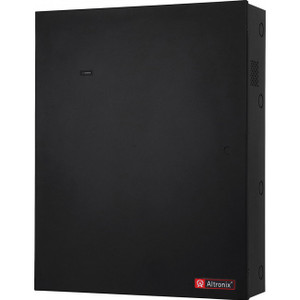
Altronix T2SSK1DQ Dual-Output 24V/12V Power Supply with Battery Backup Enclosure
The Altronix T2SSK1DQ is a hardened, dual-output power distribution unit delivering 24VDC at 10A and 12VDC at 10A simultaneously — purpose-built for mid-to-large surveillance camera installations, access control panels, and hybrid-voltage systems where a single supply voltage won't cover the full device mix. It ships in a steel enclosure sized at 27.25" × 21.5" × 6.5", giving integrators enough room to land conduit, manage wiring, and house backup batteries without resorting to an external cabinet. If you're pricing out Altronix power solutions for a multi-device security deployment, the T2SSK1DQ is the unit to evaluate when you need both 24V and 12V output rails running concurrently at meaningful amperage.
Overview
Dual AC inputs — 120VAC/60Hz at 4.5A max and 120VAC/60Hz at 3.5A max — feed the two independent DC output sections. That separation matters: if one AC circuit is interrupted, only the corresponding DC rail is affected. The unit supports onboard battery charging at 12VDC/12AH, accepting sealed lead acid or gel-type batteries, so critical loads on either rail can ride through brief outages without adding a separate UPS. Eight PTC-protected outputs distribute power to downstream devices, with PTC resettable fuses replacing the glass-fuse replace-and-restock cycle that slows down service calls. CE conformity is the listed agency certification.
Key Features
- Dual independent DC rails (24VDC @ 10A + 12VDC @ 10A): 20A of combined DC capacity means you can power a full run of 12V cameras on one rail while simultaneously driving 24V door strikes or pan-tilt mechanisms on the other — no secondary power supply needed, no voltage conversion waste.
- Dual AC inputs (120VAC/60Hz @ 4.5A and 3.5A): Bringing the two input feeds from separate breakers on the electrical panel gives you fault isolation between voltage rails. A tripped breaker on one circuit doesn't take down the entire security system.
- Battery backup with 12VDC/12AH charging: Onboard charging circuitry keeps a sealed lead acid or gel battery topped up so the system holds through a power interruption. This is a code-relevant feature for installations where UL-listed continuous operation is specified — verify battery sizing against your actual load to determine hold time.
- 8 PTC-protected outputs: Resettable polymer fuses on each output eliminate the field service call to swap glass fuses after a device fault. The fuse resets once the overcurrent condition clears, which is the correct behavior for camera or reader faults in unstaffed remote locations.
- Large steel enclosure (27.25" × 21.5" × 6.5"): Enclosure depth of 6.5 inches accommodates battery installation and still leaves working clearance to dress and terminate field wiring cleanly. For surface-mount mechanical room or closet installs, this is the footprint to plan around.
- Operating range 0°C to 49°C: Covers the full ambient range of a conditioned mechanical room or interior IDF closet. Not rated for outdoor or unheated environments — if the mounting location drops below freezing, the enclosure needs supplemental heat or the unit needs to move indoors.
- CE European Conformity listed: Relevant for projects with European compliance requirements or multi-site deployments that span jurisdictions. Verify whether your specific project specs call for UL listing, as CE and UL are distinct certifications.
Integration & Compatibility
The T2SSK1DQ fits into any installation that draws both 24VDC and 12VDC from a centralized power supply point. Common configurations include mixed analog/IP NVR-based systems where legacy 12V analog cameras share a rack with 24V PTZ or reader hardware, and access control panels that run 24V locks alongside 12V readers. The eight-output PTC topology allows home-run wiring from the enclosure to individual devices — the preferred architecture for fault isolation and per-device current monitoring. Wire sizing to each output should be calculated against device inrush current, not steady-state draw, to avoid nuisance PTC trips during power-up sequencing. The enclosure dimensions and dual AC input configuration also support integration with access control systems requiring battery-backed centralized power per NFPA 72 or similar standards — consult the authority having jurisdiction for code-specific requirements.
Frequently Asked Questions
Q: Can the T2SSK1DQ supply 24VDC and 12VDC outputs at the same time?
A: Yes. The T2SSK1DQ provides both output rails simultaneously — 24VDC at up to 10A and 12VDC at up to 10A — fed by two independent 120VAC input circuits. Both rails operate concurrently in normal conditions.
Q: What battery type does the T2SSK1DQ accept for backup power?
A: The unit charges sealed lead acid or gel-type batteries at 12VDC/12AH. The battery is not included — you'll need to source and install an appropriately sized SLA or gel battery for the backup runtime your project requires.
Q: How many protected outputs does the T2SSK1DQ have, and what type of fusing is used?
A: The T2SSK1DQ provides 8 outputs, each protected by PTC (Polymeric Positive Temperature Coefficient) resettable fuses. PTC fuses reset automatically once the overcurrent fault clears, eliminating the need to replace glass fuses in the field after a downstream device fault.
Q: What are the input voltage requirements for the T2SSK1DQ?
A: The unit uses two 120VAC, 60Hz AC inputs — one rated at 4.5A max (feeding the 24VDC rail) and one rated at 3.5A max (feeding the 12VDC rail). Standard North American single-phase AC from dedicated breakers on your electrical panel.
Q: Is the T2SSK1DQ suitable for outdoor installation?
A: No. The T2SSK1DQ is rated for 0°C to 49°C operating temperature in a steel enclosure without an environmental IP rating. It is designed for interior, conditioned spaces such as mechanical rooms, server closets, or IDFs. Do not install in unheated or outdoor locations.
Q: What agency certifications does the T2SSK1DQ carry?
A: The T2SSK1DQ lists CE European Conformity as its agency certification. If your project specification requires UL listing, confirm this against current product documentation before specifying — CE and UL are independent certifications with different scopes.
The T2SSK1DQ is the Altronix unit I reach for when a project's device mix straddles the 12V/24V divide and I don't want to install two separate power supplies or deal with voltage conversion losses. The dual 10A DC rails running off isolated 120VAC inputs — 4.5A feeding the 24V section, 3.5A feeding the 12V section — let you keep fault domains clean at the panel level, which is the kind of thing that saves hours on a service call six months after commissioning.
Technical Highlights:
- Dual 10A DC Rails: 24VDC and 12VDC simultaneously at up to 10A each — enough headroom to drive a full row of PTZ cameras or door hardware on one rail while powering a separate run of analog or IP cameras on the other without headroom concerns.
- 8 PTC-Protected Outputs: Resettable fuses on all 8 outputs mean a shorted camera or reader doesn't leave you hunting for the right glass fuse at 2 AM. The PTC clears itself once the fault is removed — appropriate behavior for unmanned remote locations.
- Onboard 12VDC/12AH Battery Charging: Internal charging circuitry keeps a sealed lead acid or gel battery conditioned for backup duty. Size the battery to your actual load — the charger supports up to 12AH, which sets your ceiling on hold time at a given draw.
Deployment Considerations:
- Both AC input circuits should come from separate breakers on the panel — that's the only way to get fault isolation between the two DC rails, which is the main architectural advantage of this unit over a single-input supply.
- The operating temperature ceiling is 49°C — that's tight for a mechanical room in a hot climate without HVAC. Verify that your mounting location stays within spec in peak summer conditions before locking in this location.
The T2SSK1DQ is the right call for a commercial building access control retrofit where you're inheriting a mix of 24V electrified hardware and 12V readers spread across multiple floors, and you need battery-backed, centralized power distribution in a single steel enclosure that doesn't require a second panel knockout for a separate supply.