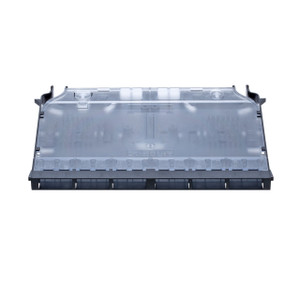
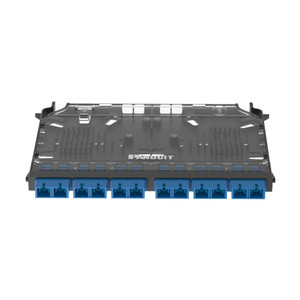
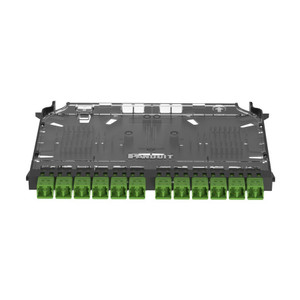
Panduit FHS9N-24-10R HD Flex 24-Fiber OS2 LC Splice Cassette
The Panduit FHS9N-24-10R is a pre-loaded 24-fiber OS2 splice cassette built for high-density singlemode structured cabling in enterprise data centers, campus backbone runs, and large-scale security infrastructure backbones. Part of the Panduit HD Flex platform, it ships ready to install with discrete ribbon pigtails already fusion-spliced inside — no field splicing, no loose fiber management headaches at the panel.
Overview
This cassette delivers 12 LC duplex ports on the front face, accommodating 24 individual OS2 singlemode fibers through a single modular unit. The polycarbonate housing snaps into any HD Flex-compatible enclosure, letting you scale port count by adding cassettes rather than reterminating the entire trunk. If you're building out a fiber optic cassette infrastructure and need singlemode capacity without field labor overhead, this is a direct path to a clean, tested termination.
Key Features
- 24 OS2 Singlemode Fibers: OS2 (9-micron core) supports runs well beyond the 300m OM4 ceiling — use this on inter-building campus links, long data center spine connections, or any path where distance or low-loss wavelength-division multiplexing matters. You get 24 fibers in a single cassette footprint.
- 12 LC Duplex Ports, Front-Access: LC duplex is the dominant connector format in current-generation 10G/40G/100G SFP transceivers. Twelve ports per cassette means 12 active duplex circuits — enough to serve a full ToR switch uplink bank without a second cassette.
- Pre-Loaded Ribbon Pigtails: Factory-spliced ribbon pigtails eliminate field fusion work at the panel. Each pigtail is bonded inside the cassette housing before it ships, so installation is a pull-and-snap operation. This is the spec that reduces your truck-roll time on large backbone deployments.
- Standard Insertion Loss Rating: The PI (standard) insertion loss grade means each mated LC connection meets industry-standard attenuation thresholds. For a structured fiber optic infrastructure with a defined optical link budget, standard-grade is the cost-effective choice when you don't need the tighter tolerances of ultra-low-loss (ULL) connectors.
- HD Flex Polycarbonate Housing: The polycarbonate shell is lighter than metal alternatives while still providing the rigidity needed to protect ribbon fiber inside a busy panel. It's also why the HD Flex platform achieves its high port density — the slim cassette profile lets you stack more circuits per rack unit than traditional fiber panels.
- Modular, Cassette-Based Architecture: Cassette-swap maintenance means a single bad termination doesn't require reworking the entire panel. Pull the affected cassette, replace it, restore the circuit. In a network infrastructure environment running 24/7, that's a meaningful operational advantage over field-terminated panels.
Integration & Compatibility
The FHS9N-24-10R (often searched as FHS9N 24 10R) is designed for Panduit HD Flex enclosures and fiber optic panels that accept the HD Flex cassette form factor. Front-face LC duplex ports are compatible with any standard LC-LC duplex patch cord. The OS2 singlemode fiber type is compatible with singlemode transceivers operating at 1310nm and 1550nm wavelengths — verify your transceiver specifications before deploying on multimode-only links. Package quantity is 1 cassette per unit; carton quantity is 10.
Frequently Asked Questions
Q: What fiber type does the FHS9N-24-10R use, and does it support multimode links?
A: The FHS9N-24-10R uses OS2 singlemode fiber (9-micron core diameter). It is not compatible with multimode links. For multimode applications, select a cassette specifying OM3 or OM4 fiber type.
Q: How many LC duplex ports does this cassette provide?
A: It provides 12 LC duplex front-access ports, supporting 24 individual fibers (12 duplex circuits) per cassette.
Q: Does the FHS9N-24-10R come pre-loaded or does it require field splicing?
A: It ships pre-loaded with factory-spliced discrete ribbon pigtails — no field fusion splicing required at installation.
Q: What enclosure or panel system does this cassette fit?
A: The FHS9N-24-10R is designed for the Panduit HD Flex platform. Verify your enclosure model accepts HD Flex cassettes before ordering.
Q: What is the insertion loss grade on this cassette?
A: It is rated to standard (PI) insertion loss — the industry-standard grade for structured cabling. It is not an ultra-low-loss (ULL) variant.
The FHS9N-24-10R is the cassette I reach for when a project calls for high OS2 fiber density and the schedule won't support field fusion work at the panel. The factory-spliced ribbon pigtail construction means every termination in this unit was done under controlled conditions — not in a congested IDF closet with a handheld splicer and a tight deadline.
Technical Highlights:
- 24 Fibers / 12 Duplex Circuits Per Cassette: Packs a full 24-fiber OS2 ribbon into a single HD Flex cassette footprint. On a 4U HD Flex enclosure you can stack enough cassettes to terminate a 288-fiber OS2 trunk without breaking into a second rack unit — meaningful when you're counting U-space on a dense spine row.
- OS2 Singlemode, 9-Micron Core: Singlemode at 9µm means this cassette is the right call for inter-building runs, long campus backbones, or any segment feeding 10G/25G/100G SFPs that specify SMF. Don't drop OS2 cassettes into a multimode plant — the core mismatch will kill your link budget immediately.
- Standard (PI) Insertion Loss: PI-grade is the correct spec for the majority of enterprise backbone applications. If your optical link budget is tight (long-haul WDM, coherent optics) you may need ULL-grade instead — but for standard 10G-LR or 100G-LR4 runs, PI is sufficient and the cost delta is real.
Deployment Considerations:
- Confirm your enclosure accepts HD Flex cassettes before ordering. The HD Flex snap-in form factor is not universal across Panduit's full panel lineup — a wrong-generation panel means this cassette won't seat correctly.
- The unterminated (ribbon pigtail) rear means the field connection is a fusion splice to your trunk cable. Budget for a fusion splice tech on the trunk side; the front LC terminations are done, but the backbone splice is still a field operation.
This cassette is the right fit for enterprise data center inter-row backbone builds and campus fiber aggregation points where OS2 capacity needs to scale quickly, installation windows are tight, and you want factory-quality terminations at the patch panel rather than field-variable results.