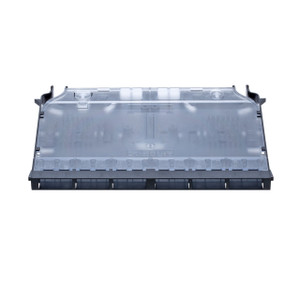
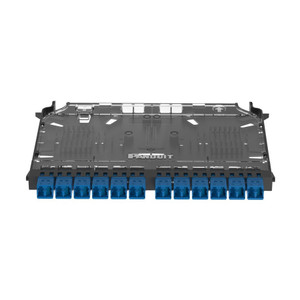
Panduit FHSZA-24-10P 24-Fiber OM4 HD Flex LC Splice Cassette
The Panduit FHSZA-24-10P is a 24-fiber OM4 HD Flex™ splice cassette loaded with discrete pigtails terminated in duplex LC connectors on one end and left unterminated (splice-ready) on the other. Designed for the HD Flex™ platform, it delivers ultra-low insertion loss (IL) across all 12 duplex LC ports — the kind of performance spec that matters when you are stacking multiple cassettes in a high-density backbone and cannot afford cumulative loss budgets eating into your link margin. If you are deploying OM4 multimode infrastructure in a data center, enterprise MDF/IDF, or building automation backbone, this cassette is the structured cabling component that keeps splicing organized, labeled, and serviceable inside a standard HD Flex panel or enclosure.
Key Features
- 24-Fiber OM4 50µm Multimode: OM4 supports 40G and 100G Ethernet applications at distances up to 150m (OM3 tops out at 100m for 100G) — if your backbone needs to reach across a large floor plate or between MDF and IDF without dropping to single-mode, this fiber grade keeps you in budget without sacrificing headroom.
- Ultra-Low Insertion Loss (IL Ultra): Every dB of IL you save at the cassette level is headroom preserved for longer cable runs, additional connectors, or future network upgrades. Ultra-low IL on all 12 duplex LC ports means the cassette itself is not the limiting factor in your loss budget calculation.
- 12 Duplex LC Ports (24 Fibers): LC is the dominant connector in modern high-density multimode environments — it plugs directly into SFP+ and QSFP transceivers without adapters. Twelve duplex ports pack 24 fibers into a single cassette footprint, which means fewer cassette slots consumed per cable count in your panel.
- Discrete Pigtail Splice Design: Unlike fusion-splice-only approaches, discrete pigtails give field technicians a defined, replaceable splice interface. If a pigtail is damaged post-installation, the individual fiber can be re-spliced without replacing the entire cassette — a maintenance advantage in long-lived infrastructure.
- Unterminated Connector 2 (Splice-Ready): The unterminated ends connect directly to incoming trunk or branch cables via mechanical or fusion splicing. This design keeps the cassette flexible: you bring whatever cable you are splicing into the panel, and the cassette handles the LC interface side cleanly.
- HD Flex™ Platform Compatibility: The HD Flex™ system is Panduit's high-density modular fiber infrastructure. Cassettes snap into HD Flex panels and enclosures with tool-free installation, and the modular architecture lets you reconfigure port counts without rewiring — useful in environments that grow incrementally.
- Polycarbonate Housing: Polycarbonate construction handles the thermal cycling and mechanical stress of a populated rack enclosure without cracking or warping over time. It is also rated for the bend-radius protection the discrete pigtails need to maintain their IL spec inside a confined cassette body.
- Black Color / Single-Unit Packaging: Ships as a single cassette (package qty: 1), available in carton quantities of 10 for larger deployments. Black housing integrates with standard rack aesthetics and keeps visual port identification clean when used alongside color-coded patch cords.
Integration and Compatibility
The FHSZA-24-10P is designed for use within Panduit's HD Flex™ fiber infrastructure ecosystem — specifically HD Flex panels, wall-mount enclosures, and rack-mount fiber enclosures that accept this cassette form factor. The duplex LC interface on the front is compatible with all standard LC-LC patch cords and LC-type SFP/SFP+/QSFP transceivers. The OM4 50µm fiber is backward-compatible with OM3 equipment and laser sources, though operating at OM4-rated distances requires OM4-rated patch cords throughout the link.
For backbone planning in fiber optic cassette installations, verify that your target enclosure or panel explicitly supports the HD Flex™ cassette footprint — not all Panduit enclosures use the same cassette format. If you are designing a new structured cabling backbone, review your network infrastructure rack layout before committing to cassette count, as the HD Flex platform supports mixed fiber types in the same enclosure when different cassette models are used.
Competitive reference: the FHSZA-24-10P is a direct technical alternative to the Corning CCH-CS24-E4-POOTE in OM4 24-fiber splice cassette applications.
Frequently Asked Questions
Q: What panel or enclosure does the FHSZA-24-10P install into?
A: The FHSZA-24-10P is designed for Panduit HD Flex™ panels and enclosures. Confirm your target enclosure supports the HD Flex cassette form factor before ordering — not all Panduit fiber enclosures share the same cassette slot format.
Q: Is the FHSZA-24-10P compatible with OM3 fiber infrastructure?
A: Yes. OM4 50µm fiber is backward-compatible with OM3 laser sources and equipment. However, your link will operate at OM3-rated distances and bandwidth when mixed with OM3 components — you only realize the full OM4 performance advantage when the entire link (cassette, trunk, patch cords) uses OM4-rated components.
Q: What type of splicing is required on the unterminated end of the FHSZA-24-10P?
A: The second connector end is unterminated, meaning it accepts mechanical or fusion splicing to your incoming trunk or branch cable. Fusion splicing is the industry standard for permanent, low-loss backbone installations. The discrete pigtail design allows individual fiber re-splicing without cassette replacement if a pigtail is damaged.
Q: How many fibers does the FHSZA-24-10P support, and how many LC ports does that give me?
A: The cassette supports 24 fibers arranged as 12 duplex LC ports on the front face. Each duplex LC port carries two fibers (transmit and receive), so 12 ports × 2 fibers = 24 total fiber connections per cassette.
Q: Can I order the FHSZA-24-10P in bulk quantities?
A: Yes. The standard package quantity is 1 cassette per unit. A full carton contains 10 cassettes (carton qty: 10), which is the typical bulk procurement unit for larger backbone deployments.
Q: What is the competitive equivalent to the FHSZA-24-10P?
A: The documented competitive equivalent is the Corning CCH-CS24-E4-POOTE — a 24-fiber OM4 LC splice cassette in Corning's CCH platform. The FHSZA-24-10P is the Panduit HD Flex equivalent for integrators already standardized on the Panduit infrastructure ecosystem.
The FHSZA-24-10P is the cassette I specify when an integrator is building out OM4 backbone segments that will carry 40G or 100G links over mid-range distances — the ultra-low IL rating on all 12 duplex LC ports is what keeps the loss budget honest when you are stacking four or five cassettes across a backbone path. On a long multi-cassette link, a standard-IL cassette at each hop adds up fast; the IL Ultra spec here gives you that margin back.
Technical Highlights:
- OM4 50µm Multimode Fiber: Rated for 40G and 100G Ethernet at distances OM3 cannot match — up to 150m for 100G vs. 100m on OM3. If your MDF-to-IDF run is 120m, OM4 keeps you on multimode economics instead of forcing a step up to single-mode gear.
- 24 Fibers / 12 Duplex LC Ports: LC is native to SFP+ and QSFP transceiver cages — no adapter plates, no additional IL, no extra field labor. Twelve duplex ports per cassette is the density sweet spot for standard 1U HD Flex panels.
- Discrete Pigtail Splice Architecture: Individual fiber replaceability is a real-world maintenance advantage in a 10- or 15-year infrastructure lifecycle. A damaged pigtail on a fusion-only cassette means cassette replacement; on the FHSZA-24-10P, it means re-splicing one fiber.
Deployment Considerations:
- Verify enclosure compatibility explicitly — the HD Flex cassette footprint is Panduit-specific. This cassette does not drop into Corning CCH or Commscope InstaPatch panels even though the LC interface is standard.
- The unterminated splice end requires field splicing by a qualified fiber technician. Budget splice time and equipment access into your installation schedule — this is not a plug-and-play field replacement like a pre-terminated trunk cassette.
The FHSZA-24-10P (often searched as FHSZA 24 10P) is the right specification for enterprise MDF/IDF backbone buildouts and data center top-of-rack aggregation segments where OM4 is the fiber standard, LC is the transceiver interface, and the infrastructure is expected to support multiple upgrade cycles without cassette replacement.