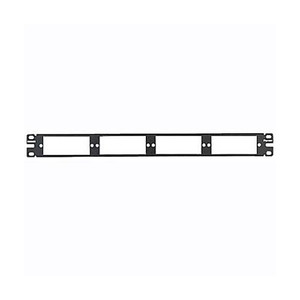
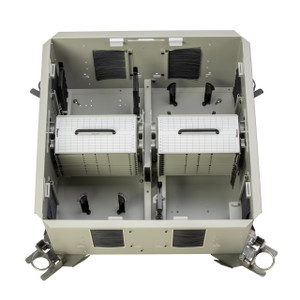
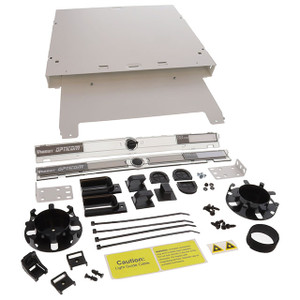
Panduit FLEX1U06 HD Flex™ Fiber Enclosure
The Panduit FLEX1U06 is a 1 RU fiber optic enclosure engineered for high-density datacenter and enterprise network deployments requiring scalable, front-access fiber termination. Ships configured with six ports and accepts up to twelve Panduit HD Flex™ cassettes or Fiber Adapter Panels, scaling from initial deployment to a maximum 144-fiber density per rack unit. Sliding front-access drawers and dual-sided tray accessibility streamline moves, adds, and changes in live network environments where downtime windows are measured in minutes. Split-tray design isolates each cassette bay to prevent fiber cross-contamination during service, while the multi-positional tray supports angled cable routing for strict bend-radius control in dense rack environments.
Key Features
- 1 RU rack-mount enclosure with sliding front-access drawers for live-network serviceability without rear access
- Ships with 6-port configuration; scales to 144 fibers with twelve HD Flex™ cassettes or adapter panels (sold separately)
- Compatible with all Panduit HD Flex™ Fiber Cassettes and Fiber Adapter Panels, including MTP/MPO to LC breakout cassettes
- Front and rear accessible enclosure tray for dual-sided cable management in hot-aisle containment or wall-adjacent installations
- Split enclosure tray design isolates cassette zones, preventing accidental fiber disruption during single-circuit troubleshooting
- Multi-positional tray supports angled cable routing to match vertical or horizontal cable manager entry points
- Integrated rack/cabinet rail mounting bracket fits standard 19" EIA racks and square-hole frames without cage nuts
- 19.69" width × 1.73" height (500.1 mm × 43.9 mm) fits standard racks with clearance margin for powder-coat or out-of-spec hole spacing
- RoHS compliant per EU Directive 2011/65/EU for government, healthcare, and multinational procurement requirements
Panduit's HD Flex™ architecture addresses the collision between rising datacenter bandwidth demands and shrinking rack real estate. The FLEX1U06 enclosure serves as the backbone for structured fiber distribution in applications ranging from enterprise SAN fabrics and hyperconverged infrastructure clusters to service-provider central offices and colocation meet-me rooms. The modular cassette design decouples physical infrastructure from active equipment refresh cycles—install the enclosure once during initial buildout, then swap cassettes as you migrate from 10GBASE-SR to 40GBASE-SR4, 100GBASE-SR10, or 400GBASE-SR8 optics without re-terminating trunk cables or disrupting adjacent circuits. Each of the twelve cassette bays accepts either pre-terminated MTP/MPO cassettes (the most common configuration uses twelve-fiber MTP backbone cables with breakout to duplex LC for switch uplinks) or traditional fiber adapter panels for legacy SC, ST, or LC patch deployments where you're integrating with older installed infrastructure.
The split-tray architecture isolates each cassette in a separate compartment with physical dividers, preventing fiber jacket abrasion during moves and eliminating the risk of accidentally disturbing an adjacent circuit when you're troubleshooting a single failed link at 2 AM. Front-access sliding drawers mean you can perform adds and changes from the cold aisle without requiring rear access—critical in hot-aisle containment environments where rear doors are sealed for thermal efficiency, or in cabinets positioned against walls in wiring closets where space constraints prevent rear access. The drawer mechanism uses a positive-stop detent that holds the tray in the fully extended position, giving you two hands free to dress cables or swap cassettes without fighting a spring-loaded tray trying to close on your fingers. When the tray is closed, a friction latch keeps it secured during shipping or seismic events, but releases with light finger pressure during service—no tools or thumb-screw fasteners that slow down emergency restoration work.
Typical colocation deployment: meet-me-room cross-connects where a single FLEX1U06 enclosure aggregates customer handoffs from twelve different tenants, each isolated in a dedicated cassette bay with physical and logical separation for security and fault isolation. The provider trunks a 144-fiber OM4 cable from the customer's cabinet to the meet-me room, terminates it on twelve MTP connectors, plugs those into twelve 6-port LC cassettes in the FLEX1U06, then provides the customer with six duplex LC patch cords to their switch. When the customer churns or upgrades, the provider swaps the cassette without affecting the eleven other tenants in adjacent bays. Enterprise network deployment: main distribution area in a campus environment where each FLEX1U06 enclosure serves a different building or floor—trunk a 144-fiber OM4 cable from the basement MDF to the 10th-floor IDF, terminate it on twelve MTP connectors at the FLEX1U06 in the IDF, then break out to duplex LC for switch uplinks, server connections, and horizontal distribution to conference rooms or workstations requiring fiber-to-the-desk.
The multi-positional tray lets you angle the cassettes to route fiber toward the top or bottom of the enclosure, matching the cable entry point of your vertical or horizontal cable managers and maintaining the 30 mm minimum bend radius required by OM3/OM4 multimode and OS2 single-mode specifications under TIA-568 and ISO/IEC 11801 standards. This matters in high-density environments where you're running eight FLEX1U06 enclosures in a single rack with cable managers at 12 RU intervals—fiber exiting the top of enclosure #3 can route upward to the manager at 36 RU without creating a sharp bend at the enclosure exit point that would exceed loss budgets or create future failure points as the fiber fatigues under repeated flexing during subsequent service events. Rack/cabinet rail mounting brackets secure the enclosure to both round-hole Chatsworth racks (common in telecom environments) and square-hole APC NetShelter frames (dominant in IT datacenters) without requiring cage nuts, which are easy to drop into energized equipment below or lose in the dark during emergency after-hours installs.
The FLEX1U06 ships as a 6-port enclosure, which is the minimum configuration Panduit offers—ideal for initial deployments where you're provisioning connectivity for a single switch stack, a small cluster of servers, or a pilot phase of a larger migration, with room to grow as the installation scales without replacing the enclosure or disrupting existing circuits. Each additional cassette you install adds six to twelve ports depending on the cassette type: a 6-port LC duplex cassette provides six duplex connections (twelve fibers total), while some high-density cassettes offer twelve duplex LC connections in the same footprint. The enclosure's 1.73" height specification leaves a 0.02" clearance margin in a standard 1.75" RU slot, ensuring it fits even in racks with slightly out-of-spec hole spacing, excessive powder-coat thickness, or rail misalignment common in older installations or budget rack systems. Panel thickness accommodates the thermal expansion that occurs when the enclosure is installed in a fully loaded 42 RU cabinet operating at 95°F intake temperature during a summer cooling system failure—the steel tray won't bind or warp under thermal stress that would prevent drawer operation during the exact moment you need emergency access.
RoHS compliance ensures the enclosure meets European Union Directive 2011/65/EU restrictions on lead, mercury, cadmium, hexavalent chromium, and brominated flame retardants, satisfying procurement requirements for government contracts, healthcare facilities subject to environmental regulations, and multinational enterprise standardization programs where a single part number must be deployable across US and EU sites without triggering compliance exceptions. The black powder-coat finish resists corrosion in coastal or industrial environments where airborne salt or particulates accelerate metal degradation, and provides a professional appearance in customer-facing colocation environments where the quality of visible infrastructure affects site-tour conversion rates. For integrators managing fiber infrastructure in 24/7 mission-critical environments—financial trading floors where a single fiber failure costs $50,000 per minute in lost transactions, hospital PACS networks where radiologists cannot read imaging studies during an outage, or manufacturing SCADA systems where a network interruption halts a $2M/hour production line—the FLEX1U06 delivers the combination of scalable density, tool-free serviceability, physical fault isolation, and standards-based compatibility that keeps networks running through technology transitions spanning ten-year depreciation cycles and three generations of active equipment refresh.