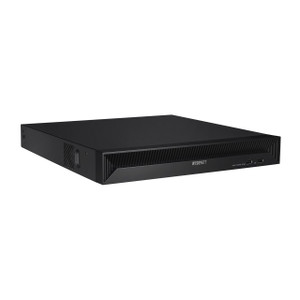
QRN-1630S-4TB Hanwha QRN-1630S 16-Channel PoE NVR with 4TB Storage
The Hanwha QRN-1630S is a 16-channel network video recorder purpose-built for mid-scale commercial and light industrial deployments where PoE power, recording storage, and video management must coexist in a single rack-mountable or wall-mounted appliance. By integrating a 130W PoE power supply into the chassis itself, the QRN-1630S eliminates the cost and complexity of external injectors or supplementary switches on projects spanning 8 to 16 cameras. The unit records up to 8MP resolution across all 16 channels simultaneously, sustains 128 Mbps aggregate throughput with H.265 codec efficiency, and stores 4TB of onboard video on a dedicated HDD—sufficient for 7–14 days of continuous 24/7 recording depending on resolution and compression settings.
Key Features
- 16-Channel PoE Power: 130W integrated PoE (802.3af) budget shared across all 16 ports. No external injectors required; cameras connect directly to the NVR. Ideal for standard-draw cameras under 13W per port.
- 8MP Multi-Channel Recording: All 16 channels support up to 8MP resolution simultaneously at 128 Mbps aggregate bitrate. H.265 compression reduces storage overhead 40–60% versus H.264 on equivalent quality footage.
- 4TB Onboard Storage: Factory-installed HDD provides 4TB capacity for local retention; supports extended playback and forensic review without external NAS or SAN infrastructure.
- ONVIF Profile S Compatibility: Works with any ONVIF-compliant IP camera from Hanwha (WiseNet Q, WiseNet X, SecuNet) and third-party manufacturers (Axis, Uniview, Hikvision, etc.). No proprietary software locks.
- Dual HDMI Output: Independent 4K and 1080p display outputs allow simultaneous monitoring on two displays or a single multi-input monitor without video scaling latency.
- Wall and Rack Mount: Supplied with universal mounting bracket; fits 1U rack or standard wall cavity. 130W power consumption at full load; stable thermal profile in typical office/facility environments.
- 5-Year Manufacturer Warranty: Factory warranty covers hardware defects, labor, and shipping during warranty period.
The QRN-1630S is engineered for system architects and integrators who need a turnkey recording backbone without the operational overhead of managing separate PoE infrastructure. The 130W shared budget means you cannot power 16 PoE+ cameras (90W+) simultaneously from this unit alone—standard-power cameras (under 13W draw) are the target. For higher-power deployments, pairing the NVR with an external PoE+ switch upstream allows you to mix standard and high-power cameras on the same network segment while the NVR handles recording from all sources via IP.
Storage retention scales with resolution and compression ratio. A typical 4MP WiseNet Q or Axis P1368 camera at H.265 consumes roughly 2–3 Mbps per channel; across 16 channels, you occupy about 32–48 Mbps of the 128 Mbps budget, leaving bandwidth headroom for metadata, VMS queries, and future expansion. At that rate, 4TB yields 10–14 days of continuous recording. For sites requiring 30+ days, external NAS attachment via Ethernet is supported; ONVIF Profile S integration ensures seamless failover between local and remote storage.
The QRN-1630S integrates with any ONVIF-aware VMS platform—Genetec Security Center, Milestone Xprotect, ExacqVision, Hanwha SmartVMS—without additional license fees or hardware adapters. Edge detection and motion-triggered recording are managed at the NVR firmware level, reducing CPU load and improving reliability on systems with dozens of alarm zones or perimeter gates. The unit's 802.3af PoE output is strictly compliant; do not attempt to parallel an external PoE injector on the same camera port, as this will cause port shutdown or hardware damage.
Hanwha backs the QRN-1630S with a 5-year manufacturer warranty covering all components. The appliance is designed and manufactured in South Korea using ASIC-based video processing (not generic x86 processors), which reduces power overhead and eliminates OS-level update dependencies that plague Windows-based NVRs. No NDAA or Section 889 restrictions apply; sourced direct from the manufacturer or US channel partner, no grey-market or parallel imports.
Ted PerryPerspective based on aggregated IPSD and affiliated engineering team experience.
We have deployed the Hanwha QRN-1630S across retail chains, small-to-medium office parks, and light warehouse facilities where the 16-channel footprint and integrated PoE budget align perfectly with mid-scale camera counts. The real strength of this appliance is not the recording density or the 4TB capacity alone—it's the elimination of external PoE infrastructure on networks with 8–16 standard-draw cameras. On a typical 12-camera retail install, removing the need for a separate PoE injector or managed switch reduces capex by $500–$1,200 and cuts physical rack space from 2U to 1U. The H.265 compression and 128 Mbps aggregate bandwidth are sufficient for full 24/7 recording on 8MP sources without needing external storage for typical 10–14 day retention windows. That said, the 130W PoE budget is a hard ceiling—if a site requires thermal cameras, PTZ, or high-power LED illuminators, you will need to either reduce the camera count or augment with an external PoE+ switch. We've also found that the dual HDMI output is genuinely useful on sites without dedicated monitoring rooms; security staff can run a 1080p display for real-time alerting and a 4K display for forensic playback in the same physical space.
Technical Highlights:
- H.265 Codec with Fallback to H.264: Reduces per-camera bitrate 40–60% compared to H.264 on equivalent quality. The NVR supports mixed H.265 and H.264 streams from heterogeneous camera sources without re-encoding, which is critical when integrating legacy Axis or third-party cameras that lack H.265 support. Bitrate savings directly translate to longer retention on the 4TB HDD.
- 128 Mbps Aggregate Bandwidth: Sufficient for 8MP 30fps recording on 16 channels if each stream is constrained to 8 Mbps (typical for 4K quality H.265). Sites recording 24/7 at higher quality should budget external NAS; the onboard HDD is single-point-of-failure on high-criticality deployments.
- 802.3af PoE 130W Total (8.125W per port average): Standard PoE, not PoE+. This is the binding constraint: any camera drawing over 13W per port will either fail to boot or cause port shutdown. WiseNet Q 2MP and most Axis P1300-series cameras operate comfortably under this limit; WiseNet X 5MP and higher, or any camera with external IR illuminators, will exceed the budget.
- ONVIF Profile S with Dual-Monitor HDMI: Profile S compatibility ensures drop-in support for Genetec, Milestone, ExacqVision, and Hanwha SmartVMS without proprietary plugins. The two independent HDMI outputs allow simultaneous 4K and 1080p playback without video codec transcoding latency—meaningful for sites where security staff need to review high-res forensic footage while monitoring live alerts on a separate display.
- Integrated 12V DC Power Supply (130W): No external PSU means fewer failure points and cleaner cabling. The unit operates normally in office-grade HVAC environments (5–40°C ambient); avoid direct sunlight or mounting above heat-generating equipment.
Deployment Considerations:
- PoE budget is absolute: 130W total across all 16 ports. A single PoE+ camera (60W) will consume 46% of the budget. If you have even one high-power device, plan to add an external PoE+ switch upstream and use the NVR for recording only. This is not a limitation—it's a design boundary you must respect.
- 4TB onboard storage scales with resolution and bitrate. At 4MP H.265, expect 10–14 days of 24/7 recording across all channels. For 30+ day retention, configure network-attached NAS via ONVIF and test failover during commissioning. Local storage failure will halt recording until the drive is replaced.
- The unit draws 130W at full load. Verify that wall outlet power or rack PDU amperage is sufficient; on sites sharing power with other equipment, use a dedicated 15A or 20A circuit. UPS backup for a 16-channel NVR recording to NAS is critical on sites with uptime SLAs.
- Dual HDMI outputs require two monitors or a multi-input KVM if you want independent 4K and 1080p streams simultaneously. A single display will fall back to one HDMI input; confirm monitoring infrastructure before installation.
- ONVIF Profile S does not include edge analytics or advanced metadata (thermal data, license-plate OCR). If you require AI-powered detection or third-party VMS deep integration, confirm that your chosen platform (Genetec, Milestone) supports those extensions outside of the NVR appliance itself.
The QRN-1630S is the right choice for integrators deploying 12–16 standard-power IP cameras where local storage, PoE power, and compact form factor are non-negotiable. It is not the choice for thermal, PTZ, or high-power installations; those require external PoE+ infrastructure. For additional models and configurations, visit the Hanwha catalog.