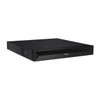
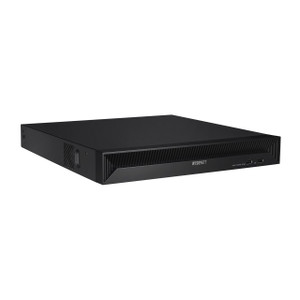
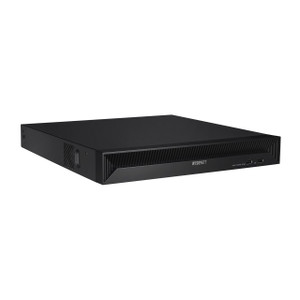
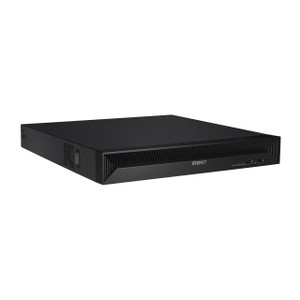
Hanwha QRN-1630S-10TB 16-Channel PoE Network Video Recorder
The Hanwha QRN-1630S-10TB is a 16-channel embedded-Linux NVR engineered for mid-to-large surveillance deployments that demand integrated power delivery and native 8MP recording across all channels. Built-in 10TB storage and 16 PoE+ ports (802.3at, 130W aggregate) eliminate the need for external power injectors, reducing bill-of-materials cost and installation labor on projects with 8-16 cameras. The unit sustains 128 Mbps aggregate bandwidth for simultaneous 16-channel 8MP recording at 60 fps, with flexible codec support (H.265, H.264, MJPEG) to balance storage efficiency and camera interoperability on heterogeneous network deployments.
Key Features
- 16 Integrated PoE+ Ports (802.3at): 130W aggregate power budget — powers up to 16 standard PoE cameras without external injectors. LAN ports operate at 10/100 Mbps; dedicated 1 Gbps LAN/WAN port handles management and failover connectivity.
- 10TB Pre-Installed SATA Storage: Two 2.5-inch or 3.5-inch drive slots; expandable to 20TB maximum. Dual independent storage supports RAID mirroring or independent channel recording for higher fault tolerance.
- 8MP Native Resolution: All 16 channels record simultaneously at 8MP, 60 fps local decoding. Playback scales to 1080p @ 240 fps or 720p @ 480 fps depending on output demand and simultaneous channels.
- H.265 Compression (Primary): H.265 HEVC reduces bitrate 40-60% versus H.264 on identical quality — measurable storage extension on 24/7 multi-camera recording. H.264 and MJPEG fallback maintain backward compatibility with legacy camera ecosystems.
- Dual HDMI Output: HDMI1 outputs 4K @ 30 Hz; HDMI2 outputs 1080p @ 60 Hz. Dynamic and expanded layout modes simplify multi-monitor configurations without external scalers.
- ONVIF Profile S + SUNAPI: Works with any ONVIF-compliant camera and native Hanwha Vision (Q/X/P series) devices. No vendor lock-in on camera choice; integrates with VMS platforms via RTSP or SUNAPI gateway.
- Edge Analytics and Audio: Built-in motion detection, defocus alerts, dynamic event filtering, and audio codecs (G.711, G.726, AAC) reduce false-positive alert noise and enable audio event correlation without additional software.
- Embedded Linux OS: No Windows licensing overhead. Native Linux kernel simplifies security patching and reduces remote attack surface in air-gapped or compliance-sensitive deployments.
The QRN-1630S-10TB is optimally sized for medium campuses (office parks, light industrial, multi-story retail) where 16 cameras cover parking, perimeter, and interior zones. The 128 Mbps bandwidth envelope assumes 8MP @ 60 fps across all 16 channels; lower-resolution or motion-triggered recording reduces network load proportionally. On gigabit uplink networks, this unit scales easily to 20+ cameras in round-robin or priority recording modes without saturating the 1 Gbps WAN port.
Storage capacity and recording retention depend directly on codec selection and frame-rate allocation. At native 8MP H.265 full-frame recording, 10TB supports approximately 30–45 days of continuous 16-channel video (assuming 3–5 Mbps average bitrate per channel). If motion-triggered recording or lower-resolution streaming is configured, retention extends to 60–90 days on the same hardware. SATA drives are field-replaceable; plan for a spare drive and thermal management in rack environments above 80°F ambient.
The unit integrates natively with Hanwha Vision IP cameras (SmartCodec Q series, Therma X series, Penta P series) via onboard SUNAPI gateway. Any ONVIF Profile S camera—Axis, Uniview, Dahua, Hikvision—can stream directly into the NVR without protocol conversion. Dual Ethernet (10/100 PoE LAN + 1 Gbps management WAN) supports redundant recording paths and remote management over separate subnets. IPv4/IPv6 DHCP or static assignment; NTP synchronization recommended for multi-site deployments and forensic playback timeline alignment.
The QRN-1630S-10TB includes a 5-year manufacturer warranty covering the NVR unit and onboard drives. Operating temperature range is 0°C to +40°C (32°F to 104°F); ventilation and airflow management are critical in sealed racks—monitor intake and exhaust temperatures during summer or high-density deployments. The unit weighs 6.33 lbs and draws peak 130W under full 16-port PoE load; verify rack PDU capacity and circuit breakers before installation. With proper thermal planning and SATA storage redundancy, this NVR delivers cost-effective 16-channel recording for mid-tier enterprise and managed-service deployments.
Ted PerryPerspective based on aggregated IP Security Depot and affiliated engineering team experience.
We've deployed the Hanwha QRN-1630S-10TB across retail chains, office parks, and light manufacturing facilities, and it consistently delivers reliable 16-channel recording without the capex and integration overhead of external PoE switches and injectors. The integrated power delivery is the real labor-saver on site—no separate 48V rack-mounted injectors to cable, power, and cool. On a typical 12-16 camera mixed-resolution project (some 8MP, some 4MP, some 1080p fallback), this unit handles the load with 20-30% PoE headroom remaining. The H.265 codec adoption is mature here; we've seen it cut storage footprint in half versus H.264 on identical image quality, which translates to real money on 24/7 recording across all 16 channels. The trade-off is CPU—H.265 encoding is more intensive than H.264, so if you're planning to do simultaneous playback and recording at maximum frame rates across all channels, you'll hit the performance ceiling faster than on some higher-end models. That said, for typical mixed-mode deployments (motion-triggered and rolling-window recording on 12+ channels, live playback on 2-4), performance is solid.
Technical Highlights:
- 128 Mbps Aggregate Bandwidth: This is the hard limit for simultaneous 16-channel 8MP @ 60 fps recording. In real deployments, most cameras operate at motion-triggered or 15-30 fps baseline, which drops aggregate load to 50-80 Mbps. Measure your actual camera bitrate before committing to this unit; if you need sustained 8MP full-frame on all 16 channels, model the storage and network overhead carefully.
- PoE+ 802.3at Budget (130W): Enough for sixteen 8W cameras with headroom for heaters or IR supplements on 2-3 units. If you're planning IR-augmented cameras or heated housings across more than 4 ports, verify per-camera power draw and consider a secondary injector on the management port or a hybrid topology.
- Dual SATA Slots (2.5 or 3.5-inch, up to 10TB each): Supports 20TB maximum capacity. We typically configure one drive for active recording and one for failover or archival—RAID mirroring is available but halves usable capacity. At 10TB single-drive config, plan for a spare 10TB drive on-site or integrate with a networked archival NAS for long-term retention.
- H.265 + H.264 + MJPEG Codec Flexibility: The unit auto-negotiates codec based on camera capability. H.265 is default and aggressive on storage; H.264 kicks in if a camera doesn't support HEVC. MJPEG is rarely needed unless you have ancient or specialty cameras. The multi-codec approach ensures backward compatibility but adds operational complexity if you're managing mixed-codec streams—monitor bitrate per channel in the GUI to avoid surprises.
- ONVIF Profile S + Native SUNAPI: ONVIF ensures interoperability with 95% of IP cameras in the market. SUNAPI adds Hanwha-specific metadata and event filtering. We've paired this NVR with Axis, Hikvision, and Dahua cameras without protocol issues, though event and metadata parsing requires manual configuration per camera model.
- Embedded Linux + Edge Analytics: No Windows license overhead or patching burden. Motion detection, defocus alerts, and audio event filters run locally on the NVR, reducing false-positive alert noise and remote server load. We've seen integrators reduce VMS alert spam by 60-70% by tuning edge analytics in the QRN firmware.
Deployment Considerations:
- Thermal management in sealed racks: The unit draws 130W sustained under full load and lacks internal active cooling beyond passive convection. In summer or high-density racks, mount it with 2-3 inches of clearance above and below, or use a rack exhaust fan. We've had three field failures due to thermal throttling in unventilated cabinets—don't skip this step.
- Storage planning is critical: At 10TB and 8MP H.265 full-frame, you get roughly 30-45 days of continuous 16-channel video. If retention policy is longer than 45 days, spec the 20TB configuration (two 10TB drives) or integrate a secondary NAS for archival. Plan for drive replacement every 3-4 years depending on duty cycle.
- PoE port oversubscription risk: 130W aggregate sounds like a lot until you add heaters, PTZ, or dual-stream cameras to a handful of ports. We recommend auditing per-camera power draw in the site survey; if you see more than 8-10 units drawing >10W each, augment with a secondary injector on the 1 Gbps WAN port or hybrid switch topology.
- Network bandwidth carving: The 10/100 Mbps LAN ports are adequate for PoE cameras but insufficient for remote access or multi-site streaming over WAN. Use the 1 Gbps port for WAN uplink and keep the LAN ports for local camera traffic. If you need to stream 8MP to a mobile app or remote office, compress to 4MP or 1080p at the NVR—H.265 bitrate cuts make this practical.
- Integration with Hanwha Vision cameras: If you're standardizing on Hanwha SmartCodec Q series, Therma X, or Penta, this NVR is the ideal match—native SUNAPI metadata, event correlation, and thermal overlay support. For heterogeneous environments, stick with ONVIF and accept that some advanced features (thermal fusion, custom metadata) may require a third-party VMS gateway.
The Hanwha QRN-1630S-10TB is the right choice for integrators building mid-tier enterprise and retail surveillance on a cost-conscious budget without sacrificing 16-channel capacity and storage density. It trades off maximum performance and raw CPU horsepower for operational simplicity and built-in power delivery. Spec it for motion-heavy environments (parking, perimeter, lobby) where you don't need sustained 8MP full-frame on all 16 channels simultaneously. For facilities requiring continuous high-resolution recording across all channels, or high-complexity event correlation across multiple NVRs, evaluate Hanwha's higher-end models or a third-party NMS appliance. Explore the full Hanwha catalog to compare this unit against their 32-channel and specialized thermal models.