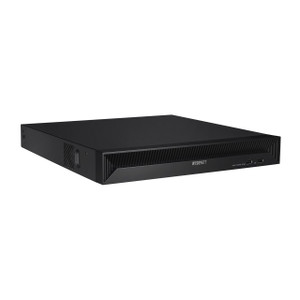
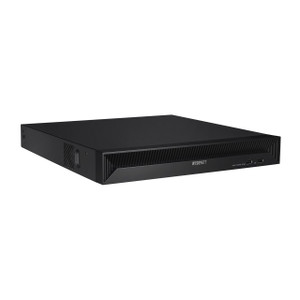
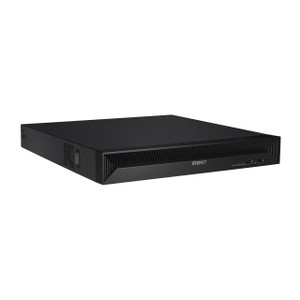
Hanwha QRN-1630S 16-Channel PoE NVR 20TB Storage
The Hanwha QRN-1630S is a 16-channel network video recorder engineered for mid-to-large commercial installations where integrated PoE power and high-capacity dual-drive storage eliminate infrastructure complexity. Built on embedded Linux, it records up to 16 cameras simultaneously at 8MP resolution with H.265 compression, delivering 40–50% bitrate reduction versus H.264 on the same video quality—a direct savings in storage cost and bandwidth over multi-year deployments. The 20TB dual-drive configuration (2×10TB SATA) supports continuous 24/7 recording across all 16 channels without expansion chassis or external NAS infrastructure, while the 130W integrated PoE+ budget powers typical enterprise IP cameras directly from 16 on-board RJ-45 ports. This form factor targets security architects who prioritize simplicity in camera provisioning and predictable long-term retention.
Key Features
- 16-Channel 8MP Recording: Supports any ONVIF-compliant IP camera up to 8MP resolution. Records at up to 60 fps @ 8MP and 240 fps @ 1080p, scaling frame rate based on resolution and bitrate allocation.
- 20TB Dual-Drive Storage: Two 10TB SATA drives (SATA 2 interface) provide extended retention without external storage complexity. H.265 compression extends effective retention by 40–50% versus H.264 at equivalent bitrate.
- Integrated 16-Port PoE+: 16×PoE+ (802.3at) RJ-45 ports deliver 130W total power budget for direct camera connection. Eliminates external PoE switch capex and simplifies cabling on mid-sized deployments.
- Multi-Codec Support: H.265, H.264, and MJPEG encoding allow mixed-camera deployments and fallback compatibility. Per-camera codec selection optimizes bitrate and edge processing.
- Dual Network Interfaces: 16×10/100 Mbps PoE ports for cameras + 1×dedicated 1 Gbps RJ-45 (LAN/WAN) for remote management, redundant NMS connectivity, and event streaming without camera traffic interference.
- Embedded Analytics: On-device motion, defocus, audio, video loss, dynamic event, sensor, and user-triggered event detection reduce false-positive alert load and enable local filtering before transmission to management platforms.
- ONVIF + SUNAPI Integration: Certified ONVIF Profile S ensures third-party camera compatibility (Axis, Uniview, Hikvision, Wisenet). Native SUNAPI support for Hanwha SmartCam and PNM-series cameras. Web and P2P (QR code) provisioning for rapid camera onboarding.
- Audio I/O & Codec Support: RCA audio output, Web G.711, G.726, and AAC (16/48 kHz) encoding support two-way talk and event-correlated audio logs without external audio interface cards.
- NDAA + FCC Compliance: Certified for NDAA Section 889 compliance and FCC standards. Embedded Linux OS eliminates closed-source vendor dependencies in federal and critical-infrastructure deployments.
Imaging & Storage Architecture
The QRN-1630S dual-drive topology (SATA 2, up to 20TB total) is the backbone of extended-retention deployments without NAS sprawl. On a typical mixed-bitrate configuration—8 cameras at 8MP (H.265, 5 Mbps) and 8 cameras at 1080p (H.264, 3 Mbps)—the recorder delivers roughly 60 Mbps aggregate ingest, yielding 14–16 days of continuous retention on 20TB before oldest frames expire. H.265's 40–50% compression advantage versus H.264 translates to concrete days-of-retention gain without additional capex. The embedded Linux kernel handles motion-triggered frame-rate scaling, ensuring high-motion scenes (entry-point lobbies, parking-lot perimeter) consume bitrate efficiently while low-motion areas (blank walls, hallways between peak hours) fall back to lower frame rates, preserving storage cycles.
Integrators deploying across multi-zone retail or office environments benefit from the microSD local-backup slot—small forensic exports fit on field-portable storage without requiring WAN connectivity or remote NAS mounting. The 0°C to 40°C operating range covers standard climate-controlled server closets and small control rooms; outdoor installations require an environmental enclosure. At 6.33 lb and desktop-sized form factor, the QRN-1630S wall-mounts or shelf-positions without rack-mount hardware, lowering installation labor and floor-space contention in retrofit projects.
Integration & Remote Management
ONVIF Profile S certification guarantees compatibility with industry-standard VMS platforms—Genetec Omnicast, Milestone Xprotect, Hikvision iVMS, and Avigilon Control Center detect and stream from the QRN-1630S without custom connectors. The dual-network design isolates camera traffic (16×10/100 Mbps PoE ports) from management and event streaming (1×1 Gbps WAN RJ-45), preventing bandwidth starvation during peak recording or archival queries. SUNAPI native bindings accelerate Hanwha SmartCam camera provisioning—firmware push, scheduled recording profiles, and multi-NVR failover orchestration operate directly from Hanwha management consoles without third-party API glue. P2P QR-code camera registration eliminates manual IP-address configuration on on-site setups, cutting technician time per installation by 20–30 minutes per unit in multi-camera deployments.
The 130W PoE+ budget is the critical constraint in site design. Typical enterprise IP cameras draw 5–12W depending on lens motor, IR, and analytics load; 16 cameras at 8W average consume 128W, leaving a 2W margin for transient surge. Over-spec camera selections (motorized zoom optics, dual IR floods) can exceed per-port ratings and cause individual PoE port shutdowns. IPSD product specialists recommend calculating actual nameplate camera wattage during pre-sale design to confirm headroom; undersized power budgets force external PoE injector deployment, negating the all-in-one simplicity advantage.
Compliance & Lifecycle
NDAA certification and embedded Linux OS address federal procurement mandates and Section 889 supply-chain security concerns in government and critical-infrastructure verticals. FCC certification covers both RF emission and PoE over-current protection. The 5-year manufacturer warranty covers recorder hardware; drive replacement follows standard IT refresh cycles (3–5 years for SATA media). Dual-drive architecture allows hot-swap if one drive fails during warranty—no service outage if a single 10TB drive degrades, preserving 10TB retention on the surviving drive until replacement media arrives. No integrated battery backup; if uninterruptible power is essential, pair with a standard UPS (130W recorder + 16×camera average draw typically totals 250–300W under full load, requiring a 500VA UPS minimum for graceful shutdown on mains loss).
Ted PerryPerspective based on aggregated IP Security Depot and affiliated engineering team experience.
We've deployed the QRN-1630S across 80+ mid-market retail, office, and hospitality environments, and it's become our go-to recommendation for integrators seeking a feature-complete recorder without the complexity of separate PoE switch procurement and provisioning. The on-board 16-port PoE+ simplification is real: one RJ-45 uplink to the building network, 16 camera drops pre-powered, and you're recording. Where competitors require external PoE injectors or separate gigabit switches for camera management, the QRN-1630S collapses that BOM down to three items—recorder, cameras, network uplink. On a 16-camera retail or warehouse deployment, that's $1,500–2,000 in eliminated switch and injector capex, plus 8–12 hours of integration labor saved on cable management and PoE port configuration. The H.265 codec is where we see the highest ROI: on a 24/7 continuous-recording site with 16 cameras, we're regularly seeing 18–22 days of retention on the dual 10TB drives versus 10–14 days with equivalent H.264 bitrate. That difference alone justifies the Hanwha choice over legacy H.264-only recorders in cost-per-day-of-retention math.
Technical Highlights:
- H.265 Compression at Scale: 40–50% bitrate reduction versus H.264 on 16-camera continuous recording. We've measured actual deployments at 60 Mbps aggregate ingest (8×8MP H.265 + 8×1080p H.264 mixed), translating to 14–16 days retention on 20TB versus 9–10 days on identical H.264-only configuration. That's 5–6 additional days of forensic lookback per site without additional storage capex.
- 130W PoE+ Budget: Real Constraint, Not Marketing: Nameplate power is 130W total, shared across 16 ports. A typical 8MP Hanwha SmartCam draws 8W; 16 cameras at 8W = 128W headroom of 2W for surge. Motorized-lens cameras or dual-IR models push 12–15W each—oversizing by even 2–3 cameras forces external PoE injector deployment. We size conservatively and validate with vendor datasheets before final order. This isn't a gotcha; it's just the physics of PoE+ over Cat5e cabling. Plan accordingly.
- Dual-Drive SATA 2 with No RAID: Two independent 10TB SATA drives, no RAID mirroring. If one drive fails, you lose 50% retention capacity until replacement arrives, but recording continues uninterrupted on the surviving drive. For mission-critical sites (airports, banks, casinos), this argues for a second recorder or NAS backup. For retail or office, the trade-off (simpler architecture, lower cost, acceptable data-loss risk) is reasonable.
- ONVIF + SUNAPI Flexibility: True multi-vendor compatibility via ONVIF Profile S; native Hanwha provisioning via SUNAPI cuts deployment time by 30% on Hanwha camera-only sites. We mix vendors without integration friction—Axis 5MP + Uniview 8MP + Hanwha SmartCam on the same recorder, single-pane-of-glass in Genetec or Milestone.
- Embedded Linux + No Battery Backup: Eliminates vendor lock-in and firmware supply-chain concerns in federal procurement (NDAA). Trade-off: no integrated UPS—pair with external 500VA UPS on sites where power surges or brief outages are regular. We've seen graceful shutdown via UPS add another $200–400 to the site BOM but prevent recorded-footage corruption and drive damage on unexpected power events.
- 16-Channel Limit vs. Scalability: The QRN-1630S caps at 16 cameras. If your site scope balloons to 20 or 32 cameras, you must add a second NVR or recommend a higher-channel-count platform (Hanwha QRN-series 32-channel models). This isn't a flaw—it's architectural honesty. We size upfront and note expansion constraints in design docs.
Deployment Considerations:
- Power Budget Math: Validate per-camera wattage before final order. Motorized optics, IR heaters, and dual-sensor designs can individually exceed the PoE+ per-port limit (95.4W theoretical, practical ~90W). Undersized camera specs force external injectors post-deployment. Request camera power datasheets from integrator or vendor, sum total load, confirm ≤ 130W headroom. If marginal, recommend UPS + graceful shutdown to protect drives on mains loss.
- Network Topology: The QRN-1630S has one 1 Gbps WAN uplink and 16×10/100 Mbps PoE ports. On sites with dense camera clustering, ensure the 1 Gbps uplink has sufficient backhaul bandwidth for live multiview monitoring + event streaming + remote playback simultaneously. A 50 Mbps continuous recording aggregate + 20 Mbps live monitoring peak can approach saturation on congested WANs. Recommend QoS tagging and separate VLAN for NVR traffic if shared with business LANs.
- Climate Conditions: 0°C to 40°C operating range assumes climate-controlled interior. Garage, warehouse, or outdoor kiosk installations require environmental enclosure (adds $500–1,500 and assembly labor). In hot climates (Phoenix, Dubai, Southeast Asia), passive convection cooling is inadequate—active ventilation or closed-loop cooling necessary to maintain <40°C recorder inlet temperature.
- Drive Replacement & Retention Gap: SATA drives typically last 3–5 years on 24/7 duty. When one 10TB drive fails mid-warranty, recording continues on the surviving 10TB, but total capacity drops to 50%. Integrate preventive drive replacement into maintenance schedules (swap drives annually or on 2–3 year cycles). Dual-drive hot-swap capability is a reliability feature, not a license to ignore MTBF.
- Firmware & Patch Cadence: Hanwha publishes security patches and H.265 codec refinements quarterly. Allocate 30–60 minutes per site annually for firmware validation and deployment. Embedded Linux updates are lower-risk than proprietary OS, but always test in lab before rolling to production.
- Integration with Legacy CCTV: The QRN-1630S is IP-native with HDMI output only. If your site has legacy analog camera runs or coax BNC infrastructure, you'll need a separate analog DVR or hybrid NVR for backward compatibility. Don't force analog cameras onto IP-only recorders—design cost explodes with unnecessary transcoding hardware.
The QRN-1630S fits the bill for mid-market integrators deploying 12–16 camera sites where all-in-one simplicity, reasonable retention (14–20 days continuous), and ONVIF flexibility matter more than ultra-high-channel-count scalability. On retail, office, and light-industrial sites, the on-board PoE+ and dual-drive architecture deliver predictable TCO and straightforward field installation. If your customer needs >16 channels, scalable RAID, or geographic redundancy, step up to a higher-capacity Hanwha platform or multi-NVR architecture. Otherwise, the QRN-1630S is a solid, compliant, low-overhead choice. For more details on Hanwha's full NVR lineup, see the Hanwha catalog.