Viking Electronics K-1270 Apartment Entry Phone with Proximity Card Reader
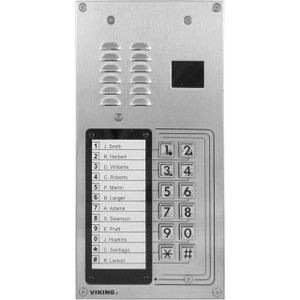
The Viking Electronics K-1270 is a 12-button, two-way handsfree apartment entry phone with a built-in 125KHz proximity card reader and integrated door strike relay — purpose-built for multi-tenant residential access control where you need both DTMF tenant calling and credential-based entry in a single flush-mount unit. If you're specifying an apartment intercom system that handles both card readers and phone-based entry without a separate reader module, the K-1270 consolidates that into one vandal-resistant faceplate.
Key Features
- 14-Gauge 316 Stainless Steel Faceplate: Marine-grade stainless resists corrosion and physical attack — meaningfully tougher than standard 304 SS used in lower-tier panels. Louvered design protects internal components without sacrificing audio performance.
- Permanent Laser-Etched Graphics: Tenant button labels won't peel, fade, or become illegible after years of UV and moisture exposure. No label replacement maintenance in year three.
- Built-In 125KHz 26-Bit Wiegand Proximity Reader: Reads standard HID-format prox cards and fobs at 1.25" to 2.0" range. The 26-bit Wiegand output is the de facto standard for access control panels — integrates directly with virtually any third-party ACP without a protocol converter.
- Dual Relay Outputs — Door Strike and Camera: The door strike relay handles 5A at 30VDC or 250VAC, covering electric strikes, magnetic locks, and most gate controllers. The secondary camera relay (0.5A @ 125VAC, 1.0A @ 30VDC) lets you trigger a recording device or external camera on each call or entry event — no separate relay module required.
- 12 Speed Dial Buttons with 22-Digit Capacity Each: Each of the 12 buttons stores up to 22 digits, supporting extensions, external lines, or forwarding chains. Twelve alternate number positions per button handle after-hours rollover or a second unit contact without reprogramming the primary.
- IP66 Weather Resistance, -34°C to 65°C Operating Range: Rated for direct rain and dust ingress — deploy in uncovered vestibules, exterior wall mount positions, or covered parking structures. The -34°C floor covers harsh northern winters without a heater accessory. EWP variant handles up to 100% condensing humidity for fully exposed locations.
- 12-24V AC or DC Power Input: Wide voltage tolerance simplifies retrofit installations where legacy wiring may be AC or DC. Proximity reader draws 60mA at 5-14V DC — budget for a separate regulated supply or confirm your ACP provides auxiliary power.
- 16 Gel-Filled Butt Connectors Included: Weatherproof splice connectors ship in the box — the detail that matters at rough-in when you're making field connections in a wet wall cavity.
- Flush or Surface Mount: Flush mount with the included rough-in box; surface mount with the optional VE-5x10 backbox. Faceplate dimensions are 127mm x 254mm x 63.5mm — verify rough-in depth before ordering in existing masonry.
Integration and Compatibility
The K-1270 outputs standard 26-bit Wiegand from the proximity reader, making it compatible with access control panels from HID, Lenel, Software House, Honeywell, and most other major ACP platforms without additional hardware. The two-wire telephone interface connects to a standard analog phone line or a PBX analog port. For VoIP environments, Viking offers the K-1270-IP variant with a SIP interface — confirm your telephony infrastructure before specifying. The Viking Electronics product family includes companion power supplies, programming tools, and the VE-5x10 surface mount box for installations where flush mounting is not feasible. Pair with a regulated access control power supply to meet the 5-14V DC reader power requirement cleanly.
Frequently Asked Questions
Q: What proximity card formats does the K-1270 support?
A: The K-1270 reads 125KHz proximity cards and fobs using 26-bit Wiegand format — the standard format used by HID, Farpointe, and most legacy prox credentials. It does not support 13.56MHz smart card formats (MIFARE, DESFire) or mobile credentials.
Q: Can the K-1270 flush-mount without purchasing additional hardware?
A: Yes. A rough-in box is included in the package for flush mounting. Surface mounting requires the optional VE-5x10 backbox, sold separately.
Q: What is the door strike relay rating on the K-1270?
A: The door strike relay is rated 5A at 30VDC or 250VAC, which covers most electric strikes and magnetic locks. The secondary camera relay is rated 0.5A at 125VAC or 1.0A at 30VDC.
Q: Is the K-1270 rated for outdoor use in cold climates?
A: The K-1270 carries an IP66 ingress protection rating and operates from -34°C to 65°C (-29°F to 149°F). It handles direct rain, wind-driven dust, and cold northern winters without a heater option. The EWP variant (K-1270-EWP) handles 100% condensing humidity for fully exposed outdoor locations.
Q: Does the K-1270 work with VoIP phone systems?
A: The standard K-1270 connects to a traditional analog telephone line or analog PBX port. It is not a SIP device. For VoIP/SIP environments, Viking offers the K-1270-IP variant.
Q: How many tenants can be programmed into the K-1270?
A: The K-1270 has 12 speed dial buttons, each storing up to 22 digits. Each button also supports 12 alternate number positions for after-hours rollover, for a total of 12 primary and 12 alternate tenant entries.
The K-1270 (often searched as K 1270) is the unit I recommend when a property manager wants card-based entry and tenant calling consolidated without running separate conduit to a standalone reader — the built-in 26-bit Wiegand prox reader at 125KHz handles that cleanly and integrates directly with any standard ACP Wiegand input port.
Technical Highlights:
- Door Strike Relay — 5A @ 30VDC/250VAC: Handles virtually every electric strike and mag lock on the market at that rating. The secondary camera relay output at 1.0A @ 30VDC lets you trigger recording on entry events without a separate relay module or additional wiring run.
- -34°C Cold Floor: Most apartment entry phones bottom out at -20°C or require heater kits below that. The K-1270's -34°C operating floor covers upper-Midwest and Canadian installations without an add-on heater — one less failure point in year five.
- 12-24V AC or DC Input: Retrofit-friendly voltage range. If the existing riser is legacy AC from a previous intercom system, you don't have to re-pull wire to a DC supply — just terminate and verify polarity requirements for your strike.
Deployment Considerations:
- Confirm your ACP auxiliary power output can supply 5-14V DC at 60mA for the prox reader before wiring — some older panels don't expose auxiliary power on the Wiegand header and need a small outboard supply.
- The standard K-1270 is analog POTS/PBX only. If the building is migrating to SIP trunks or a hosted PBX, specify the K-1270-IP at the design stage — retrofitting after rough-in is a significant rework.
Best fit for mid-size apartment buildings (up to 12 units) on analog phone infrastructure where the owner wants card-reader access and tenant calling from a single vandal-resistant panel without the cost or complexity of a networked intercom system.