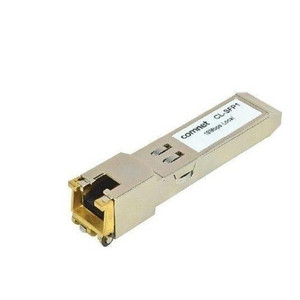
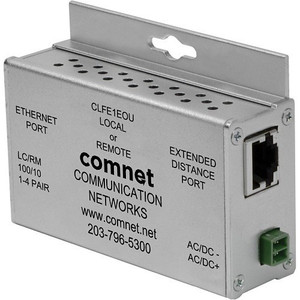
Comnet CL-SFP1 10 Mbps Copper Range Extender SFP Module
Overview
The Comnet CL-SFP1 is a small form-factor pluggable (SFP) Ethernet extender module designed to stretch bandwidth over existing copper infrastructure — a practical solution when fiber installation costs are prohibitive. Unlike fiber, the CL-SFP1 works with standard twisted-pair or coaxial cabling already in the ground, making it the preferred retrofit strategy for sprawling CCTV campuses, airport terminals, and casino surveillance networks where new cable runs would be expensive or logistically unfeasible.
Housed in a compact SFP enclosure, the CL-SFP1 (often searched as CL SFP1) plugs directly into any 100BASE-FX SFP port on a network switch or compatible Ethernet device. It must be deployed in pairs — one module at each end of the copper run — to establish a working link. The module's real value lies in distance: it extends Ethernet up to 3,000 feet over a single pair of twisted-pair cable at 10 Mbps, or 5,000 feet over coaxial cable using optional adapters.
Key Features
- Extended reach over copper (3,000 feet UTP / 5,000 feet coax at 10 Mbps): Standard Cat5 or existing legacy copper that would normally limit you to 328 feet (100 meters) now carries full Ethernet 100 feet further. Real-world deployment: a parking lot camera 2,500 feet from the control room on buried twisted pair — no additional fiber pull needed, no new conduit runs. The math works when infrastructure already exists.
- Dual data-rate support (10 or 100 Mbps): The CL-SFP1 specifically supports 10 Mbps operation and is paired with the CL-SFP3 for 100 Mbps environments. Know your bandwidth requirement upfront — switching between the two models means hardware swap, not a firmware toggle.
- MSA-compliant SFP form factor: Fits any standard 100BASE-FX SFP slot. Physical compatibility is assured; functional compatibility with third-party gear requires pre-purchase validation with Comnet technical support — not a guarantee, a checkpoint.
- Minimal power draw (1 W max at 3.3 V): A negligible load on the SFP port's power budget. Relevant for high-density deployments where every watt counts, but not a differentiator in modest installations.
- Industrial temperature range (-40°C to +75°C operating, -40°C to +85°C storage): Handles uninsulated crawl spaces, rooftop junction boxes, and outdoor equipment cabinets without thermal shutdown. Test-certified to NEMA TS-1/TS-2 and CALTRANS Traffic Signal Control standards — third-party validation of environmental robustness.
- Automatic local/remote device selection: The module intelligently detects whether it's the originating or terminating end of the link, simplifying commissioning. No DIP switch configuration, no device ID assignment. Plug both units in, link synchronization completes within one minute.
- Lifetime manufacturer warranty: Long-term coverage reflects engineering confidence. Verify warranty terms directly with the manufacturer before purchase — claims on this product are specific to Comnet's warranty policy, not a third-party guarantee.
Integration & Compatibility
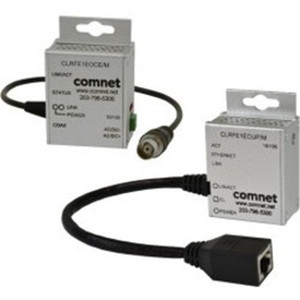
The CL-SFP1 must pair with another CL-SFP unit or a ComNet CopperLine stand-alone unit at the opposite end of the cable run. Do not connect a single CL-SFP1 to a regular Ethernet switch port — the module will not synchronize and may require a factory reset (unplug and re-insert) to recover. Connection uses pins 1 and 2 of a twisted-pair cable or a coaxial run; optional RJ-45 to coax adapters (CLRJ2COAX, CLRJ2COAXCAB) bridge different physical media types. Comnet also supplies a single-port Ethernet surge protector (CLESP) for lightning-prone installations and an RJ-45 breakout wiring kit for terminal-block integration.
LED link indicators use the host switch's 100BaseTX LED output — visual status is not independent on the module itself. Expect link synchronization to take up to one minute after power-up; this is normal behavior, not a fault condition.
Distance performance depends on cable quality, connector cleanliness, and splice count. The 3,000-foot and 5,000-foot figures are based on in-house testing; real-world transmission distance may vary. Poor-quality coax, excessive connectors, or environmental moisture can reduce effective range — field validation is prudent on longer runs.
What's in the Box
The CL-SFP1 ships as a single SFP module. Pair pricing and bulk orders should be confirmed with your supplier — the product is sold as a unit, not a kit. Optional accessories (adapters, breakout kits, surge protectors) are ordered separately.
Frequently Asked Questions
Q: Can I use a single CL-SFP1 to extend from a switch to a camera?
A: No. The CL-SFP1 must work in pairs — one module at each end of the copper link. A single module will not establish a link to a regular Ethernet port. You must install a matching CL-SFP module or a ComNet CopperLine device at the far end.
Q: What's the difference between the CL-SFP1 and the CL-SFP3?
A: The CL-SFP1 supports 10 Mbps operation (3,000 feet over UTP, 5,000 feet over coax). The CL-SFP3 supports 100 Mbps (1,000 feet over UTP, 2,000 feet over coax). Choose based on your bandwidth requirement and distance. The two models are not interchangeable in a pair.
Q: Will the CL-SFP1 work in any SFP port on my network switch?
A: The module requires a 100BASE-FX SFP slot. Comnet recommends contacting technical support (1-888-678-9427) before purchase if you plan to use it with third-party switches. SFP ports that support only 1000BASE-FX will not work with this module.
Q: What adapter do I need to use coaxial cable with the CL-SFP1?
A: Order the optional CLRJ2COAX (single adapter) or CLRJ2COAXCAB (adapter cable) separately. These bridge RJ-45 to coax connectors. Coax runs extend reach to 5,000 feet at 10 Mbps.
Q: Does the CL-SFP1 require external power or PoE injection?
A: Power is drawn from the SFP port itself (3.3 V, 1 W max). No external power supply or PoE injector is needed. The module operates on the slot's native 3.3 V rail.
Q: Is there a warranty on the CL-SFP1?
A: Yes, the CL-SFP1 includes a lifetime manufacturer warranty. Warranty terms and coverage details should be verified directly with Comnet or your supplier at time of purchase.
I've specified the CL-SFP1 on three warehouse campus retrofits in the last 18 months where running new fiber was prohibitively expensive — legacy twisted-pair was already trenched and working. The module's real strength is range: 3,000 feet at 10 Mbps over existing UTP means you can retire old analog extenders and move to native IP cameras on runs that would normally cap at 328 feet. The CL-SFP1 is the pair-only solution; you need matching modules at both ends or a ComNet CopperLine unit on the far side.
Technical Highlights:
- 3,000-foot reach over single-pair UTP: Tested range that beats standard Ethernet copper limits by a factor of 9. Real deployment: a perimeter camera 2,800 feet from the switch on existing pair — no new trenching, no conduit, no fiber cost. That's the math that wins in retrofit scenarios.
- 5,000-foot coax support with optional adapters: If your old CCTV plant used RG-59 or RG-6, the CLRJ2COAX and CLRJ2COAXCAB adapters bridge the gap. Coaxial runs hit 5,000 feet at 10 Mbps — a 67% distance gain over twisted pair at the cost of adapter hardware.
- 1 W max power draw at 3.3 V: Negligible SFP port load. On a high-density switch running 48 SFP modules, you're still well within thermal and power budgets. Not a constraint on any reasonable deployment.
- Automatic local/remote detection: No DIP switches, no provisioning steps. Plug the pair in, wait 60 seconds for sync. When commissioning a dozen remote camera links, that simplicity compresses installation time measurably.
- NEMA TS-1/TS-2 and CALTRANS certification: Third-party validation of environmental resilience. Uninsulated equipment enclosures, rooftop junction boxes, and outdoor cabinet deployments are in scope — tested to -40°C to +75°C operating range.
Deployment Considerations:
- The CL-SFP1 is 10 Mbps only. If your network demands 100 Mbps bandwidth at distance, step up to the CL-SFP3 — but you'll lose distance (1,000 feet UTP, 2,000 feet coax). Know your bandwidth ceiling before committing hardware.
- SFP slot compatibility matters. The module requires 100BASE-FX ports. Many modern switches dropped 100BASE-FX in favor of 1000BASE-FX SFP+ slots. Pre-validate your switch's SFP slot spec — a wrong port means the module will not initialize. Comnet's tech line is 1-888-678-9427 for compatibility checks on third-party switches.
- Link synchronization takes up to one minute after power-up. That's expected behavior, not a fault. If sync doesn't arrive within 120 seconds, verify the opposite end has a matching CL-SFP or CopperLine unit, not a regular switch port (single module to a regular port will not link).
- Cable quality and splice count affect real-world range. The 3,000-foot and 5,000-foot figures are lab-validated baselines on clean cabling. Old coax with corrosion, excessive inline splices, or wet conduit can shorten effective range. Field validation on longer runs (2,500+ feet) is worth an hour's work.
The CL-SFP1 is the right pick for warehouse or campus retrofit scenarios where buried or conduit-run twisted pair already exists and new fiber is not budgeted. It trades distance (1,000 Mbps per IEEE standard for copper) for reach, and that trade wins when you have legacy infrastructure and budget constraints. For new greenfield installations, fiber is cheaper per foot and avoids the pair-unit dependency. For retrofits on existing copper, the CL-SFP1 is the math that works.