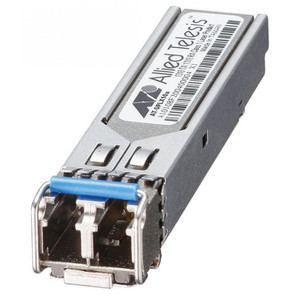
Allied Telesis AT-SP10SR 10GBASE-SR SFP+ Multimode Fiber Transceiver
Overview
The Allied Telesis AT-SP10SR is a 10GBASE-SR SFP+ transceiver designed for short-reach multimode fiber links running at 10.3 Gb/s. It fits any SFP+ cage-equipped switch or NVR uplink port and gives you a clean, standards-compliant 10GbE connection over existing MMF plant — no dedicated fiber runs required if your building already has OM3 or OM4 installed. If you're architecting a surveillance backhaul or high-density IP camera aggregation layer and need to confirm this is the right module, the reach numbers and fiber type compatibility are what decide it. Browse the full Allied Telesis networking catalog for compatible switches and infrastructure.
Key Features
- 10.3 Gb/s line rate over Dual-LC MMF: Runs the full 10GBASE-SR data rate with headroom, so camera streams from a 64-channel NVR aggregation switch won't saturate the uplink even under simultaneous playback and live view loads. The Dual-LC connector is the standard on virtually every patch panel and switch port in commercial infrastructure — no adapter needed.
- 300m reach on OM3 and OM4 fiber: That's enough to cross most commercial campus buildings or warehouse spans without a repeater. If your fiber plant is older OM1 glass, expect 33m maximum — workable for closet-to-closet hops but not floor-to-MDF runs. OM2 gives you 82m. Know your cable type before ordering.
- 850nm VCSEL transmitter, -6 dBm to -1 dBm Tx output: The VCSEL source is optimized for multimode at 850nm, and the 5.1 dB power budget (Tx min -6 dBm, Rx sensitivity -11.1 dBm) is enough to handle typical MMF patch loss including connectors and a few splices. Tight link margins on long OM1 runs should be loss-budgeted before deployment.
- Rx sensitivity of -11.1 dBm with -1 dBm max input power: The receiver handles the dynamic range you'd expect on a clean MMF link. Keep launch power within spec — connecting a single-mode source or an amplified signal above -1 dBm risks receiver saturation and link errors.
- 3.3V supply at 300mA max (roughly 1W): Power draw is low enough that you can populate a fully-loaded switch with AT-SP10SR modules without revisiting your switch's per-slot power budget in most cases. Verify your specific switch's transceiver power allocation if running near the chassis maximum.
- Operating temperature 0°C to 70°C standard, -5°C to 85°C extended, -40°C to 85°C industrial: Three thermal grades in one SKU family — the AT-SP10SR covers standard data center conditions out of the box. If you're dropping this into an outdoor-rated enclosure or an IDF closet without climate control in a cold climate, confirm which variant you're ordering against those temperature bounds.
- IEEE 802.3ae 10GBASE-SR, SFF-8472, and MSA compliant: Standards compliance means the module will negotiate correctly with any 10GbE SFP+ port that follows the MSA spec — Allied Telesis switches, third-party NVRs with SFP+ uplinks, and most enterprise switches. SFF-8472 compliance also means digital diagnostic monitoring (DDM) data — Tx power, Rx power, temperature, voltage — is readable from the host device if the switch or NVR supports it.
- RoHS 6 compliant: Meets the EU Restriction of Hazardous Substances directive, relevant for deployments subject to environmental procurement requirements or EU-market equipment regulations.
Integration and Compatibility
The AT-SP10SR follows MSA (Multi-Source Agreement) form factor and electrical interface standards, which governs physical dimensions, pinout, and management interface. Most enterprise SFP+ transceivers in this class interoperate across vendors at the physical layer, but some switch vendors soft-lock their ports to approved vendor lists. Verify your switch's compatibility list or check whether your firmware allows third-party modules before ordering at scale. For Allied Telesis switch platforms, this module is a native fit. For network switches from other vendors, consult the switch's transceiver compatibility matrix. DDM readout availability depends on the host device's management software — most modern switches expose Rx/Tx power and temperature via CLI or SNMP. If you're planning fiber runs for a new deployment, the fiber optic network planning guide covers loss budget calculation, fiber grade selection, and connector type decisions that directly affect whether this module's 5.1 dB power budget is sufficient for your link.
Frequently Asked Questions
Q: What fiber type does the AT-SP10SR require, and how far will it reach?
A: The AT-SP10SR uses 850nm multimode fiber with a Dual-LC connector. Maximum reach is 300m on OM3 or OM4 fiber, 82m on OM2, and 33m on OM1. Single-mode fiber is not compatible — this is a multimode-only module.
Q: Is the AT-SP10SR compatible with non-Allied Telesis switches?
A: The module complies with IEEE 802.3ae 10GBASE-SR, SFF-8472, and the SFP+ MSA standard, making it physically and electrically compatible with any standards-compliant SFP+ port. However, some switch vendors enforce a vendor lock that blocks third-party modules via firmware. Check your switch's transceiver compatibility list before deploying in a non-Allied Telesis platform.
Q: What operating temperature range does the AT-SP10SR support?
A: The standard variant operates from 0°C to 70°C. An extended-temperature variant covers -5°C to 85°C, and an industrial variant supports -40°C to 85°C. Confirm which variant you're ordering if the installation environment falls outside the standard 0–70°C range.
Q: Does the AT-SP10SR support digital diagnostic monitoring (DDM)?
A: Yes — the module is SFF-8472 compliant, which defines the DDM interface for reading Tx power, Rx power, supply voltage, and temperature from the host device. DDM readout requires the switch or host platform to support SFF-8472 monitoring in its management software or CLI.
Q: What is the power draw of the AT-SP10SR?
A: The module operates on a single 3.3V supply at up to 300mA, yielding approximately 1W of power consumption. This is within the standard SFP+ per-port power allocation on most managed switches, but verify your chassis's transceiver power budget if the switch is heavily loaded.
Q: Is the AT-SP10SR RoHS compliant?
A: Yes — the AT-SP10SR is RoHS 6 compliant, meeting EU Restriction of Hazardous Substances requirements. This is relevant for deployments subject to environmental procurement mandates or EU-market regulations.
The AT-SP10SR is the module I reach for when I need a clean, standards-honest 10GbE uplink over existing multimode plant and don't want to guess about interoperability. The 5.1 dB optical power budget — Tx minimum of -6 dBm against a receive sensitivity floor of -11.1 dBm — gives you enough margin for a properly terminated OM3 link at 300m without needing to sweep the fiber first, though I'd still recommend an OTDR on any run over 150m if the cable plant is more than a few years old.
Technical Highlights:
- 850nm VCSEL at 10.3 Gb/s: The VCSEL source is well-matched to OM3/OM4 bandwidth, which is why you get the full 300m reach. On OM1, modal bandwidth limits you to 33m — plan your fiber type before the cabling contractor pulls anything.
- SFF-8472 DDM compliance: Tx power, Rx power, temperature, and supply voltage are all readable from the host switch. On a 48-port aggregation switch, being able to spot a marginal Rx level (-10.8 dBm when you expect -7) in the MIB saves a truck roll.
- ~1W power draw (3.3V at 300mA): In a fully populated 48-port switch chassis, the difference between 1W and 2.5W per transceiver is real in the power budget. The AT-SP10SR won't push you into a thermal or power problem on a standard enterprise switch.
Deployment Considerations:
- Verify your switch's approved transceiver list before ordering more than a handful. MSA compliance covers the hardware, but firmware vendor locks are real — some platforms require a CLI override or a firmware flag to accept third-party modules.
- The -1 dBm maximum input power on the receiver is a hard ceiling. If you're patching into a link with an in-line optical amplifier or connecting to a single-mode source by mistake, you'll see Rx errors rather than a clean link-down alarm — check Rx power in DDM before chasing cable faults.
The AT-SP10SR is the right call for OM3/OM4 campus backbones feeding NVR aggregation switches, where you need verified DDM visibility and ~1W power draw won't stress the chassis — specifically in IDF-to-MDF runs under 300m where pulling new singlemode isn't justified.