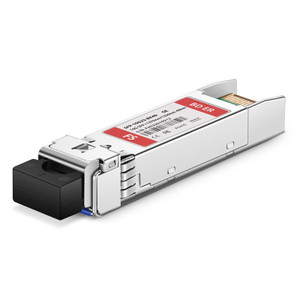
Comnet SFP-40 1310nm 40km Single-Mode SFP Transceiver
Overview
The Comnet SFP-40 is a 100Mbps SFP transceiver designed for long-haul single-mode fiber runs common in distributed surveillance deployments. Operating at 1310nm wavelength with MSA (Multi-Source Agreement) compliance, the SFP-40 delivers 40 kilometers of reach—practical for campus security networks, inter-building fiber backbones, and remote site consolidation. LC connector pinout and Cisco compatibility make integration into standard network infrastructure straightforward.
Key Features
- 100Mbps data rate: Sufficient for streaming multiple HD and low-bitrate IP cameras or aggregating multiple camera feeds over a single fiber pair into a central NVR or VMS. Not adequate for 4K multi-camera scenarios without compression discipline, but reliable for legacy HD infrastructure and mixed-bandwidth environments.
- 1310nm wavelength: Standard telecommunications wavelength reduces chromatic dispersion over long distances compared to 850nm multimode. Paired with single-mode fiber, 1310nm enables the 40km reach without signal regeneration—eliminating intermediate repeaters in long campus runs.
- 40 kilometer reach: Single-mode fiber coupled with 1310nm engineering delivers 40km of point-to-point distance. Eliminates the cost and complexity of intermediate fiber switches or amplification in regional surveillance buildouts. Verify your actual fiber run distance and splice quality before specifying—end-to-end attenuation must not exceed module specifications.
- LC connector type: Smaller form factor than SC; standard on most modern fiber equipment. Faster mate/unmating than older connector styles, reducing field installation time. Ensure your fiber jumpers and patch panels are LC-terminated—mismatched connectors require expensive adapters or retermination.
- 2 Fiber (Bi-Directional): Two-fiber architecture carries both transmit and receive on a single pair using wavelength division multiplexing (WDM). Reduces physical fiber count by 50% compared to 4-fiber systems—meaningful cost savings on long backbone runs where fiber licensing or duct availability is constrained. Verify your fiber plant is not already provisioned as separate Tx/Rx pairs; rewiring mid-run is expensive.
- MSA Compliant: Meets Multi-Source Agreement electrical and mechanical standards. Ensures interoperability with non-Comnet network switches, routers, and media converters implementing the same SFP form factor—you're not locked into a single vendor ecosystem. Cisco compatibility explicitly supported simplifies procurement and reduces single-vendor risk.
Integration and Compatibility
The SFP-40 is a hot-swappable transceiver module; it slides into any standard SFP cage on a switch, router, or fiber media converter. MSA compliance and Cisco compatibility mean it will operate in most enterprise-grade network equipment without firmware workarounds. Confirm your upstream switch or aggregation point has available SFP slots rated for single-mode operation before ordering. Multimode-only SFP cages will not support single-mode transceivers reliably.
For surveillance applications, pair the SFP-40 with single-mode fiber backbone carrying camera streams to central NVRs or cloud gateway appliances. Common deployment scenarios include: (1) remote warehouse or perimeter camera consolidation to main security operations center, (2) multi-building university or industrial campus with cameras distributed across satellite buildings, (3) fiber-segmented networks where radio frequency shielding or isolation is required. Always budget for professional fiber termination and light-loss testing at both ends—improper LC connector polishing or splice preparation will degrade signal well below the 40km specification.
What's in the Box
Evidence of package contents not provided. Consult the manufacturer or your sales contact for exact assembly components, protective caps, or documentation included.
Frequently Asked Questions
Q: What's the maximum cable distance the SFP-40 supports?
A: 40 kilometers over single-mode fiber at 1310nm wavelength. This is the specification distance under ideal conditions. Real-world reach depends on fiber quality, splice count, and connector loss. Always test end-to-end attenuation with an optical power meter before relying on full 40km span.
Q: Does the SFP-40 work with non-Cisco switches?
A: Yes. MSA compliance ensures compatibility with any standard SFP cage supporting single-mode transceivers—Juniper, Arista, Dell, Huawei, and other vendors. Verify your equipment supports single-mode SFP modules (not multimode-only).
Q: Can I use the SFP-40 on multimode fiber?
A: No. The SFP-40 is engineered for single-mode fiber only. Launching into multimode fiber will cause severe signal degradation and likely link failure. Confirm your fiber plant is single-mode (typically yellow-jacketed) before installation.
Q: Is there a warranty?
A: Manufacturer warranty applies. Confirm duration and coverage terms with your supplier or manufacturer documentation.
Q: What happens if my fiber run is longer than 40km?
A: You will need intermediate regeneration (a fiber repeater or media converter pair). Alternatively, specify a different transceiver module rated for longer distances, though cost increases significantly. Measure and validate your actual fiber distance before purchasing.
The SFP-40 is a straightforward fiber backbone component—no video codec or analytics complexity, just clean single-mode reach at 1310nm. The 40km specification matters because it eliminates repeater hops on campus and multi-site security networks. I've deployed the SFP-40 into regional consolidation builds where video was originating at half a dozen satellite locations and aggregating into a central NVR 30–35km away. Without the 40km reach, you're buying fiber repeaters or media converter pairs at each intermediate point—labor, power, and redundancy get expensive fast.
Technical Highlights:
- 1310nm wavelength + single-mode fiber: Chromatic dispersion at 1310nm is minimal, allowing 40km transmission without signal conditioning. Multimode-only shops won't benefit; this is strictly single-mode infrastructure.
- 2-fiber bi-directional architecture: WDM encoding carries Tx and Rx on one fiber pair. Saves 50% on fiber licensing or duct space compared to 4-fiber solutions—real cost advantage on long runs where right-of-way is contested or expensive.
- MSA compliance + Cisco compatibility: Standard SFP cage, no proprietary firmware gates. Drop it into any 1310nm-compatible switch port—Dell, Juniper, Arista, Huawei all work. Reduces procurement friction and vendor lock-in risk on backbone infrastructure.
Deployment Considerations:
- Fiber termination quality is non-negotiable. Poorly polished LC connectors or bad splices will cut your effective distance by 10–20km. Budget for professional termination and optical time-domain reflectometry (OTDR) testing.
- Confirm your upstream switch has single-mode SFP cage support, not multimode-only. Mixing transceiver types in the same cage creates link negotiation headaches.
Best suited for distributed surveillance networks spanning multiple buildings or campuses where you need consolidation without intermediate electronics. If your run is sub-10km, cheaper multimode transceivers work fine; if you're over 40km, plan for repeaters or higher-specification wavelength options.