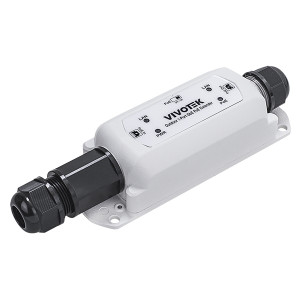
StarTech POEEXT1GAT Single-Port Gigabit PoE+ Extender
Overview
The StarTech POEEXT1GAT solves a specific, common problem in IP camera and access control deployments: you've run out of the 100-meter Ethernet distance limit, and pulling a second cable back to the switch closet isn't practical. This single-port gigabit PoE+ extender draws power and data from an upstream 802.3at or 802.3af source and retransmits both downstream — no separate power supply, no media converter, no additional switch port. Just an inline device that buys you another 100 meters per unit, up to four units deep.
For IP cameras deployed at perimeter locations, parking structures, or loading docks where cable runs routinely exceed a single 100m segment, this is often the most cost-effective fix on the table. Pair it with a PoE switch on the upstream end, and you can reach endpoints up to 500 meters from the switch — five daisy-chained 100m segments total — without touching your core switching infrastructure.
Key Features
- 100m per segment, up to 500m total: Each POEEXT1GAT unit resets the 100m Ethernet distance clock. Chain up to four units and you extend your reach to 500 meters from the source switch — practical for long-run outdoor outdoor camera installs, campus perimeter coverage, and remote gate stations where trenching additional cable is cost-prohibitive.
- 24W PoE+ output (802.3at): Delivers up to 24 watts to the downstream device — enough headroom for full 802.3at cameras, PTZ units with heaters, or access control readers with electric strike power. Devices drawing under 802.3af (15.4W) are also supported without any configuration change.
- 2 Gbps data throughput: The internal switching fabric runs at 2 Gbps, which means you're not throttling a high-bitrate camera stream or a multi-stream encoder just because it's behind an extender. Full gigabit bandwidth is preserved end-to-end across the chain.
- Only 3.2W self-consumption: The extender takes what it needs from the incoming PoE budget — just 3.2W max for itself — and passes the remaining power downstream. On a 30W 802.3at source port, that leaves approximately 24W available for the connected device, which aligns with the rated output spec.
- Daisy-chain up to four units: A single upstream 802.3at port can feed a chain of four POEEXT1GAT units, each separated by up to 100 meters of Cat5e or better. This lets you serve a distant camera using only one switch port and one continuous cable pathway, minimizing both cost and network complexity.
- Steel housing with 2kV ESD and surge protection: The steel enclosure is rated for industrial environments, and both ESD and surge protection are built in at 2kV. That matters for outdoor runs where induced transients from nearby lightning or long cable capacitance are real failure modes for inline network hardware.
- Operating range 0°C to 50°C: Suitable for indoor telecom closets, conduit junction boxes, and sheltered outdoor enclosures in temperate climates. Not rated for direct outdoor exposure in extreme cold — plan accordingly if your deployment sees sub-zero temperatures.
- Compact form factor (94mm x 69mm x 25mm, 193g): Small enough to mount inside a standard back box or junction enclosure near the camera, keeping the install tidy. The steel shell also makes it easy to attach with cable ties or double-sided mounting tape inside an enclosure.
Integration and Compatibility
The POEEXT1GAT is protocol-transparent — it does not inspect, modify, or prioritize traffic. Any gigabit Ethernet device that receives PoE via 802.3at or 802.3af will work downstream: IP cameras, access control readers, VoIP phones, wireless access points, or IoT sensors. There is no VLAN awareness or QoS tagging at the extender level, so VLAN and QoS configurations set at the upstream switch are passed through unmodified.
It requires an 802.3at upstream source operating at 52V to 56V input voltage. Standard 802.3af switches operating at lower voltages may not supply sufficient power to drive the extender and a downstream device simultaneously — verify your upstream switch's PoE output voltage before deploying. For a PoE planning guide covering budget calculations and distance planning, refer to the relevant buying resource in your project documentation.
The 2-year manufacturer warranty covers the unit against defects. For multi-extender deployments, keep a spare unit on the shelf — a failed extender in the middle of a four-unit chain takes out everything downstream of it.
Frequently Asked Questions
Q: How many POEEXT1GAT units can I daisy-chain, and what is the maximum total distance?
A: You can daisy-chain up to four POEEXT1GAT units, each segment up to 100 meters, for a maximum end-to-end distance of 500 meters from the upstream PoE switch to the final device.
Q: Does the POEEXT1GAT require a PoE+ (802.3at) source, or will an 802.3af switch port work?
A: The extender is designed for an 802.3at upstream source at 52V–56V input. An 802.3af port may not provide enough wattage to power both the extender (3.2W self-consumption) and a downstream 802.3at device simultaneously. For downstream devices that only require 802.3af power levels, an 802.3af source may be sufficient depending on your switch's actual output — verify the port wattage and voltage before deploying.
Q: What is the maximum power output to the downstream device?
A: The POEEXT1GAT delivers up to 24W to the connected downstream device. This covers most 802.3at cameras, PTZ units, and access control hardware. The extender itself consumes a maximum of 3.2W from the incoming PoE budget.
Q: Does the POEEXT1GAT affect network throughput or introduce latency for high-bitrate camera streams?
A: The internal switching fabric supports 2 Gbps, so full gigabit throughput is maintained. For typical IP camera streams — even high-bitrate 4K or multi-stream encoders — you will not experience a bandwidth bottleneck from the extender itself.
Q: What is the warranty on the POEEXT1GAT?
A: The POEEXT1GAT carries a 2-year manufacturer warranty.
Q: Can the POEEXT1GAT be installed outdoors?
A: The operating temperature range is 0°C to 50°C. The unit does not carry an outdoor IP rating, so it should be housed inside a weatherproof enclosure or junction box if installed in an outdoor or exposed environment. It is not rated for direct outdoor exposure to rain or extreme cold.
The spec I keep coming back to on the POEEXT1GAT is the daisy-chain architecture: four units at 100 meters each gives you a legitimate 500-meter reach off a single switch port, and the 3.2W self-consumption means you're not burning much of your upstream power budget just to extend the run. I've seen integrators reach for media converters or additional switches to solve long-run problems when this device handles it at a fraction of the cost and complexity.
Technical Highlights:
- 500m maximum chain distance: Four units at 100m per segment — one switch port covers perimeter camera runs that would otherwise require intermediate switch placement or fiber conversion.
- 24W downstream output: Full 802.3at delivery to the endpoint means you're not restricted to low-power cameras; PTZ cameras with onboard heaters and multi-sensor units remain on the table.
- 2 Gbps throughput: The switching fabric doesn't bottleneck a 4K stream or a multi-stream encoder. End-to-end gigabit bandwidth is preserved across the entire chain.
Deployment Considerations:
- Input voltage requirement is 52V–56V — confirm your upstream switch's PoE output voltage, not just its wattage class, before ordering. Some 802.3at switches deliver at lower voltages and may not satisfy this spec.
- The extender has no outdoor IP rating. For exposed junction points on a perimeter run, house it inside a rated enclosure — the steel shell is compact enough (94mm x 69mm x 25mm) to fit most standard surface-mount back boxes.
This unit fits cleanly into a campus perimeter camera deployment where conduit runs from a core IDF to outlying poles or gate stations exceed 100 meters and fiber isn't budgeted. One extender per pole, one switch port consumed at the IDF — straightforward to document, straightforward to troubleshoot.