Viking Electronics RG-4 Single-Line Ring Signal Shaper and Booster
Overview
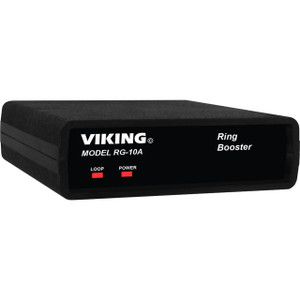
The Viking Electronics RG-4 is a single-line ring generator designed to solve a persistent low-voltage ringing problem in analog telephony deployments: when a PABX extension, FXS port, or IP phone system analog port doesn't deliver enough ring voltage to reliably drive standard phones, door phones, or alert devices, the RG-4 steps in to reshape and amplify that signal. It accepts incoming ring signals anywhere in the 20–150 VAC range, then outputs a clean 90 VAC nominal sine wave — more than enough to drive up to 4 REN of load. If you've ever had a phone that rings inconsistently on a VoIP ATA or a door intercom that won't ring on a PABX extension, the RG-4 (often searched as RG 4) is the fix.
Key Features
- Wide incoming ring detection (20–150 VAC): Accepts virtually any analog ring signal, from a weak FXS port output to a full PSTN line. This range means you don't need to pre-qualify the source signal — the RG-4 works with what it gets, whether you're sourcing ring from a legacy key system, a hosted PBX ATA, or a SIP gateway's analog port.
- 90 VAC nominal ring output (55 VAC @ 4 REN): Delivers a strong, clean ring signal capable of driving multiple devices on the line simultaneously. At 4 REN — the equivalent of roughly four standard telephone ringers in parallel — the output is still 55 VAC, well above the minimum needed to actuate most electromechanical and electronic ringers.
- Sine wave ringwave shape: Unlike square-wave ring generators that can cause buzzing, click artifacts, or false triggering on sensitive CPE, the RG-4 produces a true sine wave ring signal. This matters when the downstream device is a ring-detect circuit in a door phone, alarm dialer, or older analog modem.
- 120V AC mains power (13.8V AC, 1.25A output): Plugs into any standard 120V AC outlet — no special power infrastructure required. The unit self-powers independently of the telephone line, so ring boosting is always available even when the line signal is too weak to self-sustain the ring circuitry.
- 4 screw-terminal connections: Simple, tool-accessible wiring via four labeled screw terminals. No punch-down tools, no RJ-11 crimping — strip, insert, tighten. Suitable for both new-install wiring and field retrofits where a technician is working in a wiring closet or IDF.
- Compact form factor (76mm × 112mm × 36mm): Roughly the size of a deck of cards, the RG-4 can be mounted in a wiring closet, on a back-box, or in a telecom enclosure without consuming meaningful panel space. At 0.8 kg shipped weight, it's light enough to surface-mount on drywall anchors if needed.
- Operating temperature 0°C to 32°C (32°F to 90°F): Rated for standard indoor conditioned spaces. This is an important constraint — the RG-4 is not rated for unconditioned spaces such as outdoor telecom cabinets, unheated warehouses, or rooftop enclosures. Plan installation locations accordingly.
- Humidity tolerance 5%–95% non-condensing: Handles normal building HVAC ranges comfortably, including server rooms and telecom closets that run cool and slightly humid. Non-condensing means avoid locations prone to temperature cycling that causes moisture buildup on surfaces.
Integration and Compatibility
The RG-4 is designed specifically for analog telephone infrastructure. It integrates inline on a single telephone pair between the signal source and the terminating device. Compatible source interfaces include analog PABX extensions, FXS ports on VoIP gateways and ATAs, IP phone system analog ports, and standard PSTN lines where ring voltage has degraded due to line length or load. It is not a VoIP device and does not process SIP, H.323, or digital signaling — it operates entirely at the physical analog layer.
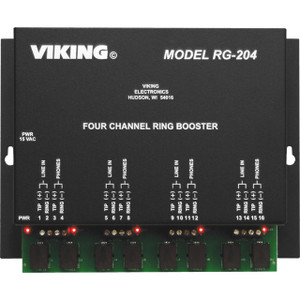
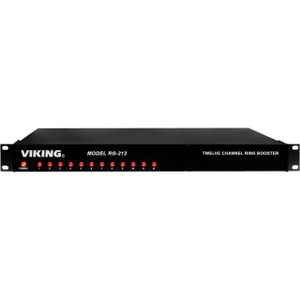
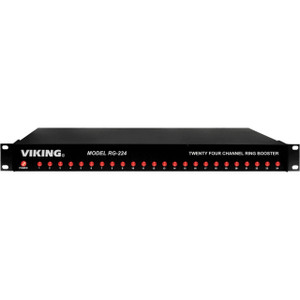
For multi-line applications, Viking offers the RG-204 (four-line) and RG-224 (24-line) variants in the same ring generator family. If you're deploying the RG-4 alongside door phones, intercom stations, or emergency call boxes, review the complete Viking Electronics telephony line for compatible endpoint hardware. Installations pairing this unit with a VoIP gateway's FXS port should verify the gateway's own ring voltage output falls within the RG-4's 20–150 VAC detection window — most commercial ATA devices do.
For larger analog infrastructure deployments requiring paging or intercom systems, the RG-4 addresses the ring-signal side only; audio amplification and paging control are separate functions handled by dedicated intercom amplifiers or paging controllers.
Frequently Asked Questions
Q: What's the maximum load the RG-4 can drive?
A: The RG-4 outputs 90 VAC nominal at no load and maintains 55 VAC at a 4 REN (Ringer Equivalence Number) load. Four REN is roughly equivalent to four standard analog phone ringers wired in parallel — more than enough for single-phone or door-phone applications.
Q: Does the RG-4 work with VoIP ATAs and SIP gateways?
A: Yes. The RG-4 is designed to work with FXS ports on IP phone system analog ports and VoIP gateways. As long as the ATA or gateway produces a ring signal between 20 and 150 VAC, the RG-4 will detect and boost it. Verify your specific gateway's FXS ring voltage output in its datasheet before installation.
Q: Can the RG-4 be used in an outdoor or unconditioned space?
A: No. The RG-4 is rated for 0°C to 32°C operating temperature and is intended for standard indoor conditioned environments. It is not rated for outdoor enclosures, unheated utility rooms, or locations subject to wide temperature swings or condensation.
Q: How does the RG-4 connect to the telephone line?
A: Via four screw terminals — no specialized tools required. The unit installs inline on the telephone pair between the signal source (PABX port, FXS port, or analog line) and the terminating device (phone, door phone, or ringer).
Q: What is the difference between the RG-4 and the RG-204?
A: The RG-4 handles a single analog line. The RG-204 is a four-line variant that reshapes and boosts ring signals on up to four PABX extensions or FXS ports simultaneously — better suited for small multi-line systems or when a single chassis needs to serve a small group of stations.
The RG-4 is one of those units I recommend whenever an integrator is migrating a site from a legacy PABX to a SIP-based system and the client insists on keeping their analog door phones or alert ringers. The FXS ports on most commercial ATAs output 40–70 VAC ring — enough for a single modern electronic ringer, but often not enough to drive an older electromechanical bell or a Viking door phone with a high REN load. The RG-4's 90 VAC nominal output with a 20–150 VAC detection window solves that without any re-engineering of the analog endpoint side.
Technical Highlights:
- 90 VAC nominal / 55 VAC @ 4 REN: At full 4 REN load the output doesn't collapse below 55 VAC — that's the real-world margin that keeps ring-detect circuits in door phones and dialers from missing ring cycles under load.
- Sine wave output: Matters specifically for ring-detect circuits in alarm dialers and legacy modems that use zero-crossing detection. A distorted or square-wave ring signal can cause false triggering or missed detections; the RG-4's sine wave eliminates that failure mode.
- Wide 20–150 VAC input range: Covers weak SIP gateway FXS ports (often 40 VAC) through full PSTN ring voltage (90 VAC) without any adjustment — install it and it works, no input sensitivity trimming required.
Deployment Considerations:
- The 0°C to 32°C operating range means this is strictly an indoor conditioned-space device — don't install it in a parking garage telecom cabinet or an exterior junction box, even in mild climates.
- The RG-4 handles one line only. If you're deploying at a site with 4+ analog stations needing ring boost, evaluate the RG-204 (4-line) or RG-224 (24-line) to avoid stacking multiple single-line units in the same wiring closet.
For a hospitality property or healthcare facility mid-migration from PABX to cloud PBX — where analog room phones and nurse-call ringers must keep working during a phased IP cutover — the RG-4 is the right inline fix: simple wiring, reliable output, and no dependency on the IP infrastructure it's bridging around.