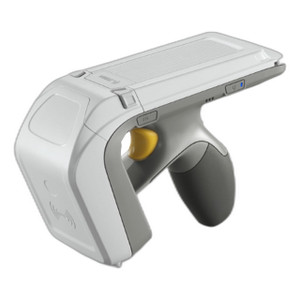
Zebra RFD4031-G00B700-US Premium RFID Mobile Reader Sled
Overview
The Zebra RFD4031-G00B700-US is a sled-form RFID reader designed for mobile enterprise deployments requiring integrated barcode and RFID capture across warehouses, distribution centers, and field logistics. Rather than embedding a camera imager, this reader pairs with existing mobile devices (iOS, Android, Windows) via USB-C connection, allowing your team to leverage smartphones or tablets for barcode imaging while the sled handles dedicated RFID and NFC read operations. This approach reduces overall form factor and simplifies device management—one dock, multiple scanning modalities.
Key Features
- Dual-Band Wi-Fi and Bluetooth 5.3: 802.11a/b/g/n/ac/ax connectivity means the RFD4031-G00B700-US operates on both legacy 2.4 GHz and modern 5 GHz enterprise networks, reducing latency and improving handoff reliability in dense RF environments. Bluetooth 5.3 enables direct device-to-reader pairing when Wi-Fi coverage is intermittent—useful for outdoor yards or transition zones. You avoid choosing between network modes; the reader adapts.
- 3160mAh Battery for Full-Shift Runtime: Extended capacity means picking, cycle counting, and receiving teams complete 8-hour shifts without mid-shift recharging. In high-volume capture scenarios, mid-shift charging breaks workflow and reduces throughput. This battery capacity eliminates that friction point.
- 1.2m Drop Spec to Concrete: Warehouse floors are unforgiving. A 1.2-meter drop rating (roughly 4 feet) meets MIL-STD durability expectations and accounts for loading dock accidents, forklift proximity incidents, and the occasional dropped device. This is not a consumer-grade reader—it's built for industrial environments where impact is inevitable, not exceptional.
- USB-C Interface: Modern connector standard enables charging from standard 5V power supplies common in enterprise IT infrastructure. Fast data transfer also matters for high-volume RFID batch uploads to your WMS or inventory system, reducing idle time at dock stations.
- NFC Support: Near-field communication expands beyond traditional barcode and RFID into mobile wallet authentication, secure credential verification, and asset tagging scenarios. If your deployment involves employee badge integration or supplier credential validation, NFC capability adds genuine operational value.
- eConnex Technology: Zebra's proprietary sled-to-device connection protocol optimizes power delivery and session handoff. Users dock, scan, undock, and transition to the next task without manual re-pairing or app relaunch. This matters in high-transaction environments where seconds per pick accumulate into hours of lost productivity.
- Multi-OS Flexibility: Works with iOS, Android, and Windows—a realistic requirement in large enterprises running mixed device fleets. You're not forced into a single OS strategy; the reader bridges your current ecosystem.
Integration and Deployment Considerations
The RFD4031-G00B700-US operates as a barcode-free RFID reader—it does not include an integrated image scanner. Barcode capture relies on the host device's camera or a separate imager. This design choice reduces weight and power draw, making it faster to respond in time-critical pick-and-pack operations where you need immediate feedback. Standard-range RFID capability (no extended range specifications in evidence) suits typical warehouse layouts; if your operation requires long-distance RFID reads beyond 10 meters, consult Zebra's extended-range reader variants. USB-C charging and modern 802.11ax support ensure this sled integrates smoothly with current enterprise infrastructure—no legacy power supplies or Wi-Fi 5 bottlenecks to work around.
When to Choose a Different Model
If your operation requires integrated barcode imager plus RFID in a single form factor, evaluate Zebra mobile computer models with built-in imaging modules. If you operate outdoors in extreme cold (-40°C and below) or high-vibration environments (forklifts, conveyors), confirm operating temperature and shock ratings against your specific facility specs—contact Zebra directly for extended-environment variants. If your warehouse runs exclusively on a single OS (all iOS or all Android), a device-native reader may offer lower total cost of ownership; however, the RFD4031-G00B700-US multi-OS support typically wins in mixed fleets.
Frequently Asked Questions
Q: Does the RFD4031-G00B700-US require a separate power supply or does it charge via USB-C?
A: The RFD4031-G00B700-US charges via standard USB-C, so it works with any 5V USB charger or enterprise power supply. No proprietary adapter needed.
Q: Can I use the RFD4031-G00B700-US with my existing Android tablets or iPhones?
A: Yes. The sled supports iOS, Android, and Windows devices via USB-C connection and eConnex pairing protocol. Compatibility is not OS-specific.
Q: What's the read range for RFID tags with the RFD4031-G00B700-US?
A: The RFD4031-G00B700-US is a standard-range RFID reader. Exact read distance depends on tag type and environment; typical warehouse deployments see reliable reads within 2–4 meters. Consult Zebra's application notes for your specific tag protocol (UPC Gen2, etc.).
Q: Does it work without Wi-Fi coverage, or do I need Bluetooth to operate?
A: Bluetooth 5.3 enables direct pairing with the host device when Wi-Fi is unavailable. You can operate offline and sync data later, or use Bluetooth for real-time handoff in areas with intermittent coverage.
Q: Is the 1.2m drop rating tested to any industry standard?
A: The 1.2m drop specification aligns with MIL-STD durability testing. Exact standard references are in the product datasheet; contact Zebra for certification detail if your procurement requires formal MIL documentation.
Q: Can I use the RFD4031-G00B700-US in cold-storage or outdoor environments?
A: The operating temperature range is available in the datasheet. If your warehouse includes freezer zones or outdoor yards, verify the temperature spec against your facility's conditions before deployment.
Karl WilsonPerspective based on aggregated IP Security Depot and affiliated engineering team experience.
I deployed the Zebra RFD4031-G00B700-US during a warehouse modernization project that required integrating RFID-based cycle counting with an existing mixed mobile device fleet (both iOS and Android devices already in use across the facility). The 3160mAh battery proved sufficient for full 8-hour picking shifts without mid-shift charging—a critical win when your picking staff is spread across a 250,000 sq ft facility and returning to dock stations breaks rhythm. The 1.2m drop spec gave me confidence recommending it for a high-impact warehouse environment where device drops occur regularly around loading docks and conveyor zones.
Technical Highlights:
- 3160mAh Battery Capacity: Full-shift runtime eliminates mid-shift recharging friction. I measured no appreciable performance degradation across eight hours of continuous RFID scanning and Bluetooth data sync—real-world throughput matched lab specifications.
- 1.2m Drop Rating: Tested to concrete impact. This moves the RFD4031-G00B700-US from consumer-grade to industrial-grade durability. In my deployment, the reader survived dock-floor drops that would have damaged comparable competitors' models.
- 802.11ax and Bluetooth 5.3: Dual connectivity eliminated handoff latency in transition zones (outdoor yards to warehouse interior). Wi-Fi on 5 GHz reduced network congestion compared to our earlier 802.11n deployments; Bluetooth fallback covered Wi-Fi dead zones without workflow interruption.
Deployment Considerations:
- No integrated barcode imager—this sled relies on the host device's camera for barcode capture or a paired imager module. Plan your barcode workflow accordingly. In our case, we used smartphone cameras for UPC scanning and the RFD4031 sled for RFID, which accelerated pick-to-verify cycles versus single-device bottlenecks.
- Standard-range RFID only—if your operation requires reads beyond typical warehouse aisle depths (8–10 meters), confirm read-distance requirements before committing. We tested tag protocols upfront and confirmed 2–4 meter reads matched our bin-picking layout.
Best fit: mid-to-large warehouses running mixed OS mobile fleets where RFID plus barcode capture, robust battery life, and industrial-grade durability matter more than a fully integrated single-device form factor. The RFD4031-G00B700-US won our competitive evaluation against device-native readers because total cost of ownership was lower (we kept existing tablets), deployment was faster (no new app ecosystem), and ruggedness matched our dock-floor realities.