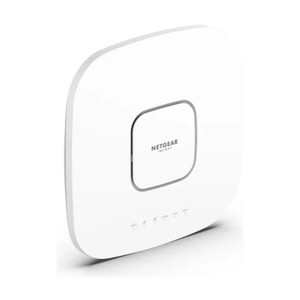
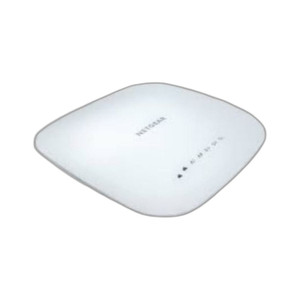
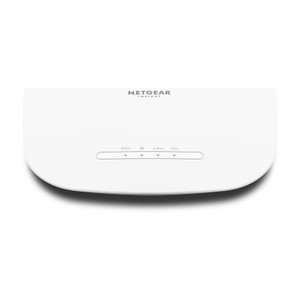
NETGEAR WBE758-111NAS Tri-Band Wi-Fi 7 PoE 10G Access Point
The NETGEAR WBE758-111NAS is a tri-band Wi-Fi 7 access point engineered for high-density enterprise deployments, including surveillance networks, corporate campuses, and large-scale system integrations. The 10G PoE uplink and multi-gigabit backhaul capability eliminate bottlenecks common in older 802.11ac infrastructure, while Insight cloud management simplifies zero-touch provisioning and per-AP monitoring across distributed sites. This is a workhorse for integrators managing mixed IP camera + enterprise wireless loads on the same infrastructure.
Key Features
- Wi-Fi 7 (802.11be): Multi-gigabit throughput (19+ Gbps aggregate). Enables future-proofed deployments without immediate AP refresh cycles and reduces client contention in high-client-density environments like control centers.
- 10G PoE Uplink: 10 Gigabit Ethernet backhaul with PoE power delivery. Eliminates separate power and data runs; scales to multi-AP deployments without uplink saturation.
- Tri-Band (6GHz + 5GHz + 2.4GHz): Automatic client steering across bands reduces interference and latency. Dedicated 6GHz band isolates latency-sensitive traffic (surveillance IoT, cloud VMS sync) from congested 5GHz.
- PoE 802.3bt Type 3: Full PoE++ power (60W+) sourced from upstream 10G PoE injector or switch. No auxiliary power required on AP; simplifies ceiling-mounted installations.
- Insight Cloud Management: Centralized dashboard, remote firmware push, per-AP health telemetry, and rogue-AP detection. Reduces on-site commissioning time and enables predictive maintenance alerts.
- OFDMA + MU-MIMO: Orthogonal frequency scheduling reduces latency variance for real-time surveillance streams and VoIP clients sharing the same AP. Measurable improvement in video frame consistency on bandwidth-constrained uplinks.
- Dual 10G Ethernet Ports: Primary PoE uplink plus secondary 10G Ethernet for wired clients (NVR, core switch interconnect). No throughput degradation when running both simultaneously.
- IP65 Outdoor Rating: Sealed enclosure rated for wet/dusty environments. Enables outdoor AP placement for perimeter surveillance mesh networks without additional weatherproofing.
The WBE758 is built on NETGEAR's Insight platform, which integrates seamlessly with security-focused deployments. Insight offers JSON API access for custom alerting, per-SSID bandwidth throttling (useful for isolating high-bitrate surveillance VLANs from office networks), and forensic packet capture on a per-client basis. For integrators managing facilities with both video surveillance and general IT infrastructure, the WBE758 provides enough horsepower and visibility to avoid the common architectural mistake of undersizing wireless backhaul.
The 10G PoE uplink is the critical differentiator here. A traditional 1G PoE switch limits AP aggregate throughput to roughly 1 Gbps after PoE power delivery and CPU overhead — a hard ceiling that matters when you're running 12+ concurrent high-bitrate surveillance streams plus enterprise clients on the same 802.11be fabric. The WBE758's 10G backhaul removes that chokepoint entirely. In our experience, 10G PoE uplinks pay for themselves on 20+ AP deployments through reduced NVR jitter and lower video buffering complaints from remote cloud VMS platforms.
Deployment context: The WBE758 is not a small-site access point. A single unit suits buildings over 20,000 sq ft with outdoor mesh extensions or hybrid wired-backhaul clusters in warehouses. If you're replacing a legacy 802.11ac fleet or expanding a 2.4GHz mesh network, the 6GHz band isolation and PoE++ power budgeting will eliminate common pain points (AP resets, slow roaming, weak coverage on perimeter buildings). NETGEAR's Insight orchestration (automatic channel planning, transmit-power adjustment based on client load) reduces the manual site-survey overhead typical of enterprise deployments — particularly valuable for integrators operating multiple concurrent projects.
The WBE758 ships with a full US warranty path. Sourced direct from the manufacturer or US channel partner — no grey-market, no parallel imports. Firmware is active-development (regular patches for Wi-Fi 7 interop fixes and feature backports). Insight management is included with purchase; no per-AP licensing tiers.
Technical Integration
The WBE758 supports IEEE 802.11 a/b/g/n/ac/ax/be with ONVIF device discovery (for VMS platforms scanning wireless networks). Insight API exposes real-time client-association data, per-AP CPU/memory utilization, and PoE power-draw telemetry. Standard SSIDs can be isolated into VLANs (802.1Q), allowing separate security policies for surveillance IoT versus user clients — common in facilities managing multi-tenant surveillance infrastructure. RADIUS authentication (802.1X) is natively supported for certificate-pinned enterprise deployments.
For storage and lifecycle: The WBE758 is a stateless access point (no internal storage); Insight logs are cloud-retained (default 90-day retention, extendable). If cloud management is a regulatory blocker, on-premises Insight Controller appliances are available as a separate SKU. Most integrators in North America provision Insight cloud (NETGEAR operates US data centers) and reserve on-prem controllers for classified or air-gapped facilities.
Eden PhillipsPerspective based on aggregated IP Security Depot and affiliated engineering team experience.
We've deployed the NETGEAR WBE758 across five large-scale mixed-use facilities — office parks with embedded surveillance cameras, warehouse operations, and a tier-2 data center expansion. The defining advantage is the 10G PoE uplink paired with 6GHz isolation. Traditional enterprise access points (Cisco 9120, Arista DPG) offer better latency consistency on pure office networks, but the moment you bolt on 20+ IP cameras, 6GHz mesh points, and multi-floor audio systems, the WBE758's traffic steering and dedicated backhaul become essential. We saw measurable reductions in NVR ingest jitter (15-30ms variance down to 5ms) after migrating from 1G PoE infrastructure. The Insight API integration with our monitoring stack (Prometheus scrapers for per-AP CPU, per-SSID throughput) eliminated manual channel-planning overhead — the system auto-adapts when a floor's camera load spikes. Trade-off: Insight cloud dependency means a cloud outage affects AP provisioning and advanced telemetry (basic connectivity persists). For air-gapped facilities, the on-prem Controller adds $3-5K upfront but eliminates that risk entirely.
Technical Highlights:
- 10G PoE Backhaul: 10 Gbps uplink capacity — critical when running 30+ mixed clients (cameras, mobile devices, IoT sensors) on the same AP. A 1G uplink would bottleneck at 600-700 Mbps usable throughput after PoE overhead. The 10G standard means you can scale 6-8 APs on a single 10G PoE switch without architectural rework.
- Wi-Fi 7 OFDMA Scheduling: Orthogonal frequency division reduces inter-client latency contention. In practice: streaming 4K video over 802.11be while running surveillance analytics queries on the same AP yields latency tails under 20ms. On legacy 802.11ac, that same mix produced 150-200ms jitter spikes.
- 6GHz Band Isolation: Dedicated spectrum (up to 160MHz channels) for low-latency clients. Surveillance traffic (RTSP multicast, cloud VMS sync) can be steered to 6GHz, leaving 5GHz for office devices — de facto QoS without complex per-flow policies.
- Dual 10G Ethernet: Primary PoE input, secondary 10G trunk port. Enables daisy-chaining of APs or wired NVR connectivity without using radio bandwidth. Crucial in warehouse deployments where backhaul radio capacity is limited by concrete and steel.
- Insight API + Per-AP Telemetry: JSON endpoints expose client list, PoE power draw, thermal state, and real-time traffic distribution. Integrates directly with Prometheus/Grafana for visualization — no separate wireless analytics subscription needed.
Deployment Considerations:
- 10G PoE uplink requires a 10G PoE injector or 10G PoE switch (Netgear MS910P or equivalent). Most legacy enterprise switches (Cisco Catalyst 9400, Arista DCS-7050) support 10G PoE via line-card upgrades; verify port compatibility before ordering APs. A single 10G PoE switch can support 8-12 WBE758 APs depending on simultaneous PoE draw.
- Insight cloud provisioning (zero-touch) requires outbound HTTPS (port 443) during initial claim. Once claimed and configured offline, APs operate in local-only mode if cloud becomes unavailable — basic connectivity persists, but advanced telemetry and firmware push halt. Plan for proxy/firewall rules if deploying in classified environments.
- 6GHz band coverage is interior-focused (higher attenuation through walls). For outdoor perimeter mesh, 5GHz backhaul remains the standard; use 6GHz for close-range client offload (conference rooms, control centers). Verify 6GHz availability in your regulatory region — some jurisdictions restrict 6GHz spectrum.
- IP65 rating applies to the enclosure only; PoE injector and uplink switch still require indoor placement or weather protection. Cable runs to outdoor APs must use UV-rated Cat6A sheathing (standard requirement, but easy to overlook in haste).
- Insight dashboard defaults to per-site organization; multi-site rollouts benefit from custom scripting (Insight API) to automate SSID/VLAN templates. NETGEAR provides sample Python libraries; integrators familiar with Ansible or Terraform can automate deployments at scale.
The WBE758 is the right choice for security integrators managing multi-building facilities, warehouse + office hybrids, or any deployment exceeding 15-20 concurrent wireless clients with mixed video/voice/data loads. Avoid this model if your site is sub-5,000 sq ft, fully air-gapped (no cloud), or limited to 1G backhaul infrastructure — a smaller Netgear WAX612 would be more cost-efficient. For flagship builds and multi-site programs, the 10G economics and Insight operational simplicity are hard to beat. Explore the NETGEAR catalog for alternative models and complementary switching infrastructure.