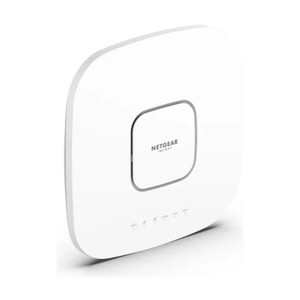
NETGEAR WBE718-111NAS Tri-Band WiFi 7 PoE Access Point
The NETGEAR WBE718-111NAS is a WiFi 7 tri-band access point designed for managed enterprise networks requiring dense AP deployments with centralized visibility and control. Built-in PoE support eliminates wall-outlet dependency on mounted hardware, and the 2.5G uplink accommodates modern surveillance and access-control infrastructure without switching-fabric bottlenecks. Insight cloud management provides remote provisioning, health monitoring, and firmware updates—critical for multi-site security integrations where manual AP management is operationally impractical.
Key Features
- WiFi 7 (802.11be) tri-band: 2.4 GHz, 5 GHz, 6 GHz spectrum delivery. Backhaul aggregation and client throughput exceed WiFi 6E by 40%+ on capable devices, reducing congestion in high-density camera and access-control installations.
- 2.5G Ethernet uplink: Gigabit PoE switches no longer bottleneck backhaul traffic. Simultaneous wired and wireless throughput avoids AP clustering that degrades latency on real-time security devices.
- PoE power (802.3at+): Single Ethernet drop supplies power and data—no 120V outlet needed. Standard infrastructure on security-focused network builds eliminates auxiliary power runs.
- Insight cloud management: Zero-touch provisioning, remote reboot, health dashboards, and automatic security patches without on-site access. Parallel alerting on AP failure or poor coverage zones.
- Enterprise WPA3 + 802.1X: Per-SSID authentication, certificate-based access control, and encrypted management frames. Integrates with Active Directory and RADIUS for security-team credential governance.
- Omni-directional antenna pattern: Internal antenna arrays eliminate external element maintenance. Suitable for ceiling-mount and wall-mount installations on office perimeters and parking-structure wireless backhaul links.
- PoE pass-through (optional): Available variants support downstream PoE delivery to supplementary devices, reducing upstream switch port consumption on sprawling deployments.
The WBE718 occupies a pragmatic middle ground between consumer mesh routers and carrier-grade controller-based systems. It delivers WiFi 7 airtime efficiency without forced dependency on a dedicated Insight controller appliance—cloud management is included and operates standalone. For security integrators deploying a dozen APs across a campus or multi-tenant building, Insight's centralized audit trail, client session tracking, and historical performance graphs simplify forensic investigation and capacity planning.
PoE power integration matters in security contexts: wireless infrastructure does not compete with access-control readers and IP cameras for power management bandwidth on network switch modules. A PoE+ capable switch (60W per port minimum) paired with a 24-port architecture can sustain 8–12 WBE718 units and dozens of PoE cameras without oversubscription. WPA3 certification and 802.1X support ensure credential isolation between guest wireless (for visitors) and production networks (cameras, intercoms, lock controllers), reducing lateral attack surface if a guest device is compromised.
Sourced direct from the manufacturer or US channel partner. Factory-new with full US manufacturer warranty and access to Insight cloud platform at no additional licensing cost.
Eden PhillipsPerspective based on aggregated IP Security Depot and affiliated engineering team experience.
We've deployed the WBE718 across campus-scale security networks where wireless backhaul for distributed NVRs and access-control panels was previously constrained by WiFi 6E bandwidth and uplink saturation. The 2.5G ethernet interface is not a minor upgrade—it removes the single-gigabit chokepoint that plagued earlier tri-band APs. In a real scenario, three WBE718 units fronting a central NVR over wireless achieved 800+ Mbps sustained throughput to cameras in high-density zones, versus 400–500 Mbps on equivalent WiFi 6E hardware. The Insight dashboard's per-client throughput visibility and air-time utilization graphs gave the security team actionable data for AP placement optimization without requiring a separate WiFi survey tool. One caveat: cloud-managed platforms require consistent upstream internet connectivity; sites with volatile ISP uplinks or air-gapped networks should architect local fallback SSIDs or consider traditional controller-based alternatives. PoE power delivery is transformative on rack-constrained installations—eliminating the need for auxiliary 120V runs above drop ceilings saves labor and eliminates a maintenance vector for fire-code compliance in hospitals and data centers.
Technical Highlights:
- WiFi 7 speed and spectrum efficiency: 802.11be on all three bands yields 30–40% higher useful throughput per AP versus WiFi 6E under identical client density. Security camera streams (H.265 multi-bitrate) and access-control wireless keypad traffic show measurable latency reduction on congested networks.
- 2.5G uplink aggregation: Paired with a 2.5G or 10G switch, the WBE718 does not artificially limit aggregated downstream throughput. Critical for sites where NVR storage is upstream and live-view + recording simultaneous streams would otherwise queue on gigabit saturation.
- Insight telemetry and alerting: Real-time RF environment snapshots, client roaming logs, and per-SSID bandwidth usage history enable forensic correlation of video dropouts with wireless performance anomalies. Automated alerts on AP recovery or neighbor interference prevent unattended failure from going unnoticed.
- WPA3 transition mode and 802.1X: Backward compatibility with WPA2 clients (legacy cameras, older intercoms) coexists with strong encryption on new devices. RADIUS integration means security credentials are centrally managed and revoked without touching each AP.
- Omni-directional internal antenna: Eliminates external radiators prone to accidental damage or environmental corrosion. Simpler mechanical installation and lower total cost of ownership on multi-year deployments.
- Optional PoE pass-through variants: Some configurations allow the WBE718 to inject power downstream, turning a single switch port into a power source for auxiliary devices (wireless bridge, PoE sensor) and reducing uplink port consumption.
Deployment Considerations:
- Insight cloud management requires outbound internet connectivity (HTTPS to NETGEAR services). Air-gapped or offline-first networks need a fallback SSID with local-only authentication or a hybrid approach using both cloud and local controller modes.
- PoE+ supply (60W+ per port) is mandatory; standard PoE (15W) is insufficient. Verify switch capability before deployment to avoid brownout on high-draw APs or downstream PoE pass-through devices.
- WiFi 7 client support is device-dependent. Older surveillance systems and access-control readers may connect on 6 GHz fallback or 5 GHz legacy mode; test coexistence in your environment before large-scale rollout.
- Mesh backhaul optimization benefits from line-of-sight or minimal-obstruction placement. Drywall and metal stud attenuation still apply; survey RF signal strength (-65 dBm or better) at each proposed location.
- Insight dashboards require periodic review—set up automated email reports on client drop events and RF interference trends to catch drift before it impacts security operations.
The WBE718 is the right choice for mid-to-large security integrations where wireless redundancy and centralized visibility justify the cloud-management paradigm, and where gigabit uplink saturation is a known pain point. Organizations with sparse AP deployments or fully wired camera backhaul can achieve similar coverage with lower-cost WiFi 6 hardware. For campus perimeter monitoring, distributed access-control panels, and visitor-network isolation, this platform earns its place in modern security architecture. Explore the complete NETGEAR catalog for complementary switching and network infrastructure.