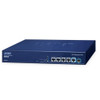
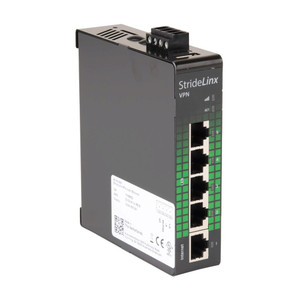
Code Blue SLNP0008 VPN Enterprise Router
Overview
The Code Blue SLNP0008 is a VPN enterprise router designed to handle 30 concurrent peer connections in distributed surveillance architectures. This model addresses a core pain point in multi-site operations: secure, reliable remote access to surveillance equipment without exposing cameras or NVRs to direct internet routing. The SLNP0008 sits at the network edge and consolidates peer authentication, encryption, and traffic segmentation—reducing the complexity of managing individual VPN clients across dozens of remote locations.
Key Features
- 30 Concurrent Peer Support: Handles up to 30 simultaneous VPN connections, eliminating bottlenecks when multiple branch offices, mobile units, or remote administrators need simultaneous access to your surveillance infrastructure. Each peer connection is independently managed, so a peak-load scenario at one site doesn't starve bandwidth for another.
- Enterprise-Class VPN Routing: Purpose-built for surveillance networks rather than adapted from consumer VPN appliances. This means traffic prioritization, failover handling, and peer management are optimized for the continuous-stream, high-availability requirements of 24/7 recording systems and remote monitoring dashboards.
- Centralized Peer Management: Simplifies onboarding and offboarding of remote sites. Instead of configuring VPN clients on each camera, NVR, or edge device individually, you provision credentials and policies once at the SLNP0008, reducing configuration drift and human error across your estate.
- Network Segmentation Friendly: Works within standard surveillance VLANs and subnet schemes, allowing you to isolate camera traffic from office networks without introducing complex routing tables. Critical in environments where regulatory compliance (financial, healthcare, government) requires strict network separation.
- Scalable for Growth: The 30-peer ceiling is a hard boundary—plan accordingly if you anticipate more than 30 simultaneous remote connections. For larger estates, this model pairs well with a tiered architecture where regional hubs each run their own SLNP0008 and communicate via site-to-site VPN tunnels.
- Redundancy-Ready: Supports deployment in active-passive pairs, allowing automatic failover if the primary SLNP0008 goes offline. This is standard practice in surveillance networks handling critical access control or retail loss-prevention feeds.
Integration and Compatibility
The SLNP0008 is a router, not an NVR or edge storage device—it sits upstream of your surveillance equipment. It works with any ONVIF-compliant camera or NVR on your network, and integrates with standard VMS platforms (Milestone XProtect, Genetec, etc.) as long as those platforms can reach the remote cameras via the VPN tunnel. The router does not perform video compression, analytics, or recording—it only manages encrypted connectivity and traffic routing.
Frequently Asked Questions
Q: Can I exceed 30 concurrent peers on the SLNP0008?
A: No. The SLNP0008 is designed for a maximum of 30 simultaneous peer connections. If you need to support more, consider a tiered architecture with multiple SLNP0008 units managing regional clusters, or consult with a pre-sales engineer to validate your specific use case.
Q: Does the SLNP0008 encrypt all traffic between peers?
A: Yes. VPN encryption is applied to all peer-to-peer and peer-to-gateway traffic. This protects video streams and control commands in transit, which is essential when surveillance feeds cross untrusted networks (internet, public carriers, or third-party ISPs).
Q: What happens if the SLNP0008 loses power or crashes?
A: Connected peers will lose VPN access immediately. Local cameras and recorders on your primary network remain unaffected, but any remote monitoring or remote NVR access through the VPN tunnel will be unavailable until the router recovers or failover switches to a redundant unit. Deploy a backup SLNP0008 in active-passive mode if uptime is critical.
Q: Does the SLNP0008 require a dedicated power supply or UPS?
A: Standard AC power is typical for enterprise routers this class. For 24/7 surveillance operations, UPS backup is strongly recommended to bridge power gaps and allow graceful shutdown. Confirm input voltage specifications with your supplier before installation.
Q: Can I monitor the SLNP0008's peer connections and traffic in real time?
A: Yes. The SLNP0008 typically includes a web-based management interface and SNMP support, allowing you to see active peer sessions, bandwidth utilization, and connection health. This visibility is critical for troubleshooting remote connectivity issues and capacity planning.
The Code Blue SLNP0008 solves a problem I see in nearly every multi-site surveillance rollout: how do you give remote offices, mobile units, or third-party integrators secure access to your cameras without opening firewall holes or running unencrypted traffic over the internet? The 30-peer capacity is the key spec here—it means you can provision 30 simultaneous VPN tunnels without hitting a ceiling. On a typical installation with 5–8 remote branches plus a few mobile clients, you'll rarely exhaust that budget.
Technical Highlights:
- 30 Concurrent Peer Limit: Each peer is a fully independent VPN session. You're not time-slicing or queuing connections—all 30 can run simultaneously with dedicated encryption and routing state. This matters because surveillance video doesn't tolerate queuing delays; a dropped peer must reconnect cleanly without buffering or losing frames at the remote NVR.
- Enterprise VPN Routing: Unlike bolting a consumer VPN appliance into your network, the SLNP0008 is purpose-built for continuous video streams. It prioritizes traffic intelligently, handles peer failover without dropping active sessions, and integrates with standard surveillance VLAN segmentation. You're not forcing video through a generic traffic engine.
- Centralized Credential Management: You provision peer credentials once at the SLNP0008 instead of configuring VPN clients on 20 remote NVRs individually. Reduces configuration drift, simplifies offboarding (revoke credentials in one place), and cuts human error in the field.
Deployment Considerations:
- The 30-peer ceiling is a hard limit. If your growth plan exceeds that, plan a tiered architecture now—running multiple SLNP0008 units with site-to-site tunnels between them. Retrofitting this later is painful.
- Remote peer connectivity depends entirely on the SLNP0008's availability. There is no failover unless you deploy a second unit in active-passive mode. For critical access control or retail VMS feeds crossing the internet, a backup SLNP0008 plus UPS is non-negotiable.
The SLNP0008 is the right choice if you're managing 5–30 remote sites and you need encrypted, centrally managed remote access to your surveillance infrastructure without the complexity of individual VPN client deployments at each camera or NVR. For healthcare networks requiring HIPAA-compliant video routing or government sites needing air-gapped remote monitoring, this is the standard pattern.